More than a decade has passed since the first Bhutanese family got resettled. Despite the augmented concerns that the Bhutanese community is losing the essence of the intact cultural and linguistic bonds, moral values and religious (and/or spiritual) credence, many opine that the community has been managing well through the transition. It is not difficult to imagine how the dynamics and the status of the exiled Bhutanese people got metamorphosed after the resettlement. For the majority of the resettled population, nothing is a perceptible success story than the fact of being able to forget back pains and miseries, troubles and adversities, uncertainties and misfortunes and start life over again from scratch.
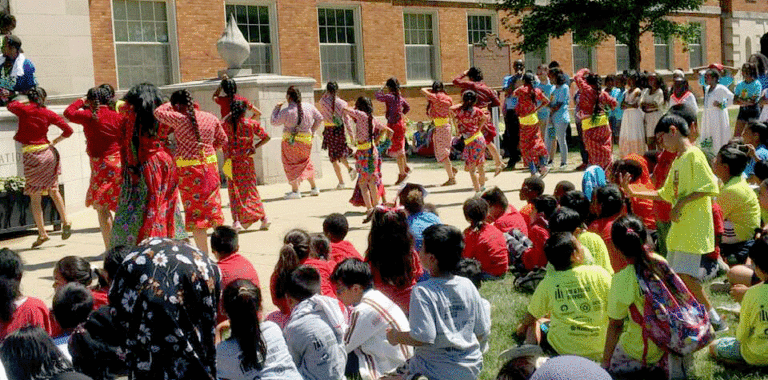
However, they have been carrying their cultural bags along with them as they carried them when they migrated to Bhutan hundreds of years ago. For these people, a celebration at the festival is not merely partying but observing the rituals rooted deeply in their cultural practices. These values and the norms that govern cultural events have always been vital for them.
The past few years have seen increased engagements regarding the celebration dates of major festivals. Some of the Bhutanese astrologers have proposed different dates for Dashain and Tihar (and other tithis) celebration in America (in fact, many existing online Panchangas had mentioned this earlier). The discussions, agreements, and disagreements regarding this proposal that have flooded in social media conspicuously reveal how concerned (and confused?) the community is towards such issues.
The sketchy knowledge the author possesses about Hindu astrology is not sufficient to interpret and derive a concluding remark on ongoing arguments regarding when the astrological tithis occur in different parts of the world. This article will try to explore the mathematical and astronomical principles that outline the foundation of the calendars that govern the occurrences of tithis.
Calendar: more than just a time tracking tool
Human civilization has implemented different measures for timekeeping and calendar-building from the prehistoric era. There are different types of calendars proposed and brought into use. Some of these are based on the progression of the seasons as the earth revolves around the sun. These are called solar calendar. Other calendars are based on the phases of the moon and are called lunar calendars. Sometimes both the solar year and the lunar phases are considered, and thus the lunisolar calendars are developed. There are six principal calendars in use today, viz. the Gregorian, Jewish, Islamic, Indian, Chinese, and Julian calendars. Among these, the Gregorian calendar is the civil calendar in use around the world [1]. This is a solar calendar.
In the Indian subcontinent, the Hindu calendar, with several regional variants, forms the basis of timekeeping and calculating the occurrences of the Hindu festivals. Though the Indian calendar and the Hindu calendar are not the same, they are often interpreted as synonymous with one another.
Hindu Panchanga: a multidimensional calendar
The earliest Vedic calendar that forms the foundation of the modern Hindu calendar (Panchanga) originated in India around 7000 BC [2]. Hindu Panchanga is a complex lunisolar calendar that provides multidimensional methods of structuring time, combining information about lunar days, solar days, lunar months, solar months, the movements of the Sun and the Moon in relation to stellar constellations, and other astronomically defined time spans [3].
As the name suggests, Panchanga has five essential limbs (components): Tithi (that serves the purpose of date), Nakshatra (the name of the star cluster amongst which the moon is located at that instant), Var (day of the week), Karana (half of the tithi at that time) and Yoga (the sum of the Bhogansh of moon and sun at that moment) [4]. The calculation of these components follows the established astronomical principles, but their significance is given by astrology. Though the western scholars do not accept astrology as science and term it as pseudo-science or insurgent knowledge, the Indian scholars argue that astrology is being forced to be the dark and shadowy twin of astronomy [5]. Panchanga guides the religious, cultural and ceremonial life of Hindus across the globe.
Tithi: a lunar day
For the general public, the tithi is undoubtedly the most known component of Panchanga. Like our Earth revolves around the Sun completing a cycle in 365.25 days, the Moon revolves around our Earth. The periodicity for this revolution (of the Moon around the Earth to reach the same visual phase; synodic month) is about 29.5 days. One complete revolution of the Moon occupies 30 tithis. Each tithi is, in fact, a phase of the Moon on a given time of a year. There are 15 tithis from Pratipada to Amavasya during Krishnapakshya and 15 tithis from Pratipada to Purnima during Suklapakshya. Table 1 below indicates the names of the tithis in Krishnapakshya and Suklapakshya starting from the full moon day.

Table 1: Names of tithis starting with Full Moon [6].
Drawing parallels between tithis and lunar phases
We have seen that the tithis are dependent upon the revolution of the Moon around our Earth. Because of this revolution, the Moon’s appearance undergoes a regular cycle of changes, called the phases, taking roughly 29.5 days to complete [7]. Due to the difference in the periodicity of the revolution of the Earth around the Sun and the revolution of the Moon around the Earth, at some point, the Moon comes between the Sun and the Earth. At this instant, the Moon is invisible. This is called the new Moon.

Figure 1: Phases of the Moon. The illustration is adopted from Astronomy Today by Eric Chaisson and McMillan Stephen [7]
As the motion of the Moon progresses in the anticlockwise direction, the lightened portion of the Moon increases (waxes) until we see the full Moon about two weeks after the new Moon. This Moon from the new Moon to the full Moon through growing crescent, quarter Moon and growing gibbous is called waxing Moon. The waxing period of the Moon is called Shuklapakshya in Panchanga. During the next 2 weeks, the Moon wanes (or shrinks), passing in turn through the gibbous, quarter, crescent phases and eventually becoming new again. The Moon on this path is called the waning Moon which is called Krishnapakshya in Panchanga. There are eight lunar phases: four primary (new Moon, first quarter, full Moon and third quarter) and four intermediate phases (waxing crescent, waxing gibbous, waning gibbous and waning crescent). The Hindu Panchang has thirty similar phases as mentioned in Table 1.

Figure 2: Occurence of Amavasya (A) and Purnima (P) and other tithis according to the Hindu Panchang.
The occurrence of tithis and phases of the Moon around the world
After establishing that the tithis are like the lunar phases explained by modern astronomy, let’s see when two primary lunar phases, the full Moon and the new Moon, occur in different parts of the world this month. The new Moon and the Full Moon are considered because it will be easier to compare them with Amavasya and Purnima respectively mentioned in the Hindu Panchang. The full moon day in the month of October this year is the last day of Dashain, while the new moon day is the Laxmi Puja in Hindu Panchang. Table 2 below shows the occurrence of the full Moon and new Moon in New York (USA), Oslo (Norway), Kathmandu (Nepal) and Adelaide (Australia).

Table 2: Occurrence of the full Moon and new Moon in different parts of the world. Data adapted from timeanddate.com [8], mooncalc.org [9], Drik Panchang [10] and Marutinandan Patro [11].
The data are taken from four different sources: Timeanddate.com, Mooncalc.org, Drik Panchang, and Marutinandan Patro. The first two databases are based on modern astronomy. Drik Panchang is an online calendar based on the principles of Hindu Panchang and developed by Adarsh Mobile Applications LLP, a Bangalore based software and IT company. Marutinandan Patro is a Hindu Panchang written by Bhutanese Jyotish Padam Lal Dhakal and published by Jyotish evam adhyatmik anusandhan kendra based in Louisville, Kentucky. The publisher of the patro mentions that it is based on Eastern Standard Time (UTC-5). It should be remembered that New York City in this time zone is currently on Eastern Daylight Time (UTC-4).
So, why do phases of moon and tithis occur earlier in America?
As it is clear from Table 2, the tithis (lunar phases) seem to first occur in the west and progress subsequently to the east with respect to how we measure time today. With some minor differences, all the four sources cited here agree with the timeframe of their occurrence.
Mathematical interpretation
Tithi is defined as the time taken for the angular separation between the Sun and the Moon to change by 12 degrees [12]. When Sun and Moon are at the same longitude, a new lunar month of 30 tithis starts. As time progresses, Moon will go ahead of Sun. When Moon’s longitude is exactly 12° greater than Sun’s longitude, the first tithi or lunar day finishes and the second tithi starts. When Moon’s longitude is exactly 24° greater than Sun’s longitude, the second tithi finishes and the third tithi starts and so on [13]. In Vedānga astronomy, a tithi was a 1/30 part of a synodic month, where the equation of center was not known [14].
The procedure explained here is just a general way of finding an approximate tithi of a lunar month. Precise calculations involve also other correction factors to be considered [6]. But the time of the tithis differs an average of less than only 13 minutes between the traditional and astronomical calculations [15].
A tithi is 23 h 37 m 28 s long on average. Kepler’s laws of planetary motion are valid for this motion too. So, the duration of a tithi varies from a minimum of about 22 hours to a maximum of about 26 hours. Tithis are calculated from the geocentric longitudes of the Sun and the Moon, and so they begin and end the same time throughout the world.
Astronomical interpretation
Unlike several other events, the phases of the Moon (and thus, the occurrences of the tithis) are the global events. This means that they occur simultaneously throughout the world. As explained earlier, the full Moon occurs when the Moon is 180 degrees to the opposite of the Sun. This is the same wherever we live. But since we have different time zones, these events seem to occur at a different time in different places in the world.
The measurement of time is a human construct. The position of Greenwich in the United Kingdom was adopted as the main time in the 19th century and today we still base the global time-zones off that universal time[16].
And how different time?
Let’s take an example from Table 2. New York has a full Moon on 13th October at 17:07. When it is 17:07 in New York, it is already 23:07 (6.0 hrs ahead) in Oslo. Similarly, it is 02:52 on 14th October (9:45 hrs ahead) in Kathmandu and 07:37 on 14th October (14:30 hrs ahead) in Adelaide. Let’s see the other way-round. At 09:23 on 28th October, it is a new Moon (Amavasya, Laxmi Puja) in Kathmandu. As this event happens precisely at the same time throughout the world, it is still 27th October (23:38) in New York. A similar interpretation can be made for other events like birth, death, social happenings and alike.
Conclusion
The Hindu Panchang is a complex lunisolar calendar that has seen several modifications and corrections over the time. Calendrical science developed in India in three distinct phases: the Vedic calendar [from unknown antiquity to the Mauryan emperor Aśoka (ca. 300 BCE)], the Greco‐Indian calendar [from the post‐Aśokan and post‐Kuṣāṇa period (ca. AD 300)] and the Siddhāntic calendar [from the Gupta period (AD 319) and onwards] and each phase influenced the succeeding one [17]. The astronomical and early mathematical developments greatly influenced the calendrical (and the astrological) sciences in the sub-continent. These sciences have amply used the mathematical formulations presented by famous Indian mathematicians like Aryabhata. Thus, the Hindu Panchanga is not merely a piece of astrology but also a sophisticated astronomical interpretation coupled with mathematical formulations.
Based on the data obtained from different sources and the mathematical and astronomical interpretations, it would be logical to conclude that the tithis are the global events and occur simultaneously throughout the world. When these events are parameterized on the human-constructed timeframe, they seem to occur first in the west and subsequently progress towards the east. The point of view of the observer can give variations of up to 12 hours if the full Moon starting on the rise of the full Moon during the night of the full Moon is considered. 3.5 hours may vary if the precise longitude of Earth is taken as the measuring point of when the Moon appears 100% fullest.
The religious and cultural norms were perhaps proposed and practiced to guide the community on the right track when there was no written law. These norms eventually became a way of life. Festivals and celebrations are the events of personal choice. We can not neglect the role played by the changed circumstances in reshaping the community. The most important issue to reflect over should be to think if we will be able to transfer the cultural rucksack to the coming generation in a most efficient way so that they will be profoundly proud of their cultural roots.
References
- Astronomical Applications, D. Introduction to Calendars. 2019, Accessed 1st October 2019; Available from: https://aa.usno.navy.mil/faq/docs/calendars.php.
- Abhyankar, K., A search for the earliest Vedic calendar. Indian journal of history of science, 1993. 28(1): p. 1-14.
- Timeanddate. The Hindu Calendar – Panchanga. 2019, Accessed 1st October 2019]; Available from https://www.timeanddate.com/calendar/hindu-calendar.html.
- Mohan, C., The Story of Astronomy in India. Research Gate, 2015.
- Kapila, S., The enchantment of science in India. Isis, 2010. 101(1): p. 120-132.
- Bhujle, S. and M. Vahia, Calculations of Tithis: An Extension of Surya Siddhanta Formulation. Indian Journal of History of Science, 2006: p. 133-150.
- Chaisson, E. and S. McMillan, Astronomy today. 2005: Pearson/Prentice Hall Upper Saddle River, NJ.
- Timeanddate. Moon Phases 2019 – Lunar Calendar. 2019 Accessed 25th September 2019]; Available from https://www.timeanddate.com/moon/phases.
- Mooncalc. Computation path of the moon for (New York, Oslo, Kathmandu, Adelaide) / Lunar data for the selected location. 2019 Accessed 25th September 2019; Available from https://www.mooncalc.org.
- DrikPanchang. Month Panchang for (New York, Oslo, Kathmandu, Adelaide)/ Panchang for the selected places. 2019 Accessed on 25th September 2019; Available from https://www.drikpanchang.com/panchang/month-panchang.html.
- Dhakal, P.L., Marutinandan Patro. 2018, Louisville, Kentucky: Jyotish evam adhyatmik anusandhan kendra.
- Lian, L.C., Indian calendars. 2001, National University of Singapore.
- Rao, P.N., Vedic Astrology: An Integrated Approach. 2001: Sagar.
- Ohashi, Y., Astronomy: Indian Astronomy in China, in Encyclopaedia of the History of Science, Technology, and Medicine in Non-Western Cultures, H. Selin, Editor. 2008, Springer: New York. p. 264–267.
- Dershowitz, N. and E.M. Reingold, Indian calendrical calculations, in Ancient Indian Leaps into Mathematics. 2009, Springer. p. 1-31.
- Spenser, E. Is it the full moon at the same time around the world? 2018 Accessed 28th September 2019; Available from http://www.lunarabundance.com/full-moon-same-time-around-the-world/.
- Chakravarty, A.K., Calendars in India, in Encyclopaedia of the History of Science, Technology, and Medicine in Non-Western Cultures, H. Selin, Editor. 2008, Springer Netherlands: Dordrecht. p. 446-449.
*Gautam is an engineer and mathematics didactician and teaches physics and mathematics in an upper secondary school in Norway. The writer can be reached at [email protected].
Editor’s Note: This article was originally published at Bhutaneseliterature.com. It is reproduced with the due permission of the author.