Camp schools transitioning to local public schools

Bhutanese refugee camps in Beldangi and Pathri are dwindling to close, and so are the camp schools. Tri-Ratna secondary school is now officially closed after 57 grade ten students wrote their Secondary Education Exams.

In the first week of March, I met a group of students at Tri-Ratna Secondary School at Beldangi, who expressed concern over the transitioning of camp schools to local schools in the neighboring villages of Damak municipality.  This means the camp students may have to walk around three kilometers every day to reach school in the locality.

While transition is inevitable, the primary focus for Caritas Nepal’s Bhutanese Refugee Education Program (BREP) is to secure enough resources for the transition and thereafter. Devendra Pokhrel, Program Manager at sub-office Damak is equally concerned about the fund crunch to sustain the refugee education program in local schools until they can be on their own.

L N Pokhrel in his office/Photo BNS

BREP completed successful 25 years of operation last year.  L N Pokhrel, Assistant Education Manager at Caritas Damak office, was grateful that several individuals of the resettled community contributed to make this celebration a reality.

Pioneering work

Caritas Nepal began supporting the refugee education in 1992 after the Executive Director Ashish Gurung visited camp along Mai river. School was first set up by voluntary effort of Student’s Union of Bhutan, that later formed Bhutanese refugee education coordination committee (BRECC)for overseeing the camp education.

Dr. Prakash Subedi now living in UK remembers the old challenging days of establishing schools in camp. Student Union of Bhutan (SUB) assumed initial responsibility for starting rudimentary, open-sky classrooms for the students fresh out of their schools in Bhutan. Though it was a chaotic situation with no external funding or any support, envisioning camp education was a big dream the educated youths turned into reality with tireless effort.

Dr. Prakash recalls, “I was then secretary of SUB entrusted with responsibility of taking students to form school in Mai river and organize classes depending on the age and grade level of students. It was not easy task to manage those open classes without any material to teach. Later in 1993, Caritas Nepal came up with Rs 500 as an incentive to volunteer teachers, provided some infrastructures and building materials for schools that motivated the stronger foundation of camp education.”

Dr. Prakash specially credits Tekbir Chhetri, Tarabir Subedi and Narayan Sharma for their pioneering leadership to form BRECC and establish office in Damak before Caritas came with full funding to run the project-BREP.

“There are so many others who did valuable work in this noble endeavor,” he says in a voice message sent to BNS.

Transition to local schools

New classrooms of Dhukurpani School/Photo BNS

The first phase of transition to local government schools has been done by providing access to refugee students of grade nine in host community schools; 74 students of Beldangi camp enrolled in Dhukurpani secondary school, Damak, some three kilometers away from the Beldangi camp.  They are assigned a separate classroom and teachers who can teach in English medium.

At Dhukurpani school, the students enjoy a better classroom, but the attendance is weaning because third country resettlement continues to affect them. The day Caritas staff and I visited the classroom, only 47 students were present.

According to a science teacher we spoke to as he was waiting outside the classroom soon after recess, “there is low spirit in the students because resettlement is taking some of them to western countries. So, students think there is no value of education at the local school.”

The headmaster echoed the same concern. But  he still expects to get another batch of grade nine from refugee camp school while the current batch of grade nine will move into grade ten.  He is hopeful that school can accommodate them.  “Clearly, the school needs some capacity building that might be supported by Caritas or other partnering agencies,” was his message.

 BREP staff with Headmaster of Dhukurpani school/Photo BNS

He also requested the Caritas staff to incorporate some confidence building talks encouraging students to attend classes regularly.

However, this agreement of taking camp students by Dhukurpani School is not officially endorsed by the government authority. It is a gesture of goodwill shown by the school to ensure the right to education of students.

In New Horizon Academy of Pathri camp, headteacher DK Subba prefers a self-sustaining close community of the refugees who can take care of health, education and employment by themselves given that infrastructure.  “But chances for transition to local schools are high,” he agrees.

At his school there are 274 students and 25 teaching staff in a total of 1300 camp population. He estimates some 60 to 70 students going to private English medium boarding schools outside the camp. They are mostly supported by their resettled relatives.

Mr. Subba is in favor of community partnership for facilitating the transition, but except for personal interaction with the resettled community, there is no formal organized effort to bring the partnership yet.

“I suppose such partnership and giving back to the camp community by resettled community shall be beneficial to our children.”

Devendra Pokhrel says, “We will develop our strategic plan for sponsoring the transition of camp school to local schools, with careful consideration that no child in camp is deprived of education.”

“But we also need a strong support of erstwhile camp teachers, resource persons and caritas staff who laid foundation of successful education in refugee camps in those starving days,”

He is hopeful that Caritas shall get a meaningful support from the growing Bhutanese Diaspora in the west.

Prahlad Dahal, former Store/Logistics officer at Caritas sub-office Damak, is of the opinion that fund generation by the resettled communities should be planned and serve specific purpose. Also, the children-at-risk who are left uncared by the parents need educational support. So, a comprehensive data of such children is required to allocate funds appropriately.

He says, “the resettled folks can advocate on behalf of all children who are left behind in the camps, and those who opt for repatriation. The advocacy is to allow all minors in camp to be resettled when they become adults. UNHCR should be able to protect the rights of these children who are camp-born.”

Dr.Prakash is concerned about the sustainability of such funds generated in the west. “For how long can we get the funds? And for what needs of the students?” he seeks to get a clear picture of the implementation.

Open Backdoor

There are 1006 students in Pancha-oti English school, 57 in Tri-Ratna secondary school and 274 in New Horizon Academy. If UNHCR and Nepal government strike a deal for letting the refugees fend for themselves, all of these students should find a place in local schools. The Nepalese government seems to gradually allow refugees to open bank accounts and set up businesses.  The camp teachers are already using ATM cards from NIC Asia bank for drawing their incentives.

And, for the local public schools to open the door to camp students, they need extra infrastructures and capacity building.  Caritas sub-office Damak is ready to pave the way to transition, provided they can secure funding for initial phase.


Housekeeping to Nursing-Kumari’s career pathway

Kumari Pokhrel became refugee at the age of six when her parents fled their home in Damphu Chirang (now Tsirang) Bhutan. Kumari is the eldest of her three siblings.  She does not remember much about the place and situation, except that they had to walk up to Damphu Bazar to get a truck.

Kumari began her first school in Oasis Academy of Timai refugee camp. After finishing grade 10 from the camp school, she pursued education at Amity college in Birtamode majoring in science.

She was a B.Sc student at Mahendra Morang Campus in Biratnagar when the opportunity for resettlement came.

In 2009, when US economy was reeling under recession, Kumari’s family arrived in Syracuse.

“There were not many jobs and I applied at many different places. I got a job at AJ Wright store that payed me 7.25 dollars/hour after five months of resettlement.”

Kumari took a housekeeping job after two months for that gave her $8 per hour. And, she decided to take nursing classes while working full time at this job in a hotel. Now she is a registered nurse with a BSN degree from State University of New York polytechnic institute.

‘While in refugee camp, I had heard about USA as land of opportunity. So, when I started the process with IOM, I thought of continuing education to become a heath care professional. My dream will come true in May, 2018 when I graduate with Masters of science degree on Family Nurse Practitioner.’

Kumari boasts of number of awards and merit honors in recognition of her outstanding performance in college and community service. Graduating her BSN, she received Ellen P. Coher award for outstanding academic achievement and leadership in promoting the ideas of professional nursing practice.

She is also honored with SUNY highest achievement award- chancellor’s award for student excellence, won graduate diversity fellowship award and listed in president’s list of academic excellence in 2014, 2015 and 2016. In 2017, she won the American Red Cross hero award: ‘Ordinary people, Extraordinary courage’.

She serves as board member in Thea Bowman House in Utica.

‘I am very thankful to my wonderful husband who always inspire, motivates, and support me to continue education along with the community service.  Without his help, direction, and mentoring, I would probably fail to achieve and take this merit.  It is not easy to maintain balance between family life; having a baby and school, especially graduate school with so many of clinical hours.’

She and Bikash Regmi met in 2010, fell in love, and married in 2012 starting a family. Now they have a seventeen months old daughter, expecting another in August.

In the initial days of resettling, Kumari volunteered at Catholic Charities by helping people reading mails, filling the paper work for newly arrived refugees from various countries such as Burma, Africa, and interpreting for Bhutanese Nepali community.

That was the tip of ice for her to begin volunteer work across communities in Syracuse.

The Regmi couple organize blood drives to educate people of refugee and immigrant communities for saving life by donating blood. The recent one was at DeSales, Utica.

Niagara falls is the wonder she could visit and even sport boating, that Kumari knew of only from books in Nepal.

“I did not understand about the blackboard thing that teacher was talking about. He said, everything was in blackboard. I only knew blackboard in my class in camp school that teachers wrote with white chalk.  Later I found it was web based blackboard, that instructors use to upload tasks for students” Kumari shares her interesting learning curve.

Also see: bhutanese_refugee_organizes_blood_drive_to_raise_awareness_and_help_save_others

A Tribute to a Great Man, Hasta Bhattarai 

I should have written this piece while the subject of the story was still alive. Let that be a lesson to all of us to pay tribute to those we admire now. As much I regret that I did not, now I cannot help but discuss the life of Hasta Bhattarai in Diaspora Stories series this week.

Originally from Dagana, Bhutan, Bhattarai passed away suddenly on April 8, 2018 in Chicago, leaving behind his young wife and two kids, just eight and three years old. He himself was only 46. This irretrievable loss to the family also certainly spills over to the entire Bhutanese diaspora. He was such a great social worker who also generously lived for others—lending them helping hands in need.

Mr. Bhattarai’s life was indeed like a thick book carved with immense knowledge and augmented experiences—that benefited thousands of Bhutanese refugees and others over the years.

“He [Hasta sir] taught us to be respectful to everyone, and to remain dedicated towards what we do in life,” recalled Nirmala Mapchan, one of his former fifth grade students in the early 1990s.

She said Hasta, who taught her English, was one of the best teachers she could ever remember. “He was very generous and organized teacher with every quality that a teacher and a good human being should possess.”

Although Mr. Bhattarai never taught me, I first heard his name in the Beldangi-II refugee camp school in Eastern Nepal in 1992/93 when I was studying in grade one. I had heard that along with his generosity and impressive teaching skills he also carried with him the ‘strict’ nature—as like many other teachers back in the days. According to a family source, Mr. Bhattarai taught in the refugee camp school for close to a decade.

I had the honor to know him better after the Spring of 2005 when he moved to Kathmandu, Nepal for further studies and to carry on his teaching profession. We met fairly on a regular basis not only to engage in casual conversation, but also to discuss on broader topics such as the literature, journalism, social service, repatriation, among others.

I was a big admirer of his persuasive English writing skills. His flawless and immaculate writings—usually filled with literature and philosophy—always inspired me. We often used to hang out in a nearby park, where he read to me his literature pieces, mostly poems. Whenever I visited him at his apartment, located less than a minute walk from mine, I always found him with a book in his hand. He was not only a regular reader, but he was equally filled with virtuous analytical skills to easily understand multifaceted literature books. He was a simple man with a wide-smile on his face, and he never boasted to know everything.

Initially as I struggled to take in the role of one of the editors of The Bhutan Reporter Monthly, Mr. Bhattarai gave me a moral boost, including his second set of eyes to comb through my writings to make it readable. Although I’ve appreciated his assistance privately so many times, I wish I had said this publicly when he was still with us physically.

Following his resettlement in Chicago, Illinois he quickly started volunteering to assist other fellow Bhutanese refugees for their successful local integration. In 2010, Mr. Bhattarai along with others from the community formed the Bhutanese Community Association of Illinois (BCAI), and he actively worked for it until it was dissolved in 2016.

“Hasta was the one who welcomed Bhutanese refugees arriving in Chicago at the airport and rendered all other necessary services to them,” said Dilli Acharya, the founding President of BCAI. “He was a great leader, very honest, hardworking and family-oriented.”

Whether to provide post-resettlement services to community members, to engage them with gardening works and/or to organize an entertainment event, it was almost impossible without Mr. Bhattarai’s direct involvement, said Acharya.

Now that he is no longer with us, as a community we can live by his example—by helping others in need. When I visit his family possibly in the first week of May, I plan to trace any remains of his literature writings from which we’ll likely learn more about him.

Rest in Peace, Hasta sir!

Editor’s Note: Have a diaspora story you’d like to see us tell? Know of someone in the community who is doing formidable work? We’d love to hear about them. We are in particular seeking stories about women and elders and how they’re integrating into their new communities.


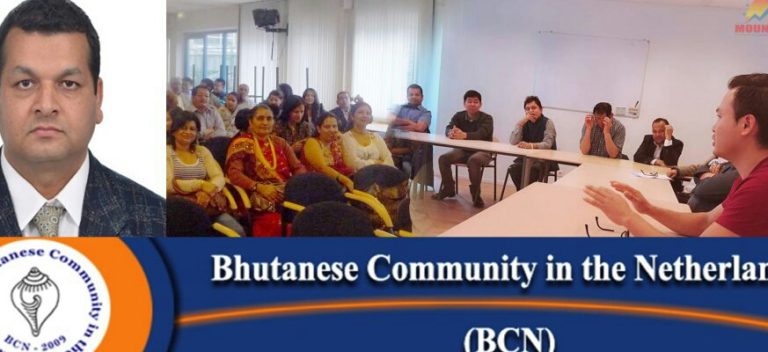
भुटानीज कम्यूनिटी इन नेदरलेन्डस् (BCN) को अध्यक्ष पदमा तेस्रो पटक डी. पी. मैनाली निर्बाचित…

15 अप्रिल। नेदरलेन्ड्समा बसोबास गर्ने नेपाली भाषी भुटानीहरुको साझा संस्था भुटानीज कम्यूनिटी इन नेदरलेन्ड्स (Bhutanese Community in Netherlands-BCN) को पाँचौ अधिवेसन यहाँको शहर उत्रेकको एक सभाहलमा संस्थाका पूर्व अध्यक्ष छत्र राईको अध्यक्षतामा सम्पन्न भएको छ। BCN को पाँचौ अधिवेसनले पूनः तेस्रो पटक अध्यक्ष पदमा वर्तमान अध्यक्ष डी. पी. मैनालीलाई निर्बिरोध निर्बाचित गरेको हो। मैनालीले यो भन्दा पहिला लगातार दुइ पटक अध्यक्ष पद सम्हालेर धरै अन्नुभव बटुली सकेकाले वहाँको तेस्रो कार्यकाल पनि सफल हुनेमा सबै भुटानीज कम्युनिटी इन नेदरलेन्ड्सका सदस्यहरु निश्चिन्त देखिन्छन्।

अध्यक्ष मैनालीको नँया कार्यसमिति:

श्री डी. पी. मैनाली – अध्यक्ष
श्री राम कार्की – उपाध्यक्ष
श्री अम्बर सुब्बा – महासचिब
श्री नवराज गजमेर – कोषाध्यक्ष
श्री जिम्मे गुरुङ्ग – सदस्य
श्री आइमान समाल – सदस्य

भुटानबाट नेपाल हुँदै नेदरल्याण्ड्ससम्म आइपुगेका मैनाली यहाँको युनिभर्सिटीबाट विज्ञान र गणित बिषयमा स्नातकोत्तर तहको अध्ययन पूरा गरेर शिक्षण पेशामा सम्लग्न हुनुहुन्छ। सरल स्वभाव अनि सबैलाई सम्मानजनक व्यबहार गर्ने, समाजको हकहित र अवश्यकतालाई राम्रोसँग बुज्न र त्यस अन्नुरूप आफ्ना क्रियाकलापलाई अगाडि सार्न सक्ने भएकाले पनि मैनाली तेस्रो पटक निर्बिरोध निर्बाचित भएको बताइएको छ।

माउन्ट मेडियासँग कुरा गर्दै मैनालीले ‘आँफुले पहिले जस्तै यहाँको डच र नेपाली समाजसँग स्थापित गरेको सम्बन्धलाई अझ मजबुत बनाउँदै लाने’ बताउनु भएको छ।

स्मरण रहोस् मैनाली माउन्ट मेडियाको ग्लोबल भुटानिज कम्यूनिटी कोअर्डिनेटर पनि हुनुहुन्छ। वहाँलाई माउन्ट मेडिया हार्दिक बधाई ज्ञापन गर्दै नयाँ कार्यकालको पूर्ण सफलताको लागि शुभकामना समेत व्यक्त गर्दछ।

साभारRK Subedi/माउन्ट मिडिया  

नयाँ वर्ष तथा नेपाली-भाषा पुस्तक सार्वजनिक कार्यक्रम

डिमोइन, आयोवा । नेपाली नयाँ वर्ष २०७५ का अवसरमा डिमोइनमा नेपाली सांस्कृतिक कार्यक्रम तथा नेपाली-भाषा पुस्तकको विमोचन गरियो । कार्यक्रम हिन्दू सांस्कृतिक तथा शैक्षिक केन्द्र तथा सी.आर्.सी. को संयुक्त आयोजना गरिएको थियो । समाजसेवी टंक धिताल सभापति तथा डिमोइन सहरका मेयर फ्य्राङ्कलिन क्याउनी मुख्य अतिथि रहेको कार्यक्रममा राज्य सिनेटर म्याट म्याकोइ, भूटानी समाजका अग्रज विद्वान् पं. शिवप्रसाद पोख्रेल, नागरिक तथा मानव अधिकारका निर्देशक जोसुवा भी. बार आदिको आतिथ्यता थियो । मेयर क्याउनीले दीप प्रज्वलन गरेपछि आरम्भ कार्यक्रममा पं. मुक्ति सुवेदी र उहाँका विद्यार्थीहरूले मंगलाचरण तथा गीता पाठ गर्नुभयो भने सुश्री भिलास्ना आचार्यले स्वागत मन्तव्य दिनुभएको  थियो ।

   कार्यक्रममा नृत्य गर्दै बालबालिका

सांस्कृतिक कार्यक्रमतर्फ ढकाल ब्रदर्स् अर्थात् मनोज र कृष्ण ढकालले आफ्नो जोडदार प्रस्तुति दिनुभयो भने सम्पूर्ण दर्शकहरू छमछमी नाचेका थिए । अन्य विभिन्न कलाकार तथा स-साना भाइबहिनीहरूले नेपाली नृत्य एवम् गीतहरू प्रस्तुत गरेका थिए । उक्त केन्द्रले ढकालद्वयलाई गीत र कलाको क्षेत्रमा दिएको योगदानको कदर गर्दै सम्मान गरेको थियो । समाज विभिन्न स्वयंसेवकहरूलाई कदरपत्र प्रदान पनि गरिएको थियो ।

कार्यक्रममा विद्वान् पं. पोख्रेल, अतिथि बार, समाजसेवी धिताल, सचिव सोम आचार्यलगायतका विशिष्ट व्यक्तित्वहरू तथा साना बालक सोहन पोख्रेलले संयुक्तरूपमा खिम खतिवडाद्वारा लिखित नेपाली पाठ्यपुस्तक ‘हाम्रो नेपाली भाषा – भाग २’ को विमोचन गर्नुभएको थियो ।  अतिथि  बारले खतिवडाद्वारा सञ्चालित अनलाइन अध्ययन केन्द्र ‘हाम्रो पाठशाला’ को औपचारिक रूपमा आरम्भ गर्नुभयो । पुस्तक विमोचनअघि मुक्ति सुवेदीले लेखक खतिवडाको जीवनीमाथि संक्षिप्त प्रकाश पार्नुभएको थियो ।

कार्यक्रमका मेयर काउनीले आफू आयोवावासी भूटानी समाजसँग गत तीन वर्षदेखि सहकार्य गरिरहेको र उहाँहरूले आफ्नो भाषा तथा संस्कृतिको विकासमा गरेको लगन देखेर आफू अत्यन्त खुशी बताउनुभयो ।

कार्यक्रममा बोल्दै लेखक खतिवडाले डायस्पोरामा बसोवास गर्ने भूटानी समाजका हजुरबुबा र नातीको, अर्थात् पहिलो र चौथो पिँढीको बोलचाल बन्द हुन लागिसकेको अवस्था नेपाली पाठ्यपुस्तक लेखेर यसै दूरीलाई कम गर्ने प्रयास गरेको बताउनुभयो । उहाँले धेरै ठाउँमा भाषा कक्षा सञ्चालन गर्न नसकिएको र सञ्चालन भएका ठाउँमा पनि कतिपय अभिभावकले चाहँदाचाहँदै पनि आफ्ना नानीलाई कक्षामा लान नसकेको अवस्थामा विद्यार्थी र अभिभावकहरूले पनि लाभ लिन सकून् भन्ने उद्देश्यले ‘हाम्रो पाठशाला’ नामक अनलाइन अध्ययन केन्द्र शुरु गरेको स्पष्ट पार्नुभयो ।

कार्यक्रममा मनसून नामक संस्थाकी निर्देशक लता डि. मेलोले पनि आफ्नो विचार प्रस्तुत गर्नुभएको थियो । कार्यक्रम सञ्चालन कवि, गीतकार एवं उक्त केन्द्रका संस्थापक सदस्य खेम रिजालले गर्नुभएको थियो ।


आमाहरू सम्मानित

नेपाली संवाददाता/न्यु ह्याम्सर

स्थानीय हुक्सेटस्थित मेन्टेनिङ्ग इन्डिपेन्डेन्स नामक माता-पिताहरूको दिवा-सेवा (डे केयर) संस्थामा शनिबार (अप्रिल १४) मा आमाहरूलाई सम्मान गरिएको छ । माता तीर्थ औंसीको अवसरमा उक्त कार्यक्रम गरिएको उक्त कार्यक्रम ‘के दिएर मनाऔं शिवलाई रु शिव मान्दैनन्’ बोलको भजन गाएर प्रेम खतिवडा शुरू गर्नुभएको थियो ।

सुमात्रा सुवेदी, राजेश कोइराला, विष्णु कोइराला, विवेक राई, विष्णु खड्का आदिले आमाको महिमा गर्दै मन्तव्य दिनुभएको थियो । मेन्टेनिङ्ग इन्डिपेन्डेन्सका सञ्चालक कायल वर्थले अमेरिकामा मनाइने ‘मदर्स डे’को इतिहास सुनाएका थिए ।

आमाहरु सम्मानित/ फोटो : मेन्टेनिङ्ग इन्डिपेन्डेन्स

कार्यक्रममा आमाहरू, नर्स, कर्मचारी, स्थानीय समाजसेवीहरूले आमाहरूलाई सम्मान गर्नुभएको थियो । मेन्टेनिङ्ग इन्डिपेन्डेन्सका सञ्चालक कायल वर्थकी आमा लिजलाई पनि सम्मान गरिएको थियो । हरिमाया खतिवडा, सेतीमाया मगर, नरमाया दर्जी, आदिले भजन गाउनुभएको थियो । सामुहिक फोटो खिचाइ, संस्थामा कार्यरत ३ नर्स बहिनीहरूको सम्मान, तथा गुरू सुवेदीको व्यापारिक प्रवचनसहित कार्यक्रम सकिएको थियो ।

सन् २०१५ देखि हुक्सेटमा सञ्चालनमा आएको मेन्टेनिङ्ग इन्डिपेन्डेन्समा ९४ जना नेपाली-भाषी तथा २५ हिस्प्यानिक माता-पिताहरूले सेवा पाउँदै आउनुभएको छ । नेपाली-भाषीतर्फ ४६ पुरुष तथा ४८ महिला हुनुहुन्छ ।  यहाँ म्यानचेस्टर र कंकर्डका माता-पिताहरूलाई सेवा प्रदान गरिन्छ ।

न्यु ह्याम्सर राज्य, अमेरिकाको उत्तर-पूर्वी राज्य हो । यस राज्यको जनसंख्या करिब १३ लाख ३० हजार छ भने नेपाली-भाषी (नेपाली तथा भूटानी) को संख्या करिब ५ हजार छ । अमेरिकाको उत्तरपूर्वमा पर्ने छ राज्यहरू: ‘मेन’, ‘न्यु ह्याम्सर’, ‘भर्मन्ट’, ‘म्यासाचुसेट्स’, ‘रोड आइल्यान्ड’ र ‘कनेटीकट’ लाई सामूहिक रूपमा ‘न्यु इंगल्याण्ड’ भनिन्छ । यस क्षेत्रमा नेपाली-भाषीको संख्या पातलो-पातलै छ ।

परम्परागत मातातीर्थ औंसी (मातृ औंसी) वैशाख कृष्ण औंसीका दिन आ-आफ्ना आमाप्रति श्रद्धा, भक्ति एवं सम्मान गरी मनाइन्छ । वैशाख कृष्ण औंसीका दिन मातृ औंसी, मातृ–दिवस, माता तीर्थे औंसी तथा आमाको मुख हेर्ने जस्ता नामले मनाइने यस पर्वमा प्रत्येक छोराछोरीले आमालाई आ-आफ्नो गच्छेअनुसार स्वादिष्ट व्यञ्जन, कपडा, सगुन र उपहार दिने गर्दछन् । आमा नहुनेहरुले दिवंगत आमाको नाममा तर्पण श्राद्ध तथा श्रद्धाञ्जलि अर्पण गर्दछन् ।

‘पराजिका’ नामक धर्मग्रन्थको ‘बुद्धोक्त वचनम्’ मा मातातीर्थ औंसीका दिन प्रत्येक छोराछोरीले शुद्ध मनले आमालाई प्रसन्न एवं खुशी तुल्याई प्राप्त गरेको आशीर्वादबाट ठूलो फल प्राप्त हुने र आमा परलोक हुने छोराछोरीले मातातीर्थ वा अन्य तीर्थमा नुहाई तर्पण, सिधा, दान तथा पिण्ड दान गरेमा दिवंगत आमा प्रसन्न भई दिएको आशिर्वादका प्रभावले छोराछोरी सुसम्पन्न भई सुखभोग गर्न पाउने र सन्तानको कल्याण हुने उल्लेख छ ।

Dr. Kamal Gautam’s journey into medicine

I was born in Maneydara, a small village in Samtse district in southwestern Bhutan. Throughout my school education, I always maintained highest level of academic progress. In the 10th grade board exams, I was in the top three country-wide, but I was denied admission in Sherubtse—then only college in Bhutan.

I, along with my family got evicted out of the country in the early 1990s. I ended up staying in the Beldangi refugee camp in Nepal, where initially I felt like my dreams were crushed badly. I did not give up, and I always kept my hopes high. Thanks to the scholarship program of the UN’s refugee agency (UNHCR), I could complete grade 12 taking Science and Mathematics. Meantime, I had joined a local campus in Damak for my Bachelor’s degree in Arts. But I forwent that campus preferring scholarship to study what was in my vein.

While in the refugee camp, I began teaching in schools before I was offered the full-ride Albert Einstein German Academic Refugee Initiative (DAFI) scholarship to pursue a career in medical field. In 1997, I was very excited to start my Bachelor of Medicine, Bachelor of Surgery (MBBS) program at the Institute of Medicine, Maharajgunj campus of the Tribhuvan University in Kathmandu, Nepal.

          Dr. Kamal with family

My interest in medical profession stirred because of my mother’s situation. I was very resolute to cure my ill and frail mother after becoming a doctor. Unfortunately, in 1998, she passed away way before I gained the knowledge and skills to look into her medical conditions. I had just started the MBBS program when she left us all from this physical world.

Having graduated from the medical school, I took a part time job in the refugee camp—where I was assigned to three different refugee camps for the “screening and consultation” so patients received further treatment when deemed necessary. I quickly learned that many refugees lived with complex medical conditions, and there were no timely treatment procedures in place. I was often frustrated to see patients dying not getting the referral or delay in the process of referral. Many could not afford to buy medications out of their pocket. I strongly felt like it was not a meaningful service I was providing to the refugees.

After serving in the refugee camps for about two years, I returned to Kathmandu along with my wife, and  started working there in a private hospital while my wife worked as a teacher.

In 2007 when the United States government offered the option of third country resettlement, I immediately realized that it was a better option for a brighter future. I, along with my family arrived in Syracuse, NY in 2010 to join other immediate family members who had lived there already for two years.

Too many to name – my wife, my father, brother, other family members, close friends and the community have always become supportive.  Thank you all. Because of your support and encouragement, I have achieved all these successes in my career.

My job in the US began as a medical assistant/nurse after two months of my arrival. Though at times I felt frustrated and had lower self-esteem, I had  plenty of opportunity to learn about the U.S. healthcare system.

I took this opportunity to prepare myself for my medical residency. I completed pre-residency licensing exam requirements including the written and practical for the U.S. Medical Licensing Exams (USMLE). I had actually completed one of the exams while in Kathmandu which counted towards meeting one of the requirements here.

Besides, I worked for a few months as a volunteer patient navigator/interpreter at the local University Hospital Medical Clinic which helped me to add to my resume and get selected for the residency program.

Getting into Internal Medicine residency was very challenging for me. I think it is always very challenging for any foreign medical graduates. It is even more a herculean task for those who have graduated from their medical school more than three years ago. For me, it was a nine years’ gap. I was fortunate to get into the Interfaith Medical Center in Brooklyn, NY due to my good grades, recommendations, and volunteer job history in my new country. Beginning in July 2012, I started the residency program. Given a long gap and other family responsibilities, it was not as easy as I had thought to go back to school. Despite all odds, I successfully completed my residency in June 2015.

Within days of completing residency, we moved back to Syracuse. I did not have the opportunity to actually start practicing in the Syracuse community until after a year of working at the Oswego Hospital affiliated primary care clinic, about 20 miles away. But I continued to look for the opportunity to work for the refugee community, in particular Bhutanese. Starting in October 2016, I began working in the Syracuse area at the Compassionate Family Medicine – the same medical office where I initially worked as a medical assistant/nurse.

Currently, I work at two locations that provide medical services, mainly to the refugees and other underserved populations. Over 60 percent of my patients are Nepali speaking Bhutanese, and they seem happy to meet a provider that speaks their language.

Although I was not able to cure my mother’s illness back in the refugee camps, I feel fortunate and encouraged to continue to work for the community in my new homeland.

One day I wish to go back and work in Bhutan in the capacity of medical professional given the chance.

Apology: BNS mistakenly published a wrong version of the piece earlier, and we sincerely apologize for the confusion caused to the author and readers. In the meantime, due to a technical error we couldn’t update the newer version immediately. The piece has now been revised.

Editor’s Note: Have a diaspora story you’d like to see us tell? Know of someone in the community who is doing formidable work? We’d love to hear about them. We are in particular seeking stories about women and elders and how they’re integrating into their new communities.

Question of defeating Miserable Life

REMEMBERING HASTA BHATTARAI

Existentialism says humans are free and responsible for their own actions in a world without meaning. But it has been a great failure in case of the people living in the Bhutanese refugee camps. What a mystery it is! We never know what we will be reaping as a fruit of our toil. What we had as our dreams when we were settled in the camps 17 years ago no longer remain even as dreamiest today. It is true that we have to expect the unexpected. We never thought that we would be in a state of such miserable plight with respect to our hopes, aspiration and ambition. At the moment, we are no more than debris. But we should never give up hopes. Debris may prove to be good nourishment for the health growth of plant. We must be able to adapt with any sort of situation that entangles us. We should always survive the ray of hope. That is the only way to positivism and easy going. According to Eliot, the only way of expressing emotions is by finding objective correlative of emotion. Objective correlatives are a set of objects, a situation or chain of events which shall be the formula of that particular emotion. We are compelled to hold the stick of our well-wishers for our rescue, in particular not to leave the right track before it is too late.

Hence, at this critical moment I take it wiser to echo with Anatole France who says that man’s prudent who neither hopes for fears anything from the uncertain events of the future. Furthermore, a material thing is simply in itself but human is for himself. So we must try to live as a human with the fulfillment of at least the basic needs.

It is natural that every one of us with evident pride says that I belong to this country, I am going to be that personality and I am going to hold that material gain. Being born and brought up in a given country it’s our moral duty to be patriotic, committed and loyal towards our nation. But there are unpredicted circumstances that we have to face knowingly or unknowingly. We may be prepared or may not be for the cause of our nation, our pride. No man ever gives up his strength to belonging to one’s nation. He may be displaced by ruthless power holders in the course of history but that never defeats him. I believe a genuine patriot even reincarnates from the ashes like phoenix. Darwinian ideology stresses struggle for existence and survival of the fittest.

Of course, every one of us tried our best to contribute for the cause of southern Bhutanese but we were destined to be evicted as destitute by the dictatorial power holders who never had the knowledge of sights and privileges of the citizens. Our voice of truth, the message of god for humanity remained unheard. Instead we are forced to undergo bitter and inhumane life in the refugee camps in Nepal. Today it seems that the god had seen our plight, sacrificial penance for the salvation of our souls. It’s certain that the people languishing in the camps having requisites below the basic requirements for human existence are in an ambivalent state. Despotic regime might have taken that evicted people disintegrate, perish and deteriorate in the miserable situation they are in but this, though is my personal opinion, is an immature logic.

Languishing in the camps for at least a couple of decades in a plightless situation has made the people take any humanitarian aid at their reach for the better further prospect. And one of such aids is the opportunity for the people to opt for third country resettlement. Not to an exception, I have also taken this opportunity in my favor. I have never prepared myself to give up my struggle for returning home with dignity and honor. I, in person, participated in many of the programs for repatriation led by political leaders in exile. Despite our active and repeated involvement in this respect, we failed in our attempts due to Indian intervention. At this desperate dispersion, I feel I made wise decision to get resettled in the foreign land.

On the day I filled up the resettlement interest form, I was saddened and shattered by the sense of dislocation and loss of identity and unity. But I was destined to master courage to show readiness for the resettlement program. I was forced to give up everything that I had at hand. I had to give up my job, my studies, friends, relatives and even family members. I am happy to abandon all my possessions for abroad resettlement. It should not be misread here that I opted resettlement just for pleasure but I had no often to be the substitute to support my existence as a human being. As like those already resettled, I am leaving for abroad for my better future prospect with a heavy heart. I strongly believe that going abroad at any cost does not dismantle our ambition and passion for return to hometown, Bhutan. I suppose we will have better living standard out there leading to better thoughts and actions. Of course, it is enigmatically shocking to leave our station for an unknown destination.

It is painful to leave all our close relatives behind but in the globalized context one can easily get connected with the other one provided that they are spiritually and ideologically bound to fight for dignified return to Bhutan. One day or the other we may stay abroad until the day we are fully equipped materially and intellectually to combat with the ruthless regime that aborted us for its pleasure. Living in the poor condition in the camps for eternity, we won’t gain any degree of momentum to strengthen ourselves in any ground.

In the host country, our survival is questionable in any sense. We have no right for secured life, liberty and pursuit of hopelessness. Where ever we go out our ‘refugee tag’ invites ill fate. We may be exploited, ill-treated or segregated on the ground of refugee tag. This harassment has psychologically weakened, paralyzed and discouraged our existence as normal human beings. No doubt we are not less competent in any sense with the natives of our host country. This simply discourages, reifies and makes us feel always as failures.

In my opinion at this wretched juncture, taking option for third country resettlement at the cost of any loss that we are bound to bear may not prove us to treacherous traitor who betray his countrymen instead it may add vigor, zeal and new but better perspective in our attempt to fight for returning home. I do not think having settled outside with enjoyment of better privileges one can forget one’s country where he/she was born and brought up. Instead, our scattered resettlement in various parts of the foreign land may give us easy access to raise our pathetic voice to the world communities inspiring them for their immediate helping hands towards the solution.

In this regard, I think it is reasonable for any opposition groups to stop their protest against the people going abroad. Going abroad may breed better minds. This may be of great help for the country and our suppressed, subdued and discarded brothers and sisters residing in southern Bhutan expecting great help from us. Our mission should not be other than emancipating our siblings from prolonged slavery, exploitation and discrimination. And it has been crystal clear that quarrel and enmity among ourselves besides our joint effort for our safe return home in the camps and always a failure. We also have excess skilled people in the camps who are ever unemployed. This will breed frustration, desperation and self-degeneration. On the other hand, if they can be given way to foreign resettlement, they not only raise their living standard but also do something not only for the country but also for the whole humanity.

Though we live in miserable camps, we may be having scientists, artists and scholars who can contribute something for world provided that they are given better opportunities. We must try our hands at any privileges that come to our reach rather than debating and opposing each other.

To conclude, every individual must have utmost freedom to choose his/her option with dignity and honor. Neither the supporting agencies should be bias to give priority to the only option that adds certain gain to them nor should those opting for it take their pace with the drunkenness of jealousy, greed and illogical conclusion. Our choice must not intervene any one’s rights and privileges but should guarantee peace, prosperity and safety to the concerned.

Editor’s note:  This opinion piece is reproduced here as an obituary  to late Hasta Bhattarai  who passed away on April 8, 2018 in Chicago, IL.  He died of sudden cardiac arrest at his sleep. The piece was first published in ‘The Bhutan Reporter monthly in August 2008 before he left for resettlement. BNS likes to extend heartfelt condolences to the bereaved Bhattarai family. 

 “There is a GoFund page set up to honor Bhattarai’s contributions in the community — please follow that link here:  Follow this link – Go fund Me

It is unedited for keeping the originality of his writing then. 

विभिन्न शहरमा उभौली साकेला कार्यक्रम गरिँदै

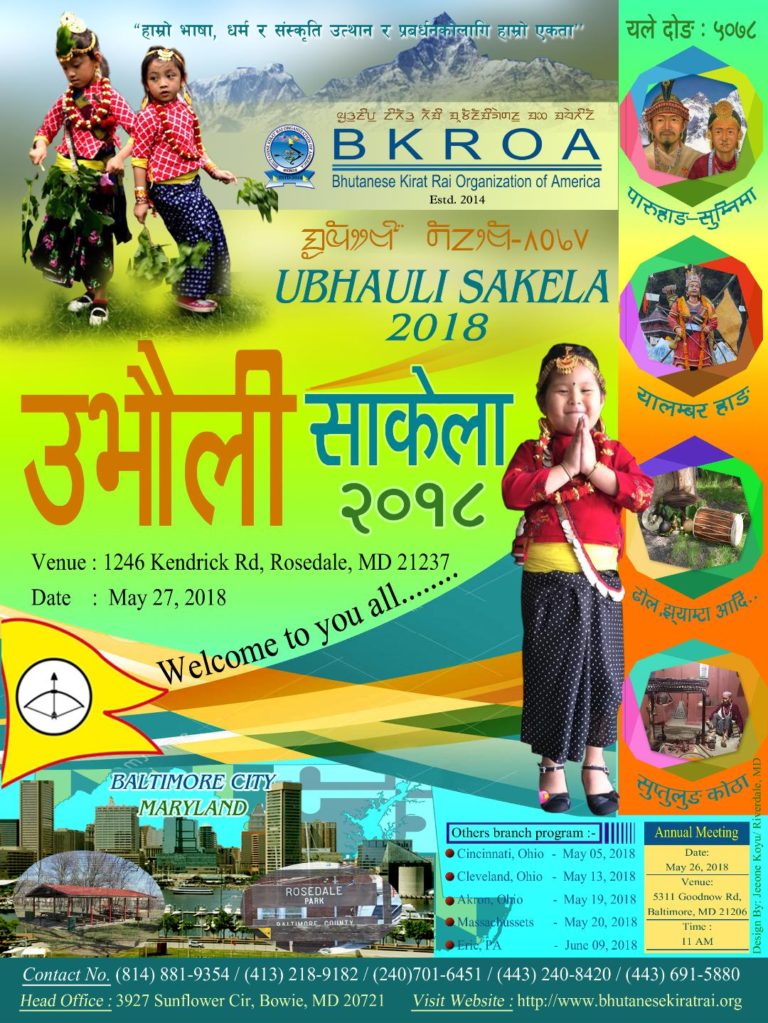
भूट्निज किराँत राई अर्गनाइजेसन अफ अमेरिका (ब्रोका; बिकेआरओए) ले आफ्ना शाखाहरूमार्फत किराँत राईहरूको महान पर्व उभौली साकेला २०१८ अमेरिकाका विभिन्न शहर मनाउने भएको छ । संस्थाका तर्फबाट अप्रिल ५ मा जारी विज्ञप्तिमा उक्त जानकारी दिइएको छ ।

खेतीपाती राम्रो होस्, अन्न धेरै फलोस्, प्राकृतिक प्रकोप नहोस् तथा समस्त मानव जातिको कल्याण होस् भन्ने पुकारका साथ यो पर्व धुमधामका साथ मनाइन्छ । किराँत धर्मावलम्वीहरू आफ्ना कुटुम्ब, इष्टमित्रसँग नाच्छन् । नाचमा ढोलक, झ्याम्टा, चौरीको पुच्छरको झुप्पा, चाम्खी आदि प्रयोग गरिन्छ । वैशाख पूर्णिमाका दिनदेखि औंसीभित्र मनाइने उभौली साकेला भुमिदेवको पूजा गर्दै विभिन्न चराचुरूङ्गीको नक्कललाई नृत्य (शिली) मा प्रस्तुत गर्दै मनाइने गरिन्छ । यस वर्षको वैशाख पूर्णिमा २०७५ साल वैशाख १७ (सन् २०१८ अप्रिल ३०) मा परेको छ ।

उभौली साकेलाबारे विज्ञप्तिमा भनिएको छ, ”अप्रिल २८ तारिखमा भर्मन्ट, मे ५ तारिखमा सिन्सिन्याटी (ओहायो), मे १३ तारिख क्लिभल्याण्ड (ओहायो), मे १९ तारिखमा एक्रन (ओहायो), मे २० तारिखमा स्प्रिङ्फिल्ड (म्यासच्युसेट्स), जुन ९ तारिखमा ईरि (पेन्सलभेनिया) मा तथा केन्द्रियस्तरको साकेला कार्यक्रम मे महिनाको २७ तारिख मेरिल्यान्डको बाल्टिमोरमा हुने सबैलाई जानकारी गर्दछौं ।”

केन्द्रिय स्तरको साकेला कार्यक्रममा शिली-नृत्यबाहेक अन्य विविध सांस्कृतिक प्रदर्शनी, मनोरञ्जनात्मक रिसिया गायन तथा नृत्यहरू पनि रहने संस्था बताउँछ । उक्त बृहत् सांस्कृतिक कार्यक्रममा उपस्थितिका लागि संस्थाले सबैलाई आह्वान पनि गरेको छ ।

उक्त कार्यक्रममा नृत्य (शिली) प्रतियोगिता पनि राखिएकाले सबै शिलीकारहरूलाई सहभागिताका लागि संस्थाले आह्वान गरेको छ । विज्ञप्तिमा ब्रोकाको वार्षिक बैठक मे २६ तारिख बिहान ठिक ११ बजेदेखि साँझ ५ बजेसम्म बाल्टिमोर शहरमा हुने पनि उल्लेख छ ।

किराँत राईहरूको मौलिक संस्कार, संस्कृति, भाषा, लिपि, र रितिरिवाज संरक्षण तथा संवर्धन गर्ने मुल उद्देश्यले उक्त संस्थाको स्थापना सन् २०१४ मा गरिएको हो । संस्थाको केन्द्रिय कार्यालय मेरिल्यान्ड राज्यको बाल्टिमोरमा छ । संस्थाले स्थापनादेखि निरन्तर रूपमा अन्य समुदायहरूसँग साझेदारी र समन्वय गर्दै समृद्ध किराँत समुदाय निर्माण, किराँत राईहरूको ऐतिहासिक गाथा, मुन्दुम लेखन, संस्कृति र भाषाको अभ्यास, उत्थान र प्रबर्धनका लागि लगातार रूपमा काम गरिरहेको छ । संस्थाले भूटानी राईहरूको अभिलेख, राईहरूको मिथक, मुन्दुम र तथ्यका आधारमा प्रत्येक वर्ष विभिन्न सांस्कृतिक कार्यक्रम आयोजना गर्दै आएको छ ।


We are all neighbors: Photographer documents history of new Ohioans

When immigrants flocked to the United States over a hundred years ago, their first point of entry was Ellis Island in New York.

That history is partly what prompted photographer Tariq Tarey to train his lens on the face of today’s newest Americans.

“The European migration was well-documented,” he said, referring to footage of beleaguered Polish, Irish, and Italian immigrants arriving in search of new opportunity after long, exhausting boat rides.  Tarey feared the stories of modern migrants, including resettled refugees like him, would be lost.

He arrived in this country on a plane, a refugee from Somalia, twenty years ago, seeking asylum from the conflict back home.

“I didn’t want the history to be lost,” he said.  So, after finding a camera at a flea market, he started taking pictures.

As the director of refugee services at Jewish Family Services in the area, he was meeting and working with another group of people experiencing political upheaval: recent arrivals from the Bhutanese-Nepali community.

“We share a story,” he said.  Though he may not share the exact religion, food, and language as that of the Bhutanese-Nepali community, he felt his own experience coupled with his ongoing work with arriving refugees gave him a unique entry point to their experience.

Over time, as Tarey has helped people find jobs and create new lives in Ohio, he slowly began to learn the individual stories.  He visited temples, and went to schools where they were learning English, as he had years before.

 Only then, he began to take photographs.

“You have to do your homework, your legwork,” he said of his approach.  His partner on the project, Doug Rutledge, provided the written text to go with his pictures.

 Then, they brought the show to the public, first to the Ohio History Museum.

He didn’t go to an art gallery, he said, because “I wanted to make sure the Bhutanese-Nepali belong to Ohio’s history.  They’re Ohioans.  They are part of the culture now.”

The show is up now at the Rutherford B. Hayes Museum in Fremont, Ohio, and will next open at the Underground Railroad Museum in Cincinnati.

And Tarey continues his work as a visual ethnographer.  He’s begun another project on a different population who are helping to reshape Central Ohio, the Congolese people.

“In America, you belong to the soil,” he said.  “What unites us is not tribal, it’s not religion.  It’s the Constitution of the United States.”

Tariq Tarey’s photographs:  http://www.tariqtarey.com/neighbors

Video interview with Tariq Tarey from PBS’ Broad & High:

http://www.pbs.org/video/bhutanese-nepali-neighbors-photographs-tariq-tarey-nqrwp4/

Have a diaspora story you’d like to see us tell? Know of someone in the community who is doing formidable work? We’d love to hear about them. We are in particular seeking stories about women and elders and how they’re integrating into their new communities.