‘भाषा हो सभ्यता हाम्रो सारा उदय, उन्नति जीत, वैभव भाषामै बाँच्तछन् पछिसम्म यी’

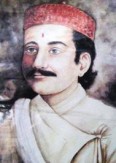
जुलाई १४ का दिन अमेरिकाको पेन्सिभेनिया राज्यस्थित पिट्सबर्ग नगरीको स्मिथ फिल्डमा अवस्थित ह्यूमन रिसोर्स सर्भिस सेन्टरको भवनमा भूटानी समाज पिट्सबर्गद्वारा आयोजित १९९ औं भानुजयन्ती समारोहले नेपाली भाषाका नाट्यसम्राट बालकृष्ण समका माथिका पंक्तिहरूलाई पुनरावृत गराइदियो ।

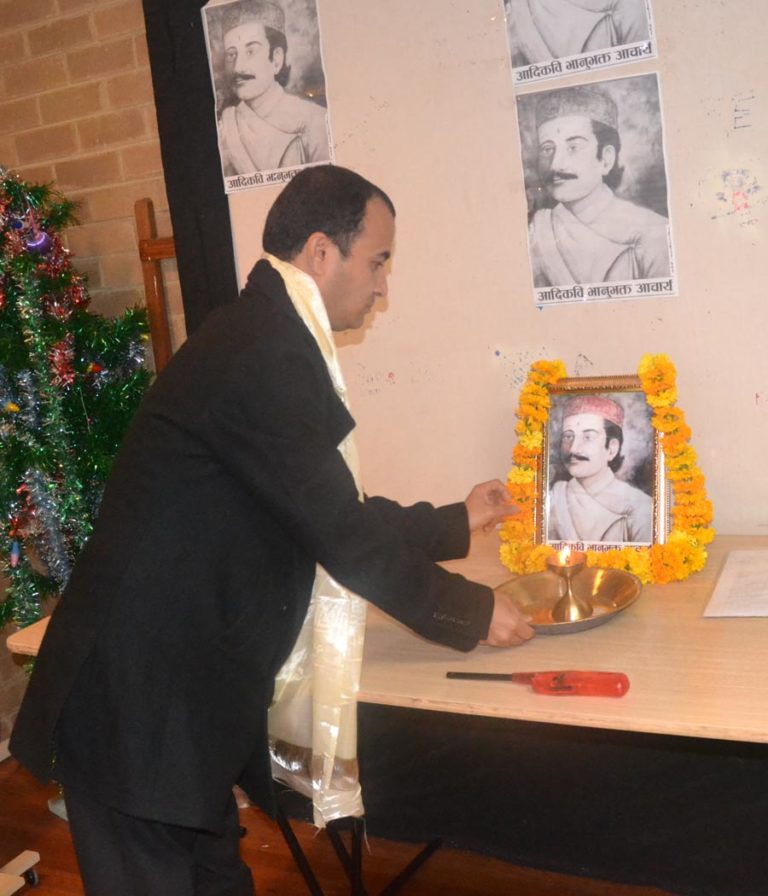
कवि भानुभक्त आचार्यको स्मृति गर्दै कार्यक्रमका मुख्य अतिथि भक्त घिमिरेद्वारा दीप प्रज्वलन तथा भूटानी स्रष्टा सञ्चमान खालिङको स्वागत मन्तव्यबाट शुरु गरिएको सो कार्यक्रममा रामायणको सुन्दरकाण्ड वाचन, विभिन्न दर्जाका कविता प्रतियोगिता र नृत्य-गानहरू प्रस्तुत गरिएको थियो ।

‘‘भूटानबाट आफ्नो भाषा-संस्कृतिसहित सम्पूर्ण जायजेथाबाट वञ्चित भई नेपालमा शरणार्थी बनेको हाम्रो समाज शिविरमा रहँदादेखि आजको वर्तमान अवस्थासम्म भाषा र संस्कृतिको संरक्षणको सवालमा लगातार डटिरहेको छ’’-सो समारोहका मुख्य वक्ताहरूले आ-आफ्नो मन्तव्यमा विशेषरूपमा यिनै कुरा दर्शाए । नौलो मुलुक, नयाँ समाज र सम्पूर्ण परिवेश अनौठो भएर पनि, जीवनयापनको माध्यम अति व्यस्ततामुखी भएर पनि भाषा र संस्कृतिको जगेर्नातर्फ सधैं सचेत रहने सो कार्यक्रमा आयोजक, वक्ता तथा सबै सहभागीहरूको प्रतिबद्धता विभिन्न क्रियाकलापहरूले झल्काइरहेका थिए ।

पिट्सबर्गबासी भूटानीहरूका अग्रज बुद्धिजीवी केएन तिम्सिनाको सभापतित्व तथा उमा गौतम र तारा फुयलको उद्घोषणमा सञ्चालित सो कार्यक्रममा स्थानीय भूटानी विद्धार्थीहरूले उल्लेखयोग्य स्वयंसेवा प्रदान गरेका थिए ।

भूटानी समाज पिट्सबर्गका बलराम गुरुङ, अग्रज अशोक गुरुङलगायतले कार्यक्रमको संयोजनमा भूमिका खेलेका थिए भने भूटान साहित्य परिषदका जनसम्पर्क संयोजक रुपनारायण पोखरेल, परिषदकै अर्थ संयोजक  डोना आचार्य, ईरीबासी भूटानी साहित्यिक स्रष्टा झगेन धिमाललगायतको पनि उपस्थिति रहेको थियो । कार्यक्रममा नेपालका जय शाह र भारतका पञ्कज लाठिया समेतको उपस्थिति थियो ।

“We are working wholeheartedly to maintain peace and order”

26,644

Following camp consolidation, the current population of three Beldangi camps almost stands as initial population that the camps had in early 1990s. The Chief of Camp Watch Team (CWT), Sanchahaang Subba, has stressed that the increase in population has changed overall dynamics of the camps one more time. According to him, maintaining peace and order in three Beldangi camps is very challenging these days. Regional Coordinator of the Bhutan News Service, Tilak Niraula, talked to him on various challenges facing the CTW and other issues.

What is the current camps’ situation?
It is obvious to all that the population of three Beldangi camps has increased one more time since we received fellow refugees from Khudunabari, Timai and Goldhap camps. More population means added efforts for efficient management. The Camp Watch Team (CWT) has to primarily maintain peace and order in three camps, and it is quite challenging.

CWT Chief Subba (Picture : Durga Pokhrel/BNS)

What are those challenges?
The challenges are more complex when one of the world’s largest resettlement programs has been underway in our camps. I have noticed that sometimes refugees, who are to depart for resettlement, become problematic to manage as their younger ones try to get engaged in various forms of entertainments right before their departures. Our team has been more vigil to control such youths during nights. We are very cautious to prevent probable gang-fights and disputes provoked by use of alcohols among youngsters.

How have you been overcoming them?
The sole efforts of CWT would be nowhere in maintaining peace and order in the camp had there been no supports from other parties. We are working closely with various camp-based organizations and number of community volunteers.

How are you discouraging youths from alcoholism?
The CTW has its own method of discouraging youths from using various alcoholic products. If any CWT team on petrol finds drunken refugees in camps, it brings them to our counseling office, where they will be asked to drink jugs of water so that they vomit what they have drunk completely. Then, we call their guardians or spouses and handover them after necessary counseling and warning to avoid repetition in future.

Some youths accuse you of being too arrogant in handling their cases?
I don’t think that I have crossed my limit. When we work for community, it is certain that everyone will not be satisfied with what we do. But, I believe that I am working with proper principles. This is why I have been receiving amazing support and solidarity from the community.

Subba with interviewer Niraula (Picture : Durga Pokhrel/BNS)

How do you handle complicated cases?
When cases become complicated or sensitive on various grounds, we forward those cases to either the United Nations High Commissioner for Refugees (UNHCR) or Armed Police Force (APF) for necessary actions. This has been in practice for a longtime. Here, sensitive cases are those connected to sexual and gender based violence.

Your last message to the community.
I would like to request everyone to be sincere principally and accepts that all human beings are social animals. We must promote peace and order in our community. However, we should never forget that we are in a democratic country where we have several rights to exercise, but without harming others. Indeed, refugees have rights to opt any options and it is up to them to choose resettlement, repatriation or local assimilation.

बेलडाँगीमा बरामद रक्सी नष्ट

डिकेश लामा, बेलडाँगी

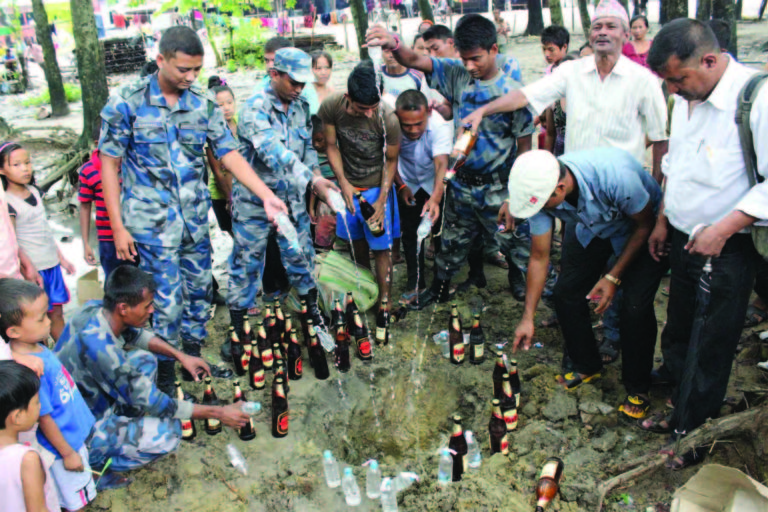
झापाको भूटानी शरणार्थी शिविरभित्र लाँदै गरेको अवस्थामा बरामद गरेको मादकपदार्थ वियर र रक्सी आज सार्वजनिक रुपमा नष्ट गरिएको छ ।

बरामद रक्सी नष्ट गर्दै प्रहरीहरु | तस्बीर: डिकेश लामा

विहीवार साँझ बरामद गरिएको ६ हजार मूल्य बराबरको ४८ थान रियल गोल्ड वियर र ३० थान सिल्डप्याक रक्सी नष्ट गरिएको सशस्त्र प्रहरी सुरक्षा बेसक्याम्प बेलडाँगीका प्रमुख निरीक्षक विजय हमालले जानकारी दिए ।

शिविरभित्र साइकलमा लाँदै गरेको अवस्थामा बरामद गरिएको रक्सी शिविर व्यवस्थापन समिति, सामुदायिक सञ्जाल, सामाजिक अगुवा, स्थानीय संचारकर्मी लगायतको उपस्थितिमा नष्ट गरिएको सशस्त्र बेसक्याम्पले जानकारी दिएको छ ।

विगत लामो समयदेखि शिविरभित्र मादक पदार्थको प्रयोग प्रयोजन बन्द गरिए पनि लुकिछिपी मादक पदार्थको प्रयोग तथा विक्री वितरण गर्ने कार्य रोकिन सकेको भने छैन ।

यस अघि पटकपटक बरामद गर्दै नष्ट गरेको घरेलु तथा सिल्डप्याक रक्सी वर्षमा १ लाख रुपैयाँभन्दा बढी रकमको नष्ट हुने गरेको सशस्त्र सुरक्षा बेसक्याम्प बेलडाँगीले जानकारी दिएको छ ।

Giris’ funeral slated on Saturday

26,644

The funeral of the Giri brothers killed in Queensland car accident is scheduled for Saturday.

RIPPED APART: The driver and front seat passenger of this Toyota sedan were killed instantly when their car collided with a semi trailer on the Bruce Highway at Feluga. PIC: John Flynn Source: Townsville Bulletin

According to Prahlad Dahal, Community Officer of Bhuanese Community in Crains, three Bhutanese youths were returning home from Townsville after completing medical appointment of Purna Giri in Townsville hospital before their car met with an accident.

While they were driving back home, their car collided with a semi trailer in Tully, about 200 Km. from Cairns. Furthermore, the car was hit by another car in full speed from back.

“It is learned that Sashi Giri and Purna Giri died instantly while Amrit Bhattarai, who was critically injured, was rushed back to Townsville hospital,” Dahal told BNS over telephone.

The dead bodies of Giris are discharged after postmortem and are kept in a local funeral house.

Amrit Bhattarai, who sustained critical injuries, is under treatment at Townsville hospital. Photo/Nisha Mishra

Bhattarai, who sustained severe hand and leg fracture, suffered also lever bleeding and was admitted to Intensive Care Unit (ICU).

BNS contacted Krishna Bhattarai, brother of Amrit Bhattarai earlier today. “The doctors have become a bit optimistic about Amrit’s case,” Krishna said.

“From 2pm Wednesday until 10am Thursday, five people were killed in four separate car crashes, prompting police to remind drivers to take care on the roads,” writes couriermail.com.au,  a local online.

Sashi Giri was survived by his wife and three children, eldest being 10, while Purna Giri have two daughters, the mother lactating the youngest of 2 months.

The funeral is expected to get completed as per the Hindu rituals. “We had an emergency meeting in our community which decided to bear the total funeral cost,” Dahal informed BNS.

Deceased brothers: Purna Giri (left) and Sashi Giri (right)

Dahal expressed his happiness to the employees of the local funeral house, who wished to work voluntarily on Saturday. “It is their greatness that they wished to complete the funeral task on Saturday despite it being a public holiday,” he said.

In a separate telephone conversation from Sydney, Suman Chhetri informed BNS that they were evaluating if they needed to come up with some financial assistance.

The Giris were resettled in Australia from Sanischare refugee camp in Morang, Nepal.

While in camp, Purna Giri served as an assistant teacher for over a decade in a camp school managed by Caritas Nepal. Sashi Giri was a long time volunteer in Refugee Camp Security Unit.

ABA’s fifth national convention ends

26,644

The fifth annual convention of the Association of Bhutanese in America (ABA) ended successfully on 6th July.

Participants of the convention (Picture courtesy : ABA)

A statement issued by Chairman Dr Purna Chhetri mentioned that the welcoming of the guests from long distances was done on the July 4 at the chairman’s residence with the welcome dinner.

The guests that were attending had travelled from places such as Canada, Missouri, DC, New York, Iowa, Colorado, and New Mexico, according to the statement.

“There was renewal of friendship. It gave hope to bridge the gap in generations, and it provided many people the opportunity to work as a team,” said Dr Chhetri.

Addressing the convention on the second day, guest speaker Sydel Maher, who works for USAID as an administrative officer for overseas operations, highlighted the ways to strengthen the organization.

Dr Chhetri further said that the convention also saw a rigorous workshop and group discussion based on the needs of the community.

The workshop is said to have attended by around 80 guests. It was essentially a brain storming session. The board meeting followed it.

Meanwhile, the final convention on July 6 took place at the Ethington Theater of the Grand Canyon University, inaugurated by Charles Shipman, the State Refugee Coordinator followed by Hari Acharya’s presentation on ABA activities.

Then, the three guest speakers we invited spoke, said the statement.

“They were very knowledgeable who had many years of experience in their own respective topics. Their message was very simple and eloquent, yet helpful to the Bhutanese.”

One of the speakers, Dr Martin Krepcho, who is a behavior scientist, spoke on psychosocial issues and how to overcome depression while Dr. Ambika Adhikari, Faculty Associate of ASU spoke on social integration, economic well-being and cultural preservation.

Similarly, Joanne Morales, the Director of Catholic Charities spoke on refugee programs and path of self-sufficiency.

While, Chairman Chettri gave a vote of thanks on behalf of the ABA and organizing committee to all delegates, guests and the audience.

“The slide show that was presented was about Bhutanese culture, and examples of life in the refugee camp and memoirs of previous ABA conventions. There were over 300 attendees,” added he.

The cultural program on the closing session was very exciting and entertaining and many people were waiting patiently for a long time.

Other activities during the conviction included live songs, and fashion show, among others.

First Bhanu Jayanti observed in Melbourne

26,644

Melbourne celebrated its first and the 199th Bhanu Jayanti in Glenroy Neighbourhood Learning Centre on Friday July 13 in Melbourne.

Drona Panta, Victorian Coordinator Non-residence-Nepali Assosication Australia and NCC Member, offering garland to revere Bhanu

More than 180 people, mostly seniors from the Bhutanese community attended the function, according to organizers.

Tracey Oliver, the community engagement coordinator graced the occasion as chief guest by lighting up the auspicious lamp (die).

She said that it is wonderful to see that community come together in such a large number to celebrate the importance of language and culture.

Meanwhile, Drona Panta, Victorian Coordinator for Non-Residence Nepalese Association in Australia and NRNA-A NCC member assisted in putting on garland to the portrait of Bhanu Bhakta and reciting a poem composed by himself.

Panta said, “Celebration of this event is a stepping stone to preserve Nepalese language, culture and heritage. Away from home country, when Nepal is going through changes, seeing these amazing programs and enthusiasm of our seniors and Bhutanese community, it makes me feel like I am in my own village in Nepal.”

The program included recitation of poems composed by local Bhutanese youths which reflected them on life in Nepal as refugees, changes that culture shock brought them in Australia and some romantic folk poems which made everyone in laughter.

Gazals, tukas and solo songs were very much became the part of celebration, added the organizer.

Ramayan verses recitation by Dilliram Adhikari and Thakur Prasad Luitel was special to all seniors and lesson to youths to keep the age old heritage of our language and culture.

Bhutanese Community members with Chief Guest Tracey Oliver (third from the left in the front row)

A Couple of young children performed Bhutanese Nepalese traditional dances and provided entertainment in a thrilling manner.

The program was beautifully managed by a pair of master of ceremony, Roshni Chherti and Khagen Acharaya who were extremely professional but at the same time so funny that people nicknamed them Madan Krishna and Hari Bangsa of Melbourne.

The best of Bhutanese cuisine was served after the event to attendees prepared by a volunteer group led by Maya Adhikari.

Likewise, Kubir Khanal offered the vote of thanks to all and reminded that the preservation of language and culture in the foreign land, which we have decided to call our home for rest of our live, is responsibility of all and not of few in the community.

Bhutanese brothers lose life in car accident

26,644

Two Bhutanese brothers lost their lives in a car accident in Queensland, Australia Wednesday evening.

Late Purna Giri (left) and Sashi Giri (right)

The detailed information of the accident is yet to be received but it is learned that Purna Giri and his brother, Sashi Giri were returning home in Cairns from a regional Hospital which was about 4.5 hrs drive from their home.

According to a post made in a Facebook Group by Suman Chhetri from Sydney, another youth was critically injured and was under treatment in Townsville Hospital.

A Bhutanese lady–resettled  in Cairns– who was contacted by Bhutan News Service confirmed that Amrit Bhattarai, resettled from Khudunabari refugee camp, was in a critical situation.

According to her, Purna Giri, who was sick, had an appointment in the hospital that day. They were returning home after the appointment in a car driven by Sashi Giri when they met the accident.

“The family members do not actually know where the dead bodies are. The case is under police investigation”, she said.

Bhutan News Service could not independently verify the claim.

Despite repeated efforts, Bhutan News Service could not reach any community activist in Queensland for their immediate response.

The Giris were resettled in Australia from Sanischare refugee camp in Morang, Nepal.

While in camp, Purna Giri served as an assistant teacher for over a decade in a camp school managed by Caritas Nepal. Sashi Giri was a long time volunteer in Refugee Camp Security Unit.

Cadastral survey victimizes Lhotshampas

Almost two decades after the mass eviction of 1990s, the land commission has started a so-called digital cadastral survey in all districts of the south.

The survey has finally come to the south as the National Land Commission (NLC) had launched a nationwide re-survey of land holdings, at an estimated budget of Nu 460 million on July 13, 2008.

The Commission said that it decided to go for re-surveying of all landholdings in the country, which number around 100,000, for settling existing disputes related to lands.

The survey would take an accuracy of 10 cm instead of sectoral meters used with the old system, and accordingly the data would be stored in digital form meeting the international standards.

Lhotshampas dwelling in the south have felt that the move is an attempt to capture all land data to victimize them in long run.

Nepali-speaking people in the south expressed fear that the fate would be severe for households, which had to split during mass eviction of 1990s with inheritable landholding or have purchased lands from those who have become refugees.

“The idea itself seems noble, but people in the southern belt are facing yet another burden as some of them own the inherited lands from those who were evicted in 1990s. There are many households that bought lands at low price when their friends had to abandon everything” said a retired civil servant from Samtse, requesting his anonymity.

Several had suffered the same fate in Samtse and Sarpang when the then Home Minister Dago Tshering termed all such landholdings as illegal after learning such kinds of land trade during the eviction period.

“This survey is being exercised to collect actual data of all landholdings in the south, and according declare them illegal to victimize the citizens,” added the source.

The survey officials are even learnt to be demanding citizens to pay a heavy sum for extra land accusing them of illegally capturing the lands and farms inherited to them by their ancestors, who have either passed away or were evicted in 90s.

“The cadastral survey is already in the field even in other places like Thimphu. However, the officials are applying completely different techniques in victimizing Lhotshampas in the southern districts. The reality is different in Thimphu,” the source further said.

Citizens in the south suspected that the survey team has been striking off private and fertile lands under cultivation, likely to be confiscated or allotted to someone in future as kidu by the King.

Several households from Tsirang, Samtse and Samdrup Jongkhar are learnt to have met such a fate already. The survey team was said to have returned following stern protests in Samtse.

According to the existing Land Act, households categorized as F5 and F4 (those people who could produce a certificate of origin proving only one parent had been born in Bhutan where only the certified parent qualifies for citizenship) are not allowed to hold any land properties in Bhutan and with this rules many are deprived of the rights of keeping their inherited lands or buying immoveable properties in their names.

The country’s Land Act was revised in 1979, but just came into implementation from January 1, 2008.

Following the implementation of the revised act, the land commissioned has settled over 6,000 land disputes so far. It is said that several Lhotshampas were made empty handed while settling those disputes, and several cases are awaiting legal clearance from the kangaroo court of Bhutan.

Bhutanese arrested in connection with forged IDs

26,644

Following a tip-off, Nepalese police arrested two persons in Jhapa on the charge of selling fake Bhutanese citizenship to non-Bhutanese.

Nepal Police Inspector at Kakarvitta of Jhapa, Suk Dev Khanal, shows forged Bhutanese identity cards confiscated from the arrestees during a press meet on Monday  (Picture courtesy : The Kathmandu Post)

The Area Police Office, Kakadbhitta arrested ‘U’ Wangchuck and ‘K’ Dorjee three days ago with 30 fake copies of Bhutanese citizenship, reports the Kathmandu Post, Tuesday. The Bhutan News Service has withheld initials of their names on security grounds.

Police believe that there is a large network of people running the fake citizenship racket, particularly active in Sikkim, Darjeeling, Manipur and Shillong, in India.

The racket has reportedly taken off with the third country resettlement scheme for Bhutanese refugees living in Nepal.

A confidential source informed BNS that some of the district officials at the Refugee Coordination Unit have also been involved in the racket. However, the claim couldn’t be verified independently.

Police also claimed that such activities have increased as initial registration process of remaining asylum seekers from Bhutan has been underway in Jhapa since a month.

A Royal Encounter

26,644

I’ve just devised a mathematical formula that you’re unlikely to encounter in a textbook: Take a small country, add a large and accessible royal family, combine with a relatively low number of tourists – and the probability of visitors encountering the King and Queen, or at least a Queen Mother or two, is relatively high.

OK, I’ve only tested this less-than-scientific calculation in Bhutan but after about 10 years of implementation, it has been holding up to scrutiny rather well.

Bhutan, which in 2008 crowned its fifth king, His Majesty Druk Gyalpo Jigme Khesar Namgyel Wangchuk, put its first king on the throne in 1907.

It was in the 1950s that the third king, Jigme Dorji Wangchuk, began cautiously to edge his Himalayan kingdom into the modern era. He abolished slavery, instigated work on the country’s first road to connect west with east, established a cabinet and sought and got Bhutanese membership of the United Nations.

When he died in 1972, his son – father of the present king – took over and change in Bhutan accelerated, although it was closely monitored. During this reign of Jigme Singye Wangchuck, television and the internet were introduced and tourist numbers increased (the first tourists entered the kingdom only in the 1970s).

The fourth king abdicated in favour of his son when he turned 50 and it is his family life that intrigues visitors the most and has led to the statistically high chance of a royal encounter for visitors.

This king has four wives, all sisters, who between them have 10 children; the fifth king is the oldest of the princes and the son of the third queen. Polygamy is not common in Bhutan; the fourth king’s marriage of four sisters is connected with a prophesy linking the Wangchuck family with that of the queen’s as a way to improve the longevity of the kings.

The four queens, now officially known as the queen mothers, each have a villa set on the hills overlooking Bhutan’s capital, Thimpu. The fourth king lives in a separate, very simple wooden house nearby. One of my earlier encounters with royalty came on the roads near the palaces when we rounded a corner in the tour bus and straight across the intersection was the fourth king at the wheel of his Land Cruiser.

Even if there hadn’t been a small retinue of vehicles with flashing lights it would be easy to spot as there are special licence plates for the royals; the king’s is simply BHUTAN. Other members of the family have vehicles bearing the numbers Bhutan2, 3 etc.

The one trap for visitors is that the country’s chief abbot, the Je Khenpo (who is held in almost equal rank with the king) travels in a vehicle labelled Bhutan 1. However, this most senior monk doesn’t drive and is normally swamped in prayer scarves given to him by locals during his travels.

The queen mothers have always been extremely active in their country’s development, whether it is education and vocational opportunities for girls, preserving and furthering the country’s superb textiles tradition; working to reduce HIV/Aids and so on. This means they, too, are often out and about. Because there is only the one main road that links the country from the capital in the west to the far east, encounters en route are not uncommon. Now in their late 40s-early 50s they are all strikingly beautiful and always dressed in the most superb examples of khira, the traditional dress for women that features Bhutanese silk on silk weaving.

But I digress. The fourth king abdicated at age 50 to make way for his Oxford-educated son as a step towards the move from an absolute monarchy to a constitutional democracy (which took place in 2008).

And last year, the fifth king to wear the Raven Crown was married. This was a cause of much celebration in Bhutan although it equally broke rather a lot of young women’s hearts, with the fifth king being exceptionally handsome. On an official visit to Thailand some years back he caused the kind of scenes among Thai young women akin to those that once surrounded an unmarried Prince William.

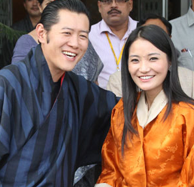
The king, who is 31, married 21-year-old student and commoner Jetsun Pema Wangchuck, whose father was a pilot with Bhutan’s national airline, Druk. The ceremony took place in the Punakha dzong, one of Bhutan’s most stunning buildings and a uniquely Bhutanese combination of religious and administrative offices.

Following the ceremony the king and his new bride took more than 10 hours to travel back to the capital, stopping continuously along the way to meet their subjects.

The Bhutanese revere their royal family. They believe they have every reason to do so. Not only did their fourth king voluntarily give up his power as an absolute monarch but the dynasty has also managed to steer Bhutan along a relatively peaceful path, sandwiched as they are between China and India.

The population is also justifiably proud of its kings being instrumental in Bhutan being renowned as the only country in the world where Gross National Happiness is regarded as more important than Gross National Product. Policies to conserve and nurture Bhutan’s forests, wildlife, culture and spiritual heritage are also regarded as being very much spearheaded by the royal family.

One of the few really serious gaffes a visitor can make is to in any way criticise or make jokes about the royal family.

The closest to any levity surrounding the royals is that the present king is sometimes referred to as K5 and his father as K4.

While I was in Bhutan recently, in the central Bhutanese valley of Jakar, the royal couple had also been in town. It was impossible not to get caught up with the hype as everyone wanted to see their new king and queen on what was an informal walkabout of the town centre. Even a few staunch Kiwi republicans were unable to resist.

We’d already seen the king earlier that day, enjoying a little time out. A keen mountainbiker, he had been cycling up towards the 2900-metre-high Kiki La (Kiki Pass), two companions riding just slightly behind him, jeeps with flashing lights in front and behind. Apparently he cycles in the hills around Thimpu most days, often followed by a bevy of bikers, which is doing wonders both for fitness levels in the capital and in the promotion of cycling as a sport.

Jakar has suffered two catastrophic fires in recent times that destroyed much of the central business area and the king and queen’s walkabout gave them a chance to visit shopkeepers who were now back in action.

We were standing on a street corner, along with a gaggle of giggling school kids and under the relaxed but still watchful gaze of the royal bodyguard and local police, when the couple emerged from a general store. The king was holding his bride’s hand. Physical displays of affection are not common in Bhutan so this gesture is significant, and, say some locals, has started a whole new trend.

The king, as befitting his position, was not only in traditional dress, complete with magnificent handmade knee-high boots but had a golden yellow kabne (a large ceremonial shawl) draped over one shoulder. The queen was in a multi-coloured khira and high heels. They walked towards us, pausing as they came alongside. “It is very nice to see you in Bhutan; thank you for coming,” the king said. We’d been carefully schooled not to take photos or otherwise make spectacles of ourselves so possibly their highnesses’ lasting impression, should they have one, would have been of a group of rather scruffy tourists (we’d been out walking that day) grinning inanely at them.

The rest of the retinue swept past, including various local dignitaries with silver swords strapped to their sides. Our last sight of the king (the supreme protector of the people; the great elected one; the upholder of the law) and his queen, was them popping into another shop, while a policeman shooed away the ubiquitous stray dogs that had been sleeping nearby.

Courtesy : Stuff.co.nz