Time To Excel To Erase The Label We Were Given As Refugees – “Shallow And Empty”

Such were the times. “You will stay in the caves in the nearby jungle until we come to fetch you.” With this solemn decision, my mother’s course of life was forever changed. 

It was in the early 1960s and the government of Bhutan, having just been hit with the realization of the significance of modern education, was sending recruiters to enroll children in schools. 

That fateful day, word had reached the hermitage of my grandparents in the remote eastern Bhutan that young children of the village were gathered to be taken far away to a place called “ischool” [school] where they would be taught to live like foreigners. 

The idea of a girl being rooted out of a domestic sphere to read and write alien subjects was incongruous and they felt that it was their filial responsibility to protect their daughter from this precarious encounter of modernity. Her parents deemed that she was saved from the vices of the outside world, but she would have to live with an eternal self-questioning of “what if?”

This is not just my mother’s story; it is a shared experience of many. 

Times have changed to such an extreme that the once unattainable education is now depreciated to a mere appendix whose reliability is doubtful, and its need questionable. 

“What is the use of education? I make the same money or maybe even more than my colleague who is a college graduate.” This is a common attitude of many nowadays. 

What makes it grimmer is that this attitude is prevalent in my own community here in the USA, and it is more painful when it comes from fellow women. These words instantly delegitimize centuries-long cries of advocates who have been fighting for rights to education; women have cried harder. 

The eighteenth-century Mary Wollstonecraft to Malala Yousafzai in the present have been championing similar belief that social progress will be achieved only through the education of women.. Besides, such a mindset of money-equals-education does not even align with either our background or our present contexts. We come from a culture where learning is worshipped, to a point where it is blasphemous to even stamp our feet on a written word. 

This paradox is further perfected by the fact that if our elders are asked the reason for moving to the USA, a unanimous answer is “for our children to have better education.” 

Joining a college still remains a far-fetched dream to many in the parts of the world from where we come.  Yet the loud defense now is that Bill Gates and Steve Jobs did not need education to reach the heights they have scaled. What is not considered here are the countless hours they have spent to master their skills and the volumes of knowledge and information that they have absorbed before their ingenuity spilled open. And most of the time, for such individuals, money is not even the end goal. 

Money is a by-product of excellence, but excellence does not occur in a vacuum. Education is one reliable path which will lead to excellence, and therefore should not be taken for granted. Scientists, priests, businessmen, kings, sportsmen, artists, scholars, parents…name anyone and everyone’s true end goal is excellence, and hence their emphasis on education.

Times are changing. Education is no longer bound in the concrete classrooms. Online classes and digital learning bring classrooms and teachers to you.  Information is shared in a nano-second and a touch of a button on our phones and computers can unlock a world of books and articles. Gone are the days when women had to bribe their brothers to access their books and when women writers adopted male pseudonyms to publish their writings. There has never been an easier time to excel. The once unattainable education is now in our hands, becoming an integral part of us. 

We, former refugees, should know first-hand that it is only with education that our faculties will be strengthened so that we do not once again succumb to subjugation of any kind. Education is the only peaceful answer to silence and a means to eventually overcome any level of oppression, whether inflicted by an individual, group, government or system. 

It is only with education that we can erase the label we were given as refugees – “shallow and empty”. As new citizens of a country that has given us the right to nationality, let us establish our Bhutanese-American generations by exercising the right to education and celebrating the privilege to learn, instead of shutting ourselves in the caves of ignorance.

Allow me to end by congratulating the Bhutan New Services for the relaunch and also by extending my deepest appreciation for keeping our collective voice from being stifled by the changing times. I also call upon for more female readers and writers to contribute in making this voice heard, not just louder but wiser and better represented. Our social media platforms highlight the Bhutanese diaspora with pictures of ourselves in the best of costumes, enjoying the most succulent of delicacies, and dancing to the liveliest tunes; let us likewise channel our energy into discussions of ideas, sharing of stories, and disseminating of learned information. Let us prove that we have prospered, not just in wealth and quality of life, but that we have excelled in our thoughts, words, and actions.

__
One of the columnists for Bhutan News Service, the author is currently a PhD candidate at Georgia State University, specializing in Victorian Literature with a focus on women authorship and readership. Her next column is due in December. Views expressed here are those of the author and not that of BNS.

COVID-19 Got Me; Don’t Let it Get You

26,644

I recently tested positive for COVID-19 and I am recovering. As I write my first blog post for BNS, I am actually confined to my cozy room. Thankfully, my room has a dual-monitor setup for work and an Xbox for fun. I recently also got a reasonably fancy external microphone that I am testing to record podcasts for BNS while I isolate myself. 

I also have my beautiful [younger] sister in the next room to scream at when I need something. Yet, sometimes I suspect she pretends to not hear me when I give her a shout because I can hear her Instagram and Snapchat notifications going off. I think she is aware that I am recovering fast and screaming at her for no reason.

A few weeks ago, my mom tested positive for COVID-19. She isolated herself from the rest of the family for 14 days. Thankfully, her symptoms were not severe, and she recovered quickly. As her isolation period came to an end, I started feeling fatigued and had a mild sore throat. At first, I thought I was being paranoid. However, it was confirmed when my test result came back positive. At the peak of my symptoms, I had a fever and sore throat along with sneezing and coughing. It has since subsided quickly, and I am feeling much better now. Luckily, my father and sister tested negative and have not shown any symptoms yet.

I think this experience has taught us to be extra cautious, especially for when our isolation ends. None of us want to be locked up inside our house for more than two weeks again.

It also serves as a lesson to those who are not taking this pandemic seriously.

Early on when the virus had just entered the United States, my dad would question whether the pandemic was real or just a media hype. I did not have an answer, but l I knew we needed to start taking precautionary measures.  

The last global pandemic was the 1918 influenza also known as the Spanish Flu. It was unheard of in my parents’ lifetime. So, I understood their disbelief that a pandemic could bring the world to a close-to-complete halt. Even I was unsure of what to expect in the ensuing days.  

One typical day in March, when we entered the Costco parking lot, we saw a man pulling a flatbed cart full of supplies. When I say “full”, I mean it was likely a few feet tall pile – consisting of dry food, meat, chips, cleaning wipes, toilet paper, paper towels, dish washing liquid, water bottles, and more – and he was pulling the cart behind him with both hands. 

We steered our eyes around the parking lot and saw everyone else doing the same. It suddenly felt real and imminent. All of our disbelief and doubt over the pandemic was thrown out of the window. We grabbed some basic essential supplies – just enough to last us a month or two – and left the retail store.

“Wow, I never thought I would see such chaos,” said my dad – the shock was palpable on his face.

It has been six months since that incident. Back then, we believed the modern scientific community, backed by advanced technology, would bring this virus to its heels at its earliest. 

Sadly, that did not happen.

My parents were laid off from their jobs for five months. I continued working from home – I feel grateful that I am able to do so. My sister’s plans to start college life on campus was postponed, and it additionally gave her more opportunities to steal my share of ‘chatpate’. 

A bit of normalcy returned for my parents when my mom was called back to work in late August. However, the normalcy was short-lived, and the pandemic got my family. It has proven it can be lethal unless we take proper measures. Let’s keep ourselves mentally and physically healthy and hope that we can all sit around the table with our extended family and friends and have a proper meal as soon as possible.

Please know that this pandemic is real. COVID-19 is real and it has spread wide and far. It has already taken hundreds of thousands of lives. COVID-19 will not take me because my future blog post is due soon and I’ve a lot of other things to share.

But, I beg you to be serious about COVID-19 because this is real. And it has taken so many lives already! 

A Global Example Of Community Media Best Practice

26,644

For a media organisation to be successful it has to know its audience and what interests and concerns them most. 

It also has to understand how to explain local, national and international events in a way that relates to the lives of that audience.

The Bhutan News Service (BNS) has been doing this for 16 years – from the humble beginnings of a team of volunteer journalists working in a refugee camp in Nepal to a global community media organisation providing a unique and powerful perspective on Bhutan and the lives of those who have left the country.

I have been honoured to have been asked to help BNS at several stages along that journey as a friend, colleague, consultant, and trainer by offering advice and guidance on a voluntary basis.

Media is a business. It involves defining an audience, working out what content they value most, establishing how to create that material in order to ensure that the audience returns time and time again, and creating a revenue model based on advertising, sponsorship, subscription etc to pay the bills.

But BNS is different. It is a close-knit community media organisation with a world-wide audience. And, because of the emphasis on community, everyone involved in the production of BNS knows their audience intimately. They have grown up with them, lived with them, and travelled the same journey as them. They know, at every level, what that audience has been through and what they feel. And, although making money is essential for maintaining BNS, it is not the primary driving factor – serving the community is.

BNS will never dumb down. There will never be clickbait on BNS. The journalists will never exaggerate the facts in order to promote the news. They will never exploit interviewees to obtain a sensationalist headline.

The news produced by BNS will always be well-sourced, based on solid evidence which has been fact-checked and tested. It will be published with the sole intention of informing the public debate so that the audience can make educated choices.

Everything published on BNS will be accurate, fair, objective, and impartial. It will cover life as it is while always seeking to find out why an issue is important. And it will set out the elements the audience needs to know about in order to enhance understanding.

Because all involved in BNS have a commitment to delivering ethical journalism to its audience, BNS will never deal in gossip, rumour, or so-called fake news. All such elements are part of the news-gathering process, but BNS has a rigorous system of checks and balances in place in order to filter the facts from unreliable material that some news organisations might publish without a second thought. 

The editorial process involves producing several types of news. There will be breaking news, developing news, in-depth investigations, other stories worth archiving for future generations, and everyday community news. All are handled differently, but all are underpinned by the same editorial values.

BNS is an independent media organisation free from political ties or outside influence. Its aim is to seek the truth, deliver the facts, and offer context and analysis where appropriate while remaining non-judgemental, objective and fair. In all cases BNS strives to include all relevant opinions and ensure that no significant strand of thought is neglected.

Most important of all is the commitment of BNS to create a conversation with the Bhutanese community about the issues that matter to them and to enable maximum participation so that the output of BNS accurately reflects as diverse a range of perspectives as possible. 

BNS aims to be a listening media organisation that deals with and reflects the issues that most concern those it serves. In that light, the BNS editorial agenda will always be set by the community which the media organisation aims to serve without fear or favour.

And because of this, BNS could well be a unique model – content created for the community, by the community, for the benefit of the community.

The relaunch of BNS takes that altruistic spirit to the next level by demonstrating to the world what a global, independent, community media organization can become.

___
The author of this piece, David Brewer, is the founder and editor of Media Helping Media. He has been supporting, mentoring, and training some of the managers and younger journalists at the Bhutan News Service since the beginning.

The Unending Marriage Journey

26,644

“Oh look out there, look out there, a bride has come, a bride has come”, and everyone from their houses rushed to the patios to look at the new bride in the marriage procession. That would be a typical scene in early traditional marriages in remote villages of Bhutan. Mine was no different. 

I was seven years old and my groom was 13 when we got married in Badarey Village in Chirang, Bhutan 79 years ago. I could barely remember my marriage but certain things always stand out in life forever.

I still remember that one of my cousins poked fun at me by twitching my back when I was being carried by my father as a bride. I will never forget that incident and the teaseful conversations. I didn’t know for sure why we were married so early in life in those days. 

sabita pokhrel
Sabita Pokharel.

Even our parents couldn’t explain the reason as they simply followed tradition. However, as I grew older I began to learn from educated people that early marriages in those days were conducted to protect young girls from the capricious outreach of the rulers in India where the tradition originally started.

It probably started many many years ago as a safety shield for the young girls from forceful conversion, and marriage provided that sense of security as those militants didn’t want to take married girls. Though such incidents never happened during our time, our people carried over the same tradition. That tradition is outdated nowadays, and I use this as a moment to tease my grand-daughters who respond with funny faces.

We were not sent to our husband’s house before the age of 13. Until then, we stayed with our parents, whom we called ‘maitalu’(married daughters staying at parental home instead of with their husband’s family). I was 14 when I formally joined my husband’s house. There were around 12 people in the family already. It took a while for me to know everyone by relationship and cope with the duties and obligations of a Buhari (daughter-in-law).

I was groomed by my parents during my ‘maitalu’ days in regard to my duties and how I should act or who I would be in the new family. A daughter-in-law’s life was rather hard, not just in terms of physical work we had to put in but also in terms of the role we played as a ‘buhari’, an identity that is a lot to handle and shoulder.

The remote village of Badarey where I was born was also where I was married, but my future husband came from another village called Bokrey, close to Damphu Bazaar. I remember my groom to be a handsome 13-year-old boy dressed in traditional daura-suruwal and Feta (Nepali traditional costume).

Many of my peers were also married and the sight of marriage parties and procession was something nobody in the village wanted to miss. We were innocent and never felt shy. And we had fun with the people who joined as ‘janti’(invited guests for attending and escorting bride and bride-groom),  and who had their own fun stuff to do to make marriages interesting and memorable. The songs, traditional music called ‘panche baja’ and a big buffet (bhater) of rice, pulses, dairy, and goat meat (Jantay Bakhro) were all part of the wedding in those days. Janti would line up in the open field, either khet (wet field) or bari (dry field) and eat a feast.

My handsome and loving husband passed away in 2013. I miss him badly. My husband, Badri Nath Pokharel was a hard-working man and a great human being, and reflecting on my early marriage I feel proud of him for finding the right person. I never heard him saying ‘no’ to any one. He loved helping people during his free time and never expected anything in return. He was also a devout practicing Hindu and his religious and spiritual pursuits were very deep and exemplary.

When I look back and tell the story of my life and marriage to my grand-daughters they look at me in disbelief as if I am an alien. They think that the stories related to my marriage are fairy tales. My little grand-daughter one day asked me if I had a picture of my wedding. I smiled and said, “it’s all in my head.”

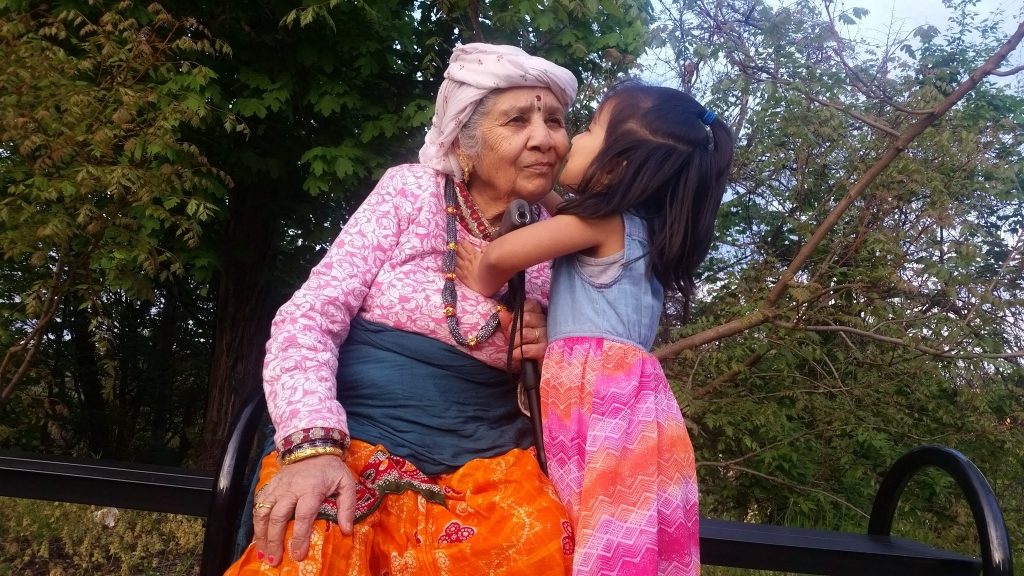
Granddaughter kisses Mrs. Pokharel

I had eleven children; six sons and five daughters. I’ve lost two daughters and a son. I am glad that most of my surviving children are here in America, except for the oldest son who is still in Bhutan. I wish he was here as well. I desperately wanted to meet him and his family one day before I die. 

I feel deeply proud to be a grandma of 30 grand-children and 35 great grand-children. My wedding saga that started when I was barely seven years old makes me feel that my grand-daughters are lucky these days in many ways. I am glad that I have been living this long to experience everything in between and share my wedding story. 

Although my husband is no more physically, I feel that my marriage journey, in reality, hasn’t ended because I still dearly love my husband. I am sure his soul continues to bless me and others in our family. 

Decoration Of The Peoples’ King

26,644

Two monarchs, who could neither secure the population nor the land area of a small nation that they rule, are at a push to own the glorious title of ‘the Peoples’ King’.

The story is about Bhutan, a 21st century kingdom in the Himalayas, and the two monarchs are His Majesty Jigme Gesar Namgyel Wangchuck and his father, His Majesty Jigme Singye Wangchuck. 

His Majesty Jigme Singye Wangchuck, born in 1955, began the reign in 1972 after his father’s demise. Two years later he became the fourth king from the Wangchuck Dynasty that had started the monarchical system in 1907 after a sequence of bloody battles and with the patronizing support of the then British India. 

His Majesty Jigme Singye Wangchuck continued the initiative of development activities to modernize the country, which was started by his father, the third King (Aris, 1995). He traveled nooks and corners of the country and also established friendly relations at an international level.

The country saw a rise in education, health and infrastructure at an unprecedented level. He was the citizens’ king by action and there was no need for decoration. 

However, a small group of people insulated him from reality, coercing him to take up a feudal and communal drive in his future approaches. He began to represent a small Ngalong tribe to which his dynasty is said to belong. 

Most cabinet members and advisors came from the group who used him to enforce every entity of the Ngalong tribal group as the national – language, culture, costume, custom, etiquette, myths, and beliefs. They pushed all other groups, big and small, toward assimilation through a forceful imposition of Ngalong chauvinism.

The royal government had evicted approximately 15 to 20 percent of the total population that they perceived as their potentially competent competitors through the state-sponsored terrorism. The peoples’ ultimate trust in their leader vanished.

The government distributed the land and properties belonging to the evicted people to those who assisted in the eviction. The government assisted the resettlement with loans and grants to establish its supporters in the evicted land. 

The initial idea was to make the resettled people dependent on the government for their survival and reciprocally have their loyalty. However, most resettled people could neither settle well nor have their increasing expectations met. 

The people favored by the monarchy are not loyal anymore. Now they know that the government has resettled them in the land made vacant after evicting their original owners. 

Less than fifty percent of the Ngalong people that comprise about 16 percent of the total population are happy with their king and his anti-people activities. The few who benefited from the eviction and their loyalty to the throne, and others who are partners in the crime, are still supportive of the system. 

Between 2005 and 2008, there was a transition in the country brought with the effort of His Majesty Jigme Singye Wangchuck. The government encoded the existing practices into a constitution and introduced a two-party system. They lifted the ban on the use of the words ‘democracy’ and ‘political party.’ 

They asked the people to choose one of the two political parties approved by the king. Citizens queued to take part in the election while the people who originally demanded democracy were languishing in prisons for their audacity of demanding it before the king had understood its concept. 

Since then, the government started publishing the map of the country, reducing its area and excluding important parts of the country from the map. His Majesty Jigme Singye Wangchuck, who was trusted as the most powerful person in the country, could neither contain the population and their demands, nor protect the land. 

In 2003, the king led his soldiers to exterminate fugitives, from neighbouring Indian states of Assam and Bengal, who were hiding in the forests of Bhutan. Any person not safe within his or her country seeks protection from neighbors. 

However, the King of Bhutan, who sided with the Indian government, went to the fugitives’ hideouts and resorted to merciless attacks. The relatives of captured, extradited, and assassinated fugitive neighbors have their grievances to pay back. 

His Majesty turned from the citizens’ king to no one’s king from his action of communal and feudal approach to solving the country’s needs. He handed partial power to his son, His Majesty Jigme Gesar Namgyel Wangchuck by making him the fifth king from the dynasty. 

Till date, the fifth King has done nothing exemplary or anything wicked. He appears in public as being good to the children and the senior citizens. He seems to have an inferior complexion before senior bureaucrats and diplomats. 

To compensate for the loss of the fourth king’s aura during his latter part of his reign, they have conferred a decoration of ‘Peoples’ King’ on the fifth king without a single action worthy of the title. To uphold the decoration, they renamed a university and few other infrastructures with his name. They display portraits of the royal couple, often with the prince in public places instead of hoarding boards. 

The future will tell if His Majesty Jigme Gesar Namgyel Wangchuck can keep the prestige of the decoration throughout his reign and ever after.  

___
References

Aris, M., (1995). The Raven Crown: The Origins of Buddhist Monarchy in Bhutan. Serindia Publications. ISBN13: 9781932476217.

Kuensel, (2018a). The People’s King is Thirty Eight. Kuenselonline, February 21. Thimphu Bhutan. Retrieved from https://kuenselonline.com/the-peoples-king-is-thirty-eight/

Kuensel, (2018b). Coronation of the People’s King. Kuenselonline, November 1. Thimphu Bhutan. Retrieved from https://kuenselonline.com/coronation-of-the-peoples-king/

__
Govinda Rizal is the author of “A Pardesi in Paradise” and one of the long-time contributing authors at this news portal. He can be reached at: [email protected].

COVID-19: Health Talk With Bikash And Kumari

26,644

Right now it is more important than ever that we think positive and try to
boost our overall health. “ Health is a state of complete physical, mental
and social wellbeing (WHO, 2020).” Healthy lifestyle habits will
turbocharge your mind and body. For your benefit each month , Bikash
and Kumari, nurse practitioners and health care promoters, will share
their insights on healthy living. These podcasts will help you to make
self care and a healthy lifestyle your priorities. If you want to learn more
about healthy living and primary prevention, this podcast is for you.

Life and Death In Pandemic: Karkala Ko Pani

26,644

Karna Gurung from Nebraska describes his experience in hospital bed fighting with COVID-19, 33 days in comma. He is back to normal life recuperating rapidly from the illness. He describes what life meant to him after he succumbed to Corona virus.
He says, life is a blessing from God, and we are all interconnected to the universe.

26,644

I think I was 20-22 years old when I got married. Although my marriage is both special and unique, many others may not believe it. One day, I had spent all my morning chores working in my crop-land, and I returned home drained looking to eat lunch. Januka, 16-year-old then, had come to my house with a firm proposal to marry me. Indeed it was her second marriage. I was single. Januka told me that her mother wanted her to leave her other husband, a gentleman with the last name ‘Siwa.’ I do not want to disclose too much details about him. I learned that Januka’s mother recommended that she leave that ‘Siwa’ and elope with me. She [Januka] was my elder sister-in-law’s sister. Indeed, Januka and I grew up together as neighbors in Dallayni, Chirang district. That day, she [Januka] insisted that she wouldn’t leave my house. She said she no longer wanted to be with that ‘Siwa’. She asked if I would accept her as my wife. I readily accepted her proposal. I think she was married to that man [Siwa] when she was nine years old. You can ask her if she remembers anything. I doubt she does. But since I was a bit older than her, I still remember her age at the time of her first marriage. She [Januka] had been with ‘Siwa’ for seven years before she married me. Although repercussions from her ex-husband were equally possible, I did not fear it; I don’t know why. Maybe that has to do with my age back then. There were no repercussions whatsoever. It was a big sigh of relief for me, and probably for her as well. Since then, we’ve stayed as a blessed couple – we have 13 children together.”


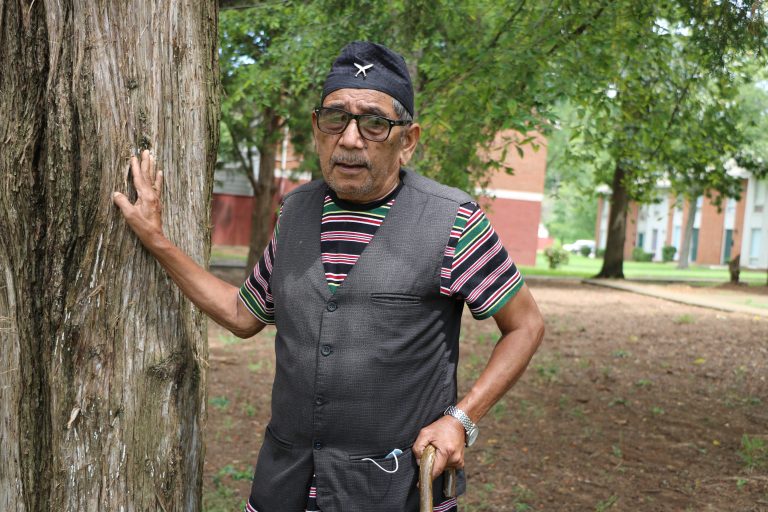
Man Bahadur Darjee, 78 is originally from Chirang, Bhutan and based in Charlotte, North Carolina at the time when this story was compiled.

Story and Photo compilation by TP Mishra for BNS 

26,644

“I do not remember much of my marriage. I was just seven when my father decided about my marriage. It was the prevailing custom. I did not know what was forthcoming. At the age of playing with mud and sticks and with goats, I and two of my cousins got married. I was born in Goshi. After marriage we were taken to Deurali, a small cluster of houses at higher elevation than Goshi. Even though marriage occurred at seven, I was actually taken to my future home at age 13. It was a matter of shame for us to look at the groom’s face, so I didn’t even know what he looked like. My cousins and I were married to two brothers of the same family. My two cousins married the elder brother and I got married with the younger brother. The marriage occurred on one auspicious night (एउटा लगन) for all three of us. That whole night we were in front of the sacred fire- maybe we got the warmth and played. I vaguely remember that we often got out of Jaggay (जग्गे) and ran to our favorite places. It was only later, maybe a year or two that I knew of his name- Bhagirath. But I still not clearly remembered whether he was called Bhim Prasad or Bhagirath. Forget about looking at the face. When the groom’s family came to us after five years of our marriage, we weren’t prepared to leave our parental home. I think I was towards the end of thirteenth year when I went with my husband to Deurali, his house. And in the future home, life was tough. My mother in-law was famous for her vocal and strict nature. All three of us really underwent that penance of women’s life. Life in Dagana was a drudgery of domestic chores-milling grains, attending to small children, tending cattle, plantation, harvesting, hauling fodder and firewood. Not having knowledge of the conjugal life, without much sharing and knowing each other, my husband died when I was just 24. Mostly he used to live in goth (गोठ) in the forest with a large cattle herd. One day he came home saying ‘I am dying.’ Not knowing what illness caught him, I had no way for treatment except the local shamans. He  bled profusely. On the fourth day, he died. And I was left alone with two children, five and three years old and one still in the womb.”

__
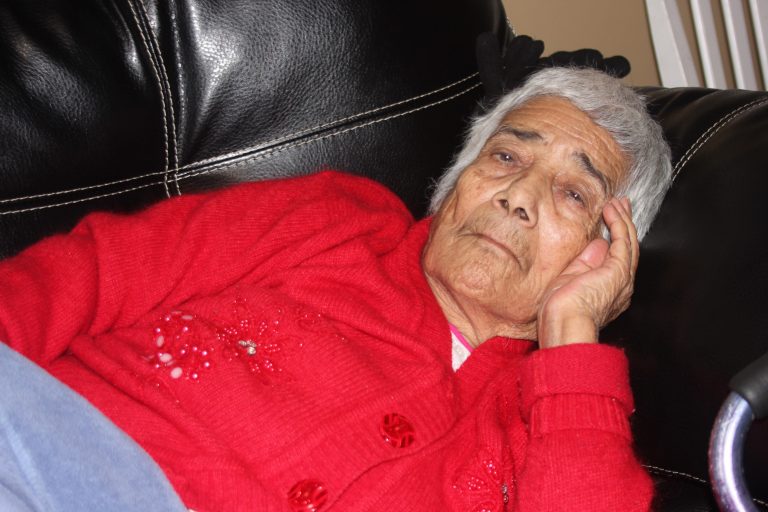
Dikura Dhakal, 88, is originally from Samrang village in Samdrupjongkhar, Bhutan, and based in Louisville, KY at the time when this story was compiled.

Story and photo compilation by Buddha Mani Dhakal for BNS

Birkha Rai

26,644

“I was twenty-four and my wife was sixteen when we got married. My wife and I lived in the same village block called Patale in Bhutan’s Chirang district. Our houses were close to each other. I frequented her home and she mine, and so did our families. There was nothing special about our interactions — it was always platonic. This continued for the next two or three years. We never thought anything would change. One typical day the possibility of us getting married was brought forth to us. My mother died when I was only three-years-old. I didn’t have brothers or sisters. I grew up an orphan. After seeing my struggles, my now-in-laws suggested that I marry their daughter. Fellow villagers followed suit and encouraged me to get married. I wasn’t exactly interested in getting married. I enjoyed my lifestyle as a bachelor, but some of these advice came from my dearest friends and family. So I began reflecting and realized they were right. I would eventually need to get married. I began feeling like if I did not get married, I would face more challenges in future. That’s how I got married. It wasn’t a love marriage, nor did we have to marry in secret by eloping. We Rai(s) have our own set of rituals and customs, and weddings are always held according to the Rai traditions. Before the wedding, my uncle and I went to the home of my bride-to-be with a special collection of homemade alcoholic beverages to ask for her hand in marriage. We already had her parents’ informal approval so going to her home and asking for approval was just a formality to appease Rai customs. The wedding day transpired quite nicely. I went to her house with a large groom’s party, or what we call janti. When I saw her at the wedding, I suddenly realized I was trapped — ha-ha — it would’ve been awkward to back out then since I had already seen her and agreed to marry her. Once we got married, there was even more pressure to take care of her and our family. I was no longer on my own and had to consult her for everything. A year and a half into our marriage, my wife gave birth to our precious son. Sadly, he passed away. It was a difficult time. But now we have seven children, who have all grown up to be adults and some even have their own families.”

__

Birkha Rai, 60, is originally from Patale Gaun in Chirang, Bhutan and based in Hartford, Connecticut at the time when this story was compiled. 

Story and Photo compilation by Susanna Pradhan for BNS.