Why We Must All Help Bridge The ‘Generation Gap’

26,644

‘Children now love luxury, they have bad manners, contempt for authority, they show disrespect for elders and love chatter in place of exercise. They no longer rise when elders enter the room. They contradict their parents……’

And so it goes on. Another attack on the ‘youth of today’ for shunning the values of their parents, values which had served the elderly well and framed their behavior. But these words are not actually a 21st century moan, they are almost 2,500 years old. They are part of a scathing observation of the younger generation by Greek philosopher Socrates. It seems that what is called ‘the generation gap’  has always existed.

But, of course, we know this is not really the case. The concept of the ‘generation gap’ was quite unknown to Bhutanese culture not so long ago. Now our intellectuals mull over the topic at length as our young people demand greater understanding and recognition of their differing roles in a changed society.

The term ‘generation gap’ was first used in the 1960s when youth culture in the US among the so-called ‘baby boomers’ stopped heeding to their parent’s beliefs and wanted to shake away anything they followed. Youths have often railed at the values of the older generation but this was much more far-reaching.   

Taking the ‘generation gap’ to represent a biological phenomenon, a mental disposition or a cultural divide, confuses things and it clouds our understanding. The practice has been to make cultural comparisons in the name of the ‘generation gap’ instead of viewing it through comparisons of age. Age is biological, and behaviors and attitudes are cultural. To compare age to attitudes is like comparing apples to oranges. 

A biological ‘generation gap’ would compare age, hormones, body hair, muscle mass, wrinkles on the face etc between people of different generations. When we say ‘you are young or you are old’ it is based on such comparisons in the order of natural age. And, this is perfectly fine because generations are not required to meet together; since the chronology of biological procreation naturally sequences them apart into different age levels. 

Despite such differences in biological age, human history has long been a journey of generational continuity undisturbed by time and circumstances. That is to say, that generations have never stopped existing since antiquity nor is there anything called a ‘generation zero’. 

The young generation was always there to lead the recovery and they always came out stronger than before. Therefore, with age strictly as the criterion, it would be unwise to say that such a thing as a ‘generation gap’ exists. That is my argument. 

However, we shall use the widely accepted anthropological explanation of the ‘generation gap’ in our analysis, which is that a ‘generation gap’ is the difference of broader values and belief systems, perception, ideas, actions, behavior and opinions, social attitudes, social norms, morality and patterns of culture; closely held by one generation of people from those held by others especially between generations. This is strictly a culturalist view. 

My argument is that such cultural differences are self imposed and dictated more by exposure to modernism, development and technology than by age or biology. For example, among the lesser known societies such as Australian aborigines, who lived under the same conditions for generations, and in agrarian feudal societies where the occupational nature of the people remained unchanged for centuries, there was little in the way of culture to divide the generations. That all changed with the advent of new technologies. Therefore, in a nutshell, the ‘generation gap’ actually seems to be a generational cultural difference caused by the technology gap and nothing more. 

That said, each generation leaves behind its own trending culture, cognitive behaviors and vernacular lingo which impact society at large. Younger generations usually step up and carve out their own cultural niche. The way these generations interact and invest in their environments precipitate a lot of cultural contrasts in their experiences and outlook towards life. 

Across the cultural landscape, older generations tend to hold conservative views about the pressing issues of society, such as morality, religion, marriage and abortion etc. Short skirts and long nails on girls and young men’s ponytails irk their nerves; not to mention of night clubs, gay rights, same-sex marriages and drugs etc. 

Flanked by technology and table opportunities, the young generation are generally not interested in the moral codes of the traditional generation, their values and priorities. They tend to live in nuclear families and are generally more open to liberal views on critical subjects such as marijuana legalization, drugs and LGBTQ issues etc. They are then likely to gradually grow conservative as they age but this change is understood, as Churchill said, ‘if you’re not a liberal at 20 you have no heart; if you are not a conservative at 40, you have no brain’. 

According to a Times article the ‘tastes of millennials have shifted the culture, and their enormous appetite for social media has transformed human interaction’. That seems true because under the new generation, the organic community of their parents and grandparents has metamorphosised into an ‘online’ community. 

The ‘generation gap’ in Bhutanese society was unknown until after their resettlement and the creation of the Bhutanese Diaspora. In the good old days, the southern Bhutanese people lived in extended families of two or three generations, consisting of grandparents, their children, and their children in the same household. Each generation tilled the land, looked after their cattles, spoke in their own mother tongue and participated in community rituals. Elders provided wisdom and their role as head of households was never disputed. 

There was respect, loyalty, unity and an understandable social order in the family. What was learned determined what they earned, as such people were unaware that such a thing as a ‘generation gap’ even existed. The situation today has sharply transformed under resettlement with the ‘generation gap’ suddenly plucking our minds, from nowhere to everywhere. 

In reality, the elder of the Bhutanese refugee generation has not faltered. Given the reality of struggle and the circumstances of time and the choice of whether to focus on the ‘movement’ or to focus on the future of our younger generations, we chose our younger generation, hoping that if we did not succeed in our ‘movement’, the young would one day carry the same torch of freedom and question our perpetrators. We did the best we could.

The opening up of schools initially in Maidhar and subsequently in all seven refugee camps was the best of anything that could have happened in exile. We provided an education in the English language no less comprehensive than in any English boarding schools in Nepal. The initial effort was single handedly led by the Student’s Union of Bhutan until organized support arrived much later. 

Our educated youths volunteered not only to teach but to transport borrowed raw materials and weave straw roofs so we could put up a crude structure which we called the first refugee school in Maidhar. The seed for the making of our young PhDs, doctors, engineers, lawyers, other intellectuals and literates today was laid long ago in the sands of Kankai Mai. That is not a small achievement. 

This would not have been possible without a culture of help, which allowed us to escape the perils of the so-called ‘generation gap’. Even though I was not a direct beneficiary of this school system, I rise here, along with others, to salute and credit all those unforgettable souls – the unsung heroes of our camp schools.   

That said, the ‘generation gap’ does seem to have penetrated our diasporic community at the micro-level. Language and household culture seem to be in the doldrums. Inside some households the grandparents speak in their mother tongue. The grandchildren, especially in the American context; either due to birth or upbringing, speak English. Much of the time, it is observed that the ‘middle generation’ of the family have to act as language brokers between their parents, and their children. 

Alongside this, the extensive use of technology among the younger generation divides the generations. The older generation live in the analogue world while the younger generation have embraced the digital world. One female in Charlottesville, Virginia told me that her kids do not ‘interact with their grandparents anymore; they have become ignorant of their culture and language’. The natural bond that used to exist between generations seems to be quickly disappearing. This is a serious indication of a shifting culture. 

This is a new space and an opportunity where our new generation are best placed to lead the intervention by volunteering to help the senior generation out of the technology darkness. My son helps me with computers just as I used to help my parents read hand written letters when I was young. Youth and technology seem to make a happy partnership. It would be helpful indeed if they used this advantage to mitigate the ‘generation gap’ within our households. 

Talking about ‘youth participation’ in general, especially from the point of social leadership, is just too vague. We need to identify who we are talking to. 

Basically, in our society, youths may be grouped into three broad categories – the ‘shining’ youths, the ‘sailing’ youths and the ‘selling’ youths. The shining youths are talented and outstanding. They shine without guidance. After all, the senior leaders of the generations before them, our first responders and our fire-fighters during a time of great crisis, were also self made individuals. Then there are the exact opposites, those youths who in spite of guidance or help will never improve. It is useless to try anything with them. This is our ‘selling’ youths; our spoilt generation. They have sold themselves to all the bad things out there. 

Lastly, there is the overwhelming majority in between these two polarities, the ‘sailing’ youths or the dormant lot. These are old buds who failed to blossom. They are just sailing cluelessly but they have the potential to rise if touched upon by guiding hands and minds. They are the ones who need help. We don’t know who they are. Certainly they should be identified and they must also look outwards; so that the connection can be made and a new discourse begun.  

It is easy to blame others or to feel betrayed. But a ‘generation gap’ does not apply only to one particular generation or to one particular time. It works in both directions, runs in cycles and it cannot be addressed one way from above. The younger generations too have to push themselves and reach out to learn or to bridge that gap. It is an exercise in mutual reciprocity. Or, they can independently work on their own inner strengths and become the movers and shakers of this community. 

The older generation played their part, notably back in the days when even to venture out could take a risk of life, but they have always tried to give their one hundred percent, never less. Life has now changed for the better. Let us also recognize the fact that there will always be a new ‘younger generation’ than the ‘young generation’ who will ask difficult questions in the future. After all, who knew that the younger generation of Greeks which Socrates so derided would be illuminated by the likes of Aristotle and Plato.

So just wait. The 21st century is only 20 years old. You, the ‘young generations’ have a long way to go.

__
One of the columnists for BNS, the author contributed this long-read piece prior to his actual column which is due on November 1, 2020. Views expressed here are those of the author and not that of BNS.  

BNS Is A Critical Forum 

I am a researcher who works in collaboration with Bhutanese resettled in North America (both the US and Canada) to give voice to the refugee life experience of Bhutanese of all ages and highlight the strengths, needs, and concerns of resettled Bhutanese.

Currently I work to share the experience of older and elderly Bhutanese, illuminating the amazing strengths and resilience of Bhutanese to overcome the multiple challenges they have faced over their extraordinary lifetimes in Bhutan, Nepal, and now in North America. 

And I am glad to learn, as a non-Bhutanese, that Bhutan News Service has relaunched.   

Bhutan News Service is a critical forum for the Bhutanese diaspora to share their experiences and engage with one another, no matter how far apart they may live geographically around the world.

For instance, I was honored to be a part of Bhutan News Service sponsored webinars this past spring to discuss COVID-19 and the Bhutanese/ Nepali migrant community in terms of public health practices around social distancing, and strategies for parents to provide educational opportunities and good parenting to youth at home.  

These were efforts that included Bhutanese collaborators and outside experts from around the world; we were provided a forum via Bhutan News Service to talk about the most important issues affecting Bhutanese with a refugee life experience today and reach a widespread audience. 

I’ve learned a lot  from the Bhutanese community over the past several years.  I have learned the importance of valuing and honoring the past; embracing, privileging, and promoting the strength of your community; and aspiring towards the well being and future of all people that are part of your community.  This work can certainly be done within the space of a family, within a small geographical community, within the span of a country, and throughout the world.

Based on what I have learned, I ask these questions: What should we aspire to in terms of the definition of our collective experience and sense of community?  What are the boundaries of our relationships? What will help us succeed as a community?  In my work with older Bhutanese, one man in his 70’s spoke to our research team about coping with the death of his mother and wife when he first came to the refugee camps in Nepal after flight from Bhutan. He stated that his friends and neighbors told him, “This ‘earth’ is like this. Don’t feel bad; we are all under the same roof.  Let us eat what is being given; if they stopped giving, we will die if it’s the day for us to die.”  He added that these messages “satisfied his soul.”  

So now I ask, how can Bhutanese, spread around the world, maintain/build/recreate this ‘collective roof ‘ that provides support for the entire diaspora community?  How can the larger Bhutanese community provide a forum that ‘satisfies the soul’ of individuals and groups? We need a forum that highlights the experience of Bhutanese around the world and engages in important discussions and conversations that include Bhutanese of all ages.  

The Bhutan News Service is an opportunity, of course, to engage in these conversations.  I would add that, based on my experience as an outsider, it is imperative that the Bhutan News Service succeeds and moves forward to promote the vision of the success of Bhutanese around the globe.  

___
Rochelle L. Frounfelker is a Post-Doctoral Fellow in the Division of Social and Transcultural Psychiatry, Department of Psychiatry, McGill University, Montreal.

Yuva Ka Kura: Intro

26,644

Biraj and Susanna, both section editors for BNS, host this show to discuss various topics in and out of the community from the perspective of youths.

Bhutanese Stambha Nirman Samiti Announced

26,644

A committee named ‘Bhutanese Stambha Nirman Samiti’ has been announced on October 3, 2020 for the purpose of constructing a Bhutanese Refugee Memorial Tower (the name yet to be deliberated and finalized), at the site of the first Bhutanese refugee camp at Kotihome, Jhapa, Nepal.

The proposed site for the monument is also popularly known by the name Kankai Maai. The river bank had witnessed the malaise in series faced by the Bhutanese refugees in the early 1990s, and hundreds of lives comprising mostly infants, toddlers and elderlies were lost.

According to a press statement signed by Narayan Phuyal Sharma, spokesperson of the Samiti, the committee is formed under the convenorship of Dr. Bhampa Rai, a medical professional and dedicated Bhutanese social worker for decades serving the Bhutanese refugee community since the inception of the camps in Nepal.

“The committee is constituted with due consideration to the geographic and demographic composition of the Bhutanese Community in the diaspora,” added the statement.

The statement further added that the committee will collaborate with the local Nepalese committee in Kotihome, Jhapa that is executing a larger project of developing Kotihome, the site of the first Bhutanese refugee camp, as a religious and tourist destination.

“The Bhutanese Refugee Memorial Tower is an integral part of that larger development project and has to be erected within the physical space and dimensions agreed upon and allowed by the said local Nepalese committee,” reads the statement, adding- “An agreement specifying all essential details will be soon entered into between the Bhutanese Stambha Nirman Samiti, represented by its members currently based in Nepal and the local Nepalese committee.”

The statement further added that the specific details as to the type or content of the proposed memorial tower are yet to be determined. “The general understanding thus far arrived at is that the local Nepalese Committee will not interfere in the specific details or contents of the memorial tower.”

“The only condition thus far specified by the local Nepalese committee is that the said memorial tower must be physically contained within the bounds of the physical space provided. The proposed agreement between the Bhutanese Stambha Nirman Samiti and the local Nepalese committee shall also mutually determine the height of the proposed tower,” added the statement.

According to the statement, the task of constructing the ‘stambha’ will begin at the designated site as soon as the agreement is entered into.

“The memorial will be a tall symbol of our collective memory of being persecuted and its memorialization in history. Erected adjacent to the East-West highway, the tower, while attracting the attention of visitors, onlookers or passer byers, will perpetually remind that “injustice anywhere is a threat to justice everywhere.”  The memorial tower will be a solemn reminder of our collective history of being persecuted and evicted and it shall symbolize our shared aspirations for conserving our history,” read the statement.

The Bhutanese Stambha Nirman Samiti has also appreciated the gesture of the local Nepalese committee to allow the Bhutanese diaspora to memorialize their history at a place that provided them hospitality at a time of overwhelming distress in their collective life.

In a virtual press meet with BNS on October 8, where a select few committee members were present, Sharma further clarified that the committee has expected to fund this project with financial support from the Bhutanese diaspora.

It is reportedly learnt that details of the costs involved in this project is yet to be determined.

“The Bhutanese diaspora must treat this as an opportunity to consolidate their history through a physical representation. Being the first of its kind in the history of the diaspora, the committee anticipates a widespread participation and support of the entire diaspora,” said Sharma, adding- “The committee commits to inform the Bhutanese diaspora on the details of the work on a consistent basis as and when progress is made on the matter.”


Tumbe Hang Limbu’s Akshyarharuko Dhrubikaran Released

26,644

Veteran Bhutanese writer Tumbe Hang Limbu has released his third book entitled “Akshyarharuko Dhrubikaran” amid a virtual event organized by the Literary Council of Bhutan. The book is a collection of poems.  The event was hosted by Sancha Man Rai from Pittsburg Pennsylvania and moderated by Rup Narayan Pokhrel. The virtual event was attended by various literary artists around the globe. More than eleven poets recited their poems and congratulated Limbu for his book.


Australia Aid To Bhutan To Fight COVID-19

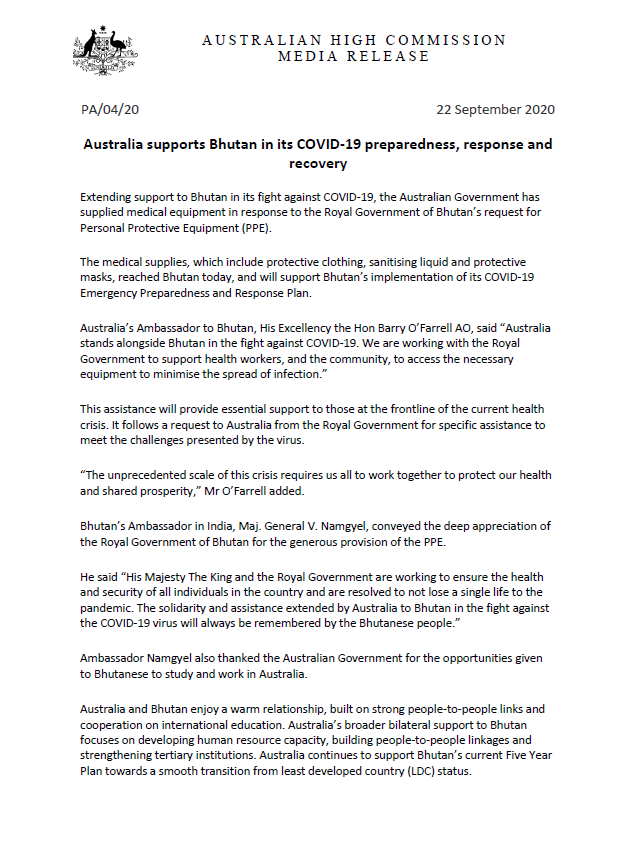
Extending support to Bhutan in its fight against COVID-19, the Australian Government supplied medical equipment in response to the Royal Government of Bhutan’s request for Personal Protective Equipment (PPE). This was made public through a press release issued by the Australian High Commission.

The medical supplies include protective clothing, sanitizer liquid and masks that reached Bhutan on 22 September. The supplies will support Bhutan’s implementation of its COVID-19 Emergency Preparedness and Response Plan. 

According to the press statement received by Bhutan Media Society via email, Australian ambassador Hon Barry O’Farrell AO, said “Australia stands alongside Bhutan in the fight against COVID-19. We are working with the Royal Government to support health workers and the community, to access the necessary equipment to minimize the spread of infection.”

Bhutan’s Ambassador in India, Maj. General V. Namgyel, conveyed the deep appreciation of the Royal Government of Bhutan for the generous provision of the PPE. 

He said “His Majesty The King and the Royal Government are working to ensure the health and security of all individuals in the country and are resolved to not lose a single life to the pandemic. The solidarity and assistance extended by Australia to Bhutan in the fight against the COVID-19 virus will always be remembered by the Bhutanese people.” 

“Australia and Bhutan enjoy a warm relationship, built on strong people-to-people links and cooperation on international education. Australia’s broader bilateral support to Bhutan focuses on developing human resource capacity, building people-to-people linkages and strengthening tertiary institutions”, the press statement reads.

According to the health ministry’s website, Bhutan’s confirmed cases stands at 282, with a new RBA man testing positive in Phuentsholing. As of October 1, 222 have recovered from the infection.

Bhutan Struggling To Fight COVID-19

The number of confirmed COVID-19 cases has risen to 280 in Bhutan, yet no death has been reported so far.

The government, led by a doctor, is grappling with scarce resources and infrastructures to fight the pandemic. The country being closer to the epicenter in China makes Bhutan a susceptible host to the virus.

According to KuenselOnline, the national daily newspaper, the first case of the virus hit Bhutan on March 6, 2020, when an American tourist was found infected with Coronavirus. Some of the border towns including Pheuntsholing are declared red-zone. Gelephu, another major town, has a similar trend of increasing cases.

According to BBS, the most recent case was found in 32 years old woman in Phuentsholing. That news prompted residents to rush for shopping anticipating the second wave of lockdown. The country is just easing after 21 days of lockdown announced following a positive case of COVID-19 in a woman in Gelephu.

Currently, there are eight reported cases, six of them being the front line employees at the border gate. A citizen in the hinterlands of Kalikhola said, “ I have not been able to reach my disabled children studying in Lamoizingkha middle secondary school due to lockdown and monsoon rain. I need to fetch them food supply and house rent.”

Like Nepal, Bhutan was reasonably unprepared to face the pandemic. The effect on the economy is paramount, especially when the majority of the development workers come from India. The tourism industry is hit hard when tourists canceled their flights to Bhutan. This creates a big hole in tourism revenue for a small country like Bhutan. In early February, 358 tourists canceled their flights to Bhutan citing the effect of the virus, according to Kuensel.

Schools are also affected. Online learning with limited data capacity led to a low response from the students. A teacher told over the phone, “ the assigned homework does not return and I have to follow up on WeChat.” Some teachers in rural parts are reported to have frequented students’ homes to ensure students get the required help. “We are back to class, so it will be much easier now,” said an English teacher in Dorokha.

Meanwhile, Australia has granted aid to Bhutan to get more PPE to fight the pandemic.

We Are Back!

26,644

After a break of six months BNS is back, thanks largely to the positive feedback from our long-time supporters and readers who have inspired us to create a fresher, more relevant, and innovative news website focused on the information needs of the global Bhutanese community.

A new group of volunteer writers has joined our editorial pool, bringing with them fresh ideas along with connections and perspectives that will ensure a more comprehensive coverage. We are delighted to see an increase in the number of female volunteers to our team.  

The editorial agenda for BNS is now more varied with several modifications to our previous offering while retaining the tone and values that have been the backbone of the BNS over the years.

A new area of the site, ‘Faces of Bhutan’, is dedicated to the issues, concerns and memories of the older members of the Bhutanese community. We hope this will become an essential repository of our shared history and a reference point and legacy for future generations. This area will include some insightful experiences shared by our seniors. We feel this is an important addition which underlines the respect we owe our elders.

BNS is now the home of a wide range of contributors from established writers, experts, citizen journalists and bloggers.

We are proud to welcome our first two official columnists, Yeshi Pelzom Pradhan and RP Subba. In the future we hope to add more columnists from diverse backgrounds, both within and outside the Bhutanese communities. In that light, we are always looking for new writers. 

BNS is embracing citizen journalism as a way to include the work of independent writers, freelancers, artists, musicians and so forth. If there are any events that you would like publicized, please let us know. We have added a section for bloggers who want to write about issues that are often ignored by the mainstream media. 

And if you are new to journalism, don’t worry, as part of the BNS editorial process we hope to be able to offer training for those not accustomed to writing for online magazines and news sites. 

To many visitors to the BNS site, it might appear to be USA-dominated, ignoring other countries of resettlement, that is because all volunteers are based in the USA. However, we are in the process of involving volunteers from all geographic locations who are representative of the Bhutanese communities resettled there. If you are in this category and would like to be involved please contact us directly. 

Community news and events from selected freelance sources will now appear in our community news section. An editor for this section will coordinate between community leaders and organizations to ensure the material submitted and published meets the BNS editorial standards. BNS and its parent organization the Bhutan Media Society have adopted a policy of entering into collaboration and partnership with social organizations that are engaged in the empowerment of Bhutanese communities across the world.

Such a collaboration will take place on mutually agreed terms and on specific areas of interest to both parties, and without compromising our editorial freedom. As we continue to look for partnership opportunities with other organizations, we also encourage you to contact us if your organization feels the same way. It is a new path for BNS to collaborate with community based organizations and businesses in this way. 

We plan to take this journey alongside you, the readers, stakeholders and donors who with your words of encouragement helped drive us to produce more in-depth narratives of the people often forgotten by the state they once belonged to.

Please take time to familiarize yourself with our new content and our redesigned website, and do let us know if you see any areas you think could be improved. And also please feel free to chip-in whatever you can by making charitable donations for the long-term sustainability of this website. 

The Impact Of Covid-19 On Recent College Graduates

26,644

Who would have thought that after all the years of hard work and dedication, my academic career would end this way?

As a recent college graduate from a four-year university, whose last semester of senior year was cut short and sent home early, I felt empty and lost. Due to COVID-19, in-person learning was forbidden, and students were required to learn virtually via zoom, which was challenging to adapt to and stay focused. 

Even with these obstacles, I had finally completed all my required credits to receive my cap and gown. I was ready to walk on the stage to celebrate one of the most precious and proud days of my life. Sadly, COVID-19 had different plans for us. 

The global pandemic was not slowing down. As days went by, more and more cases were piling up rapidly throughout the world, causing a mental breakdown for some and grocery and toilet paper shortage for others.

While approaching the end of the semester, I got an email from the dean stating, “2020 commencement has been canceled due to a viral pandemic”. 

Reading this email left a bitter taste on me; I was speechless. My colleagues expressed their feelings in social media posts throughout the day, while some shared “memes” to brighten the mood. I laid down on my bed, and I wondered, “Is this it? Is this the end of my undergraduate career and I won’t be able to celebrate with my friends, families, and faculty staff?”

COVID-19 has shattered my dreams of walking on the commencement stage into pieces. My dreams of celebrating all the years of hard work with friends and families had been washed away.

My plans for taking the national board exams were canceled due to testing centers being closed. With essential items getting the mailbox’s priorities, my cap and gown delivery date was delayed by two months. With the further outbreak of coronavirus, I was in complete lockdown like millions of citizens across the country to prevent the virus from spreading further. Not only did the global pandemic cause mental stressors, but it also caused fear of contracting the virus and losing our loved ones, especially those who were already vulnerable. 

Our daily lives had changed significantly. With social distancing, I was meeting my friends and other family members virtually. Businesses were closing down, and unemployment rates were rising swiftly. Finding jobs for recent graduates like me became almost impossible. 

Although what happened was unfortunate and sorrowful, canceling large events was the best decision for our health’s welfare. Well, to this date, without the discovery of the COVID-19 vaccine, we must continue to stay positive, maintain social distance, and wear masks in public space for the safety of all.


Masks On! Go On!

26,644

The Oval — a view that never gets old at Ohio State University (OSU). Every time I am on the eleventh floor of the Thompson Library, I can look over The Oval which is shaped by the residence halls, dining halls, and academic buildings surrounding it. Although it’s marked with circles that are six feet apart, it is still a place of serenity and peace. There are so many paths to take there but for now, it’s only to the dorm, dining hall, library, and back to my room again. This is my first time living on this campus. I was excited to meet new people, make new friends, and pull impulsive all-nighters all year long. 

Oh, how these expectations fell short! Now, I wait six feet apart in lines to get my food in dining halls and restaurants nearby. I can no longer talk to the student in front of me without them moving back. With a slightly awkward laugh, I say “I promise I don’t have corona.” 

Let’s not forget the epic football games at the Ohio stadium. I thought the Buckeye football games were going to be the highlight of my fall semester. I mean, who in Ohio doesn’t want to see Michigan University defeated by the Buckeyes. 

Regardless, I wouldn’t want to go home and miss out on relaxing by the Mirror lake at OSU. I would also miss the Thompson Library and the increase in my productivity while I’m there. Not to mention how I love to post these places on Instagram; I’m sure my Instagram followers are tired of seeing me post the Mirror Lake and Thompson Library by now.

Although there may be some students who may not feel the same. There was a party a few weeks ago where over 200 students were present — obviously lacking a common sense of good judgment. As it turns out, they were suspended for attending this party. We should all know by now that a few drunken nights are not worth jeopardizing the health and well being of those around us.

My roommate, a few friends, and I spend most of our evenings walking down High Street finding new restaurants, taking pictures, and talking — obviously with our masks on! A few here and there with their masks off but if you stare at them weirdly enough, they will put their mask on. 

This one time, I accidentally left my mask in my friend’s car; It felt like I was committing a crime so I took my sweater and held it in a way that covered my face. Ahh, the shame I felt!  

Hopefully, by next year masks are not the norm and I get to talk to the person in front of me in line. Although I do have more time to do my school work – procrastination is a thing of the past, I wish. Even better, I have more time to write about my adventures on High Street just for you.


Be with you shortly with another chapter, with another rant about another day of Arati. For now, masks on and go on!