I Loved The Land So Much That I Can Even Smell It Now 

26,644

One silent morning in October 1990 a sudden bomb-like boom rocked my village Purano Basti in Gelephu, Bhutan. Everything shook as if there was an earthquake. I shivered in fear. Almost immediately an armed Royal Bhutan Army guard standing in front of my house pounced on me and grabbed me by the neck, pinning me down. I was scared and soon soaked in sweat. 

Who planted that bomb?” he yelled repeatedly, still holding me by the throat. I was having difficulty breathing. Then he raised me like a helpless rooster picked for the pot, still screaming questions about ‘the bomb’. Realizing I was gasping for air, he dropped me on the ground. I breathed a long sigh of relief. Just then someone rushed toward us and then all became clear. The ‘boom’ was from a truck’s flat tire.

After the peaceful demonstration in Gelephu town in September 1990, against human rights abuses, the Royal Government of Bhutan deployed an army in the villages to arrest all those who had either participated in the demonstration or provided monetary support to the movement, targeting key people who held influences in the village. Soon security personnel outnumbered the local population.

Within two months the army had set-up bunkers in my backyard, without my consent. They cleared all the orchards, bamboos and converted my backyard into war trenches. Hundreds of sacks filled with sand were laid behind my house overlooking the shallow brook that sometimes roars in the monsoon. I felt like I was on a battlefield. 

My house was under constant surveillance with security personnel on my lawn, watching me and my family doing chores. The psychological fear they created made us feel constantly unsafe and I became scared I wouldn’t be able to protect my teenage daughter. I had heard enough stories of rapes and sexual assaults on females by the so called security forces. 

This torment lasted for two years. I had four other children under the age of 12. During this hostile situation, I also had to work on my farm every day. Although drained after a long-day of work, I barely slept because I feared for our safety.  

The security personnel stationed on my land inspected the villages regularly. They would arrest villagers, based on false tip-offs from their paid informants. Once released from the prison, ‘offenders’ would be given an ultimatum to leave the country, often being forced to sign ‘voluntary migration forms.’ Many neighbors and friends fled the country because of the fear of arrest and torture or to avoid filling-out ‘voluntary migration forms.’ I was fortunate that I was not arrested. I still can’t piece together why I was spared.
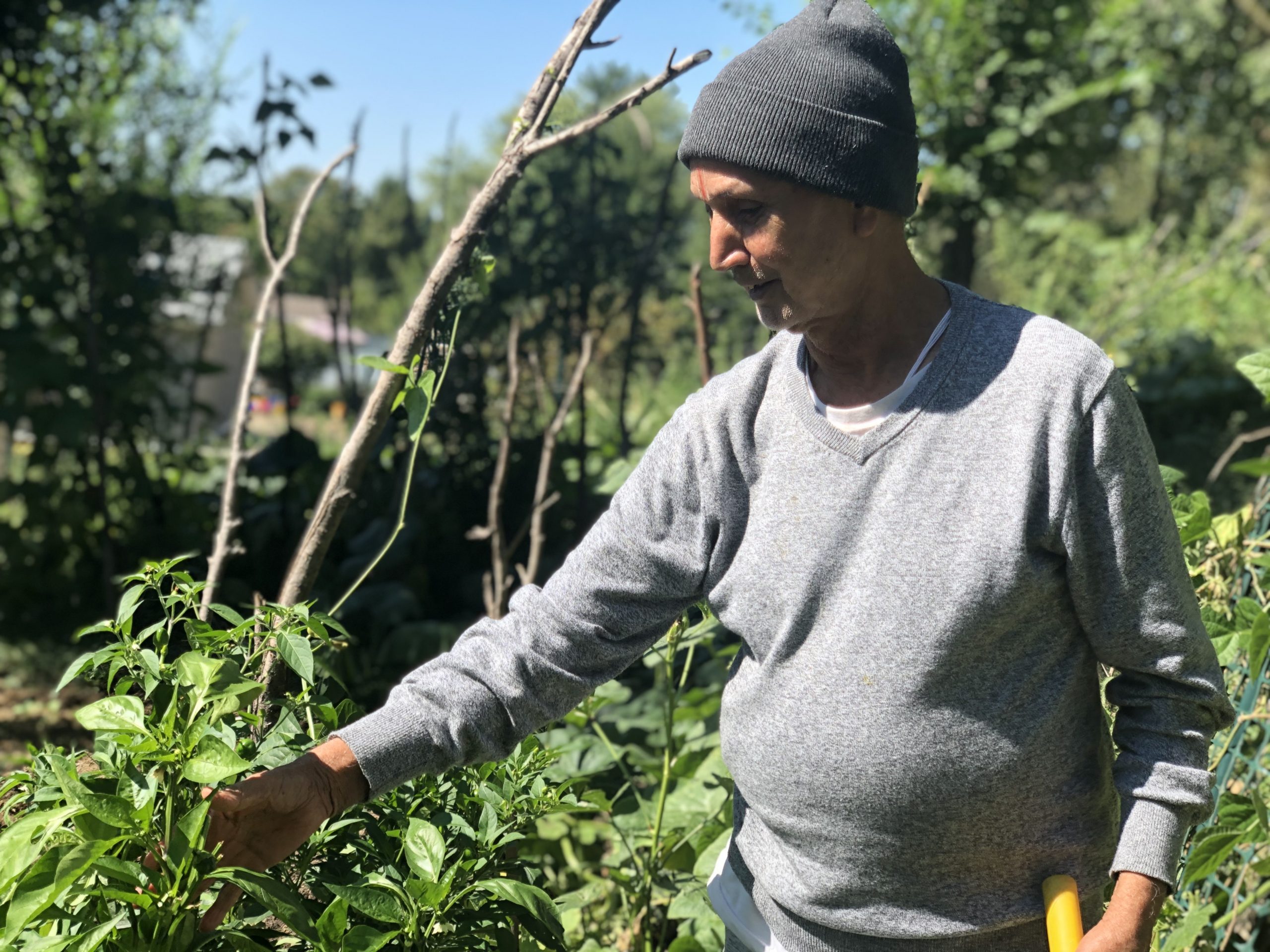
Dahal working on his vegetable garden. Photo/Upendra Dahal.

I was born in Lamidara in Chirang, Bhutan. Our families then migrated to Surey in Gelephu from where we moved to Lodrai village for a few years before moving to Purano Basti, thirty minutes’ walk away.

I never thought that the day would arrive when our new place with ten acres of fertile land would be converted into bunkers. I remember the hardship of buying a property like that. It was one of the best I ever possessed. Of course, I had to co-share with my older brother for some time before we separated into different families. All of my seven children were born on that property. 

I loved the land so much that I can even smell it now. Just before leaving the country I buried some valuables in the yard of my property, hoping to return one day and unearth them. The day we left home, I let my livestock loose on the baari (dry land). The cattle were mooing at us, as if in pain, as we left the village under duress. 

By the time I decided to leave the country for the safety of my family, my oldest son was at a High School in Paro, Bhutan. Sadly, we could not inform him about our plans. Later, he probably heard from his cousins in the capital Thimphu that we had left the country and decided to go back to Gelephu and stay with our relatives. He said he did not feel like going back to the village and checked in the old house. We heard later from the new arrivals at the refugee camp in Nepal that my house was bulldozed by the security forces to remove traces of my existence there. After more than a year of struggle and without the documentation needed to start a college life, he joined us in the refugee camp in Nepal in December 1993.

I do not remember my very early childhood. But I know I was an assertive boy grown within the family. Born as a third son in 1946 in Lamidara, Chirang, Bhutan, I was married at the age of fifteen with Pabitra Dahal, and I was eighteen when we migrated to Surey. I remember a long walk in those days from Chirang to Sarbhang and from there to Surey. Roads were unknown to us until we started living in Lodrai. 

After we settled in Lodrai, I decided to accompany my oldest brother back to Surey. He was a Sanskrit teacher there. Most of the current priests and those who are still in the country were his students. He was a renowned Pandit (priest) and a Sanskrit scholar. He played a vital role in establishing and reforming culture among the people of Hindu faith. He was a strict and vocal person. He always stood for the right way and even faced humiliation for his uprightness. 

As we were forced out of the country in mid-1992, I brought my family in a truck to Nepal to join my fellow refugees who had already endured so much hardship in the banks of Mai River, the preliminary refugee camp location in Eastern Nepal. It was a bitter saga of our lives. Every moment we spent our lives in the camps had its own unique and sad stories to tell but the shock and aftermath of the devastating blaze in the Goldhap refugee camp in 2008 hasn’t healed yet. 

Anything we had protected, saved and preserved turned to ashes within less than an hour. We had to run for cover to save ourselves from the engulfing flames. The only thing we could carry was a bag containing a few valuables. A relative of ours had a wedding planned the next day and had stored their gold jewellery at our hut the evening fire gutted our camp. Their jewellery was all that survived the devastating inferno, all because my daughter-in-law had her presence of mind to save her friend’s valuables that could have gone. 

We huddled together in a school for a few months before we rebuilt our huts. In spite of regular fury of cyclones and storms that would devastate huts within minutes and send a flood of water inside, I would say life was still meant for moving on and not to be given up simply because of a change in environment.  

Finally, after 17 years of waiting in limbo, we were presented with a dilemma. We were offered an opportunity to settle in the West, which we thought at that  time was a conspiracy to dissolve us in the West. Secondly, it was a wild idea for our older generations. But  as time wore on and a new generation grew up, everyone thought it was worth exploring a new life in another part of our Mother Earth with grace and gratitude. 

The scheme was the Third Country Resettlement Option. Any hopes we had of returning to our country were fading which was a tough pill for my generation to swallow. I knew nothing about the U.S. or the outside world but I was sure of one thing.: ‘One has to accept what is available to consume at the time of scarcity’. My children were restless and it was for their future that I decided to make my move to the West with a heavy heart. So, we landed in the U.S. in September 2008 to start a new chapter of my life that began in Chirang, Bhutan in 1946. 

In the fall of 2008 when I arrived here, Pittsburgh, Pennsylvania looked beautiful with fall foliage. But since then, it  has changed a lot, not least in terms of demography. I like the city; it has hills and valleys similar to my birthplace Chirang. Time flies so fast and it’s already been twelve years. My grandson who was barely two years old in 2008 has started high school now. My children are all married and settled with their own families. I am happy and glad that we finally made a long route to freedom and prosperity once again when I am approaching the twilight of my life. I am so grateful for being here and being accepted by my new country. 

Life has an amazing twist. I was born empty handed, left Bhutan empty handed, arrived in the US empty handed and now when it is time for me to leave this world empty handed, I will do so with all my wounds healed by the Almighty.      
_
Rup Pokhrel is one of the former chief editors and current contributing editor at BNS. 


BNS Is Back With A New Look, Now The Hard Work Begins

26,644

The Bhutan News Service is proud to be back, rejuvenated with modern digital delivery and a fresh approach to its core role of promoting our community’s interests.  I am  delighted to be onboard as one of its regular columnists.

I am dedicating my first column to reflecting on the relaunch and how we, as a community, can all help it to work. When the team announced the news media’s closure in January 2020, I wrote a piece stating that an epilogue, particularly such a sad one is painful to write and more so if you hold the subject dear to your heart. 

I tried to elucidate how an important entity such as the BNS needed to survive, not only for the development of media professionalism in our community but, more importantly, for the sake of promoting our own community interests. That’s why the relaunch is such welcome news.

I knew that the revival was coming. The news media’s Executive Editor made contact to update me about what was planned and about the changes that would be made. BNS will feature a new look and style, and it will embrace the best professional practices,’ he said. 

He was true to his word. There has been a transformation. The website glows with fresh-looking features and a more attractive professional design, all enhanced by the essential element of artful journalism.  

The ‘Faces of Bhutansection is an anthropology of Bhutan in pictures. It illustrates the diversity which comprises the ethnic mosaic that is in the southern Bhutanese society.   

The introduction of a new column section did, of course, require new writers. The Executive Editor approached me to be one of them. I agreed but only after a long pause before signing a contract which will last for a year. The other columnist is Yeshi Pelzom Pradhan, a very deserving academic and a writer of reckoning. I am happy to share the platform with Yeshi.  

Columnists are supposed to write thought-provoking pieces which offer commentary, strong messaging and firm opinions. Even for me, this is a new practice but I am sure learning comes with doing.   

I accepted the offer to become a columnist partly because I am a relentless promoter of the principle of freedom of expression. Talking about free expression makes me recall the experiences we went through growing up in Bhutan without free media and the right of expression. This taught us hard lessons. We now owe it to our past and to ourselves to exercise these freedoms whenever and however we can. We should speak for others, those for whom such freedoms are not a normal fact of life, those whose voices are still muted. BNS carries that passion and this is where we must connect.  

The constitution of the team has changed too. Some of the old guard has withdrawn, opening up opportunities for interested young enthusiasts from college backgrounds. As a person associated with BNS since its early days, it gives me immense pleasure to see many young faces join the team.

This is continuity with change, a win-win sustenance formula. The involvement of youth is a visionary step in the right direction. It can help us perpetuate our collective identity going forward. 

Media is the eyes and ears of any society and for many years the BNS has honored that solemn duty. I depend on it for news and views about our society. The disappearance of the BNS, even for a short time, led to a silence and emptiness that many of us felt was leading us into darkness. The importance of the BNS to our community cannot be overstated. Rochelle L. Frounfelker has rightly said that Bhutan News Service’ is a critical forum for the Bhutanese diaspora

The BNS has a lot of work to do. As a community where there is just a handful of practicing journalists who are still learning and a much fewer number of contributors, its role in reinforcing our stories, constructing and shaping a new narrative through community discourse is crucial. 

Also, framing a common language of the story of persecution while counteracting stigmatizing notions coming from the Bhutanese government is equally important, presenting both a challenge and an opportunity. 

It is respectable, understandable and proper that the BNS wants to become a true representative of the Bhutanese diasporic community. However, in many ways its operational style needs to be customized to suit community needs and interests. It wouldn’t be wise to always stick to rules in the name of media professionalism. 

That said, the BNS is reaching out to the community at large seeking writers, contributors, volunteers and donors to make its operations viable and to promoting a committed and expanded readership. But to my knowledge, the responses have been anything from mixed to direct discouragement.  

The Bhutanese diasporic community can do better than this.  Come on, get onboard.

_
Subba is one of the columnists for BNS. 

Beware Of Screen-Time For Kids

26,644

My daughter returned to school on August 19 despite the upsurge in cases of virus infection in Louisville, KY. I was a little skeptical about the success of school keeping students in school without having infected cases. However, it is going on smoothly.

Schools are in a dilemma. Public schools across the U.S. have experimented with running full scale classrooms as well as with  hybrid models. But the students are still at home for most of the day, often with no parent or guardian to help in their online classes.

My biggest concern when students are at home: their screen time. How long can we keep them away from computers or mobile screens? What might be other good options to engage them in creative work? Public libraries are not open to the public yet and…? 

And, there is a risk tendency of isolation. Teenagers tend to lock their rooms and not bother to get out of the houses. I often knock on the door of my teenage boy and urge him to get outside the house to bask in the warm sunlight, enjoy mild weather, and breathe in fresh air. 

What keeps them inside? Obviously the internet products- games, YouTube videos, and many more other social media outlets. As long as students are engaged in school work, doing online classes, and interacting with teachers and counselors, they should remain on track.

Overindulgence and obsessive crave for internet platforms have serious implications on the mental health of school age kids. I heard about two middle school students back in Bhutan who took their lives. I was curious to know the probable cause.  

Some kids have even lost their family members to the pandemic. This causes even greater impulse to worry and get depressed. Unintended though, they seek online entertainment, which makes them even more vulnerable to isolation.

As parents of these digitally-influenced kids, how much are we prepared to prevent them from the menace of bad internet products? Not much, I guess! For immigrants and refugees just beginning to learn ways of life in the U.S., the challenge is humongous. As for me, being in the U.S. for a decade, and literate in English, I still feel naive when it comes to controlling the internet platforms on devices.

I am happy about sending my fifth grade daughter to school rather than giving her an iPad or tablet to be absorbed in undesirable YouTube videos. At the time when pandemic is upscaling and state government warnings against sending students back to school are ramping up, some catholic schools dared to open doors to students willing to return for classroom instructions. And, it has helped a lot to minimize potential harm on mental health of young children.

I am in fact thinking of those frolicsome village days that my children miss so much –being engaged with natural processes of food production, living under limited resources and harmonious socialization with simple village folks. 

The Importance Of General Wellbeing During Global COVID-19 Pandemic

26,644

l ike many of you, I had some great plans and personal goals for the summer of 2020 that I wanted to cross off my bucket list. Unfortunately, due to the rise of the COVID-19 pandemic, all these preparations continued to fall apart.

With some poor diet choices and lack of activity during the winter season, one of my top priorities was to be healthy mentally and physically. Over the course of last winter, my academic ambition consumed much of the time as I wanted to finish my senior year of college on a high note. Living in New England during winter meant shorter daylight and longer nights. While studying comfortably inside a cozy heated room during freezing temperatures and snowy days, I wasn’t going out much and soon became an indolent student. 

The importance of physical and mental health in a person’s life is very well understood to most adults. As most of you have undoubtedly heard this many times, “healthy life means a happy life.” Proven by scientific evidence, I have also experienced this to be very accurate. 

With the addition of COVID-19 and being locked down on quarantine, my mental and physical health was steadily deteriorating. Closed gyms and parks meant I was stuck at home with limited space and equipment to exercise. My body had limited mobility compared to being out on the soccer field or at the gym with friends. 

Looking at my unhealthy body in the mirror, I became more insecure and lost self-confidence and self-esteem. Over time, I knew I had to get out of my room and shift my negative thoughts to positive to change my lifestyle.

Watching youtube videos and listening to internet influencers such as Gary Vee and Yes Theory, they gave me a ray of hope during the dark times. It was challenging to start, but following fitness trainers, motivational speakers and watching videos inspired me to eat healthily, perform bodyweight exercises, and run more often. After a few weeks of hard work, I started to notice positive results in the mirror. My sad, gloomy days became clearer and happier, and I fell in love with myself. 

In addition to feeling healthier mentally, engaging in physical activity improved my lifestyle quality and enabled me to be more stress-free. As good as I feel now, I intend to maintain this routine and do my best to remain physically and mentally healthy. 

I know it can be daunting to start, but If you feel like your health is mentally and/or physically exhausting, I encourage you to take a baby step, one day at a time. To distract your mind from stress, you can exercise at home, go for a walk/run, read books, watch sports, or whatever. You can alter the standard of your lifestyle over time by preserving consistency. Of course, please do this while wearing a face mask in public spaces and maintain social distancing for yourself and others’ safety.

Voting Is A Civic Duty Not To Be Ignored

26,644

Ihave voted. My vote may not change the game, but it will register my concern.

Some say that they will not vote because they do not like either candidate. I say that’s selfish and ignorant. We will never get a candidate whose vision aligns completely with ours. That candidate does not exist; never has and never will. Even if you ran for office yourself, you, the candidate, will have a significantly different platform than you the voter.

There is no such thing as not voting. When you don’t vote, you deny a vote to the candidate whose vision for the world and country is closer to yours. It is one less vote for the ideals you hold dear. Elections are not about thumbing your nose at people you disagree with.

When you are 90 and telling your grandchildren about these troubling times, they will ask you what role you played. Did you sit it out? Did you do something to better the world for them? Vote, so you can at least tell them that you performed your civic duties.

I voted for Biden and Harris. Neither of them is perfect, but this was the easiest of choices I have made in any election.

Americans who look like me are being falsely vilified, en-masse, as free-loaders, rapists, and criminals by the sitting president of the United States. I want this charade to end.

Hatred for the other has grown exponentially with the explicit encouragement of the president and silent condoning of the Republican party. I want this to change.

Blatant, overt racism has become an acceptable norm. Years of work on racial equality and fairness has been upended by the relentless and consistent hate-mongering by an insecure man with a bully pulpit. I want this changed.

The leader of our nation is a close friend of despots and dictators and considers our historical allies to be our enemies. This needs to change and America needs to be a champion of the most vulnerable among us.

Our system of government may not sustain the more virulent version of this nightmare for another four years. Trump may challenge the critical aspects of our system of government such as checks and balances, peaceful and orderly transition of power, and perhaps even the periodic elections with presidential term limits. If re-elected, he may not be beholden to anyone, even his most ardent supporters, because their votes won’t matter anymore.

Based on what we have seen in the past four years, he will openly flaunt the established norms between the various branches of government, more so if the Democrats take control of the Senate and retain the House. His party will silently look on and right-leaning SCOTUS will rule in his favor as he frequently clogs the courts with legal challenges. He will treat the United States as his private company and may instigate the heavily armed  right-wing militias and white supremacists to suppress dissent. It will take us decades to recoup the loss.

This may sound far-fetched, but our knowledge of history says that modern dictatorships don’t start with a bang. They evolve. The past four years have shown a slow crawl towards authoritarianism accompanied by faint rumblings of desires among his supporters for him to remain in power longer than the maximum 8 years. We need to reverse this trend.

So, the fate of our system of government is on the ballot this year. Compassion, dignity, humanity and harmony is on the ballot. These are easy things to decide about. Policies are made by many, but a leader sets the tone at the top. A good leader encourages us to love each other and doesn’t incite hatred. Such tone inspires respect for the agreements we have made as a society.

A good leader inspires respect for the law, but more than that, s/he inspires respect for justice, ethics and harmony.

Biden may not be THE good leader, but he is definitely the better leader on the ballot. He will not relentlessly tweet insults to world leaders or malign entire nations just because they did not toe his line. He will not encourage his supporters to arm themselves and intimidate and harm the opposition. He will not dehumanize and demonize other fellow citizens.

There are many things Biden can’t and may not fix, but of one thing I am sure: he will not capitalize on our fears. He will not encourage his supporters to harm others. He will try to be a president to all Americans. He will espouse empathy, compassion and caring for each other.

With that, we can hopefully start to rebuild the social and racial relationships that have been broken during the past four years. This is worth the vote.

_
Acharya has lived in the United States since 1999. He frequently travels internationally and in the U.S. for work. This is the third presidential election since he became a U.S. citizen, and he has voted in all of them.

Editor’s note: BNS neither takes political sides, nor does it endorse a particular candidate. We welcome and publish a diversity of opinions.


2: Breast Cancer Awareness: Health talk with Bikash and Kumari Regmi

26,644

Right now it is more important than ever that we think positively and try to
boost our overall health. “ Health is a state of complete physical, mental, and social wellbeing (WHO, 2020).” Healthy lifestyle habits will
turbocharge your mind and body. For your benefit, each month, Bikash
and Kumari, nurse practitioners and health care promoters, will share
their insights on healthy living. These podcasts will help you to make
self-care and a healthy lifestyle your priorities. If you want to learn more
about healthy living and primary prevention, this podcast is for you.
About 1 in 8 U.S. women (about 12%) will develop invasive breast cancer over the course of their lifetime.

दशैं-तिहार अर्को वर्ष पनि आउँछ

दशैंका सांस्कृतिक/ ऐतिहासिक पक्षहरु जे जे भए पनि सामान्य बुझाइमा दशैं भनेको सुख, खुशी र आनन्दको उत्सव हो । तर, यो वर्षको उत्सव केही फिक्का हुने यो बेलाको परिवेश छ ।  कोभिड-१९ नाम दिइएको एउटा विश्वव्यापी हैंजा-संक्रमणले आजको परिवेश बिगारिदिएको छ । मान्छेसित धन नभए पनि ज्यान स्वस्थ छ भने आनन्दित हुन सकिन्छ भन्ने कुरो तपाईं हामीलाई कसैले सिकाइरहनु पर्दैन ।

त्यसो हुनाले अर्को वर्षसम्म बाँचिएला नबाँचिएला, दशैं त मोजमस्तिका साथ मनाउनैपर्छ भन्ने जिद्धि नगरौं । आफन्तहरु पनि प्रविधिको प्रयोगमार्फत भेटघाट गर्न सकिन्छ ।  उहिले प्रविधिको विकास नहुँदै विकास भएको सामाजिक संस्कृतिको प्रतिविम्ब मात्र हो दशैं । हामी सबै स्वस्थ भई बाँचिराखे दशैं त अर्का अर्का वर्षहरु पनि हाम्रो अगाडि आई नै रहनेछ !

शुरु शुरुमा कोभिड-१९ को संक्रमणबाट मानिसहरु धेरै त्रसित थिए । तर, यतिबेला यसलाई मानिसहरुले उपेक्षा गर्न थालेका छन् । हल्का रूपमा लिन थालेका छन् ।

त्यसको तात्पर्य, हैंजाको प्रभाव घटेको छ भन्ने होइन । अहिले पनि मानिसहरुको अधिक चहल-पहल बढ्यो भने यो रोगको सङ्क्रमणलाई रोक्न सकिँदैन । कोभिड संक्रमित व्यक्तिलाई उपचारमा ढिलाइ भएमा बँचाउन सकिँदैन भन्ने स्वास्थ्य विशेषज्ञहरुको सल्लाह सबैले मान्नुपर्ने हुन्छ । अहिलेको परिस्थितिमा स्वास्थ्यकर्मीहरु नै यस धर्तीका देउता वा भगवान हुन् जसका अगाडि आपतको घडीमा मानिसहरु नतमस्क हुन्छन्/हुनै पर्दछ ।

स्वास्थ्य विशेषज्ञहरुका अनुसार कोभिड संक्रमित व्यक्तिको स्वास-प्रश्वासमा अक्सिजनको मात्रा घट्तै जान्छ । मानिसले आफैं आफ्नो शरीरले ग्रहण गर्ने अक्सिजनको मात्रा थाहा पाइरहेको हुँदैन । शरीरमा आवश्यक अक्सिजनको मात्रा ९० प्रतिशतभन्दा कम भएपछि त्यो मानिसमा रोगप्रतिरोधक क्षमता घट्तै जान्छ र उसको मृत्युको सम्भावना बढ्दै जान्छ ।

विश्वका कति देशमा स्वास्थ्यकर्मीहरुले कोभिड संक्रमितलाई ९० प्रतिशतभन्दा तल अक्सिजनको मात्रा झरेपछिमात्र उपचार शुरु गरेका कारण मृतकहरुको संख्या कहाली लाग्दो रूपमा बढेको केही विशेषज्ञहरुको दाबी छ । रोगीको शरीरमा अक्सिजन ९० प्रतिभन्दा माथि हुँदै उपचार गरिएमा रोगी मृत्यु नहुने कुरा कोभिडको असर कम भएका केही देशहरुले उदाहरण पेश गरिसकेका छन् । नेपालमै पनि यस्तो उदाहरणीय काम भएको छ पत्र-पत्रिकामा लेख र समाचारहरु पढ्न पाइँदैछ ।

अमेरिकामा पनि पहिलेको मान्यता के थियो भने अक्सिजनको मात्रा ९० प्रतिशतसम्म घटुञ्जेल अस्पतालहरुमा रोगीलाई सामान्य रूपमा राखिन्थ्यो । त्यसो गरिनाले संक्रमितहरु अचानक सिकिस्त हुँदै उनीहरुको शरीरको अक्सिजन तल तल झर्दै ७० सम्म पुग्थ्यो भने उनीहरु आईसीयू र भेन्टिलेटरमा राख्नुपर्ने अवस्थामा पुग्थे । तर, अहिले उपचारमा सचेतना विकास भएको छ र मर्नेहरुको संख्या पनि धेरै घटेको छ । यद्यपि, संक्रमणको क्रममा कुनै कमी आएको छैन ।

एकजना नेपाली स्वास्थ्यविज्ञका अनुसार कोभिडको सवालमा ‘Contact Camp’ अति महत्वपूर्ण हुन्छ । यसको अर्थ कोभिडबाट संक्रमित व्यक्तिसित तपाईंले कति समय बिताउनु भयो भन्ने हो । दश मिनटभन्दा बढी तपाईंले कुनै कोभिड संक्रमित व्यक्तिका निकटमा बिताउनुभयो भने तपाईंलाई कोभिड सर्ने लगभग निश्चित हुन्छ । तर, दश मिनटभन्दा कम समय सम्पर्क हुँदा कोभिड सर्दैन भन्ने पनि होइन । त्यसैले भौतिक दूरीलाई कोभिडबाट जोगिने अर्को मूल आधार मानिएको छ ।

अहिलेसम्म कोभिड एक व्यक्तिबाट अर्को व्यक्तिमा कुन कुन माध्यमले सर्छ भन्ने कुरामा विश्वका स्वास्थ्य विशेषज्ञहरु एकमत छैनन् । तर, मूलरूपमा सासबाटै सर्छ भन्ने कुरामा चाहिं सबैको मतैक्यता देखिन्छ । यही भएर मुखौटो लगाएर मुख छोप्ने चलन विकसित भएको हो । तर, मानिसहरु कानमा मुखौटोको उजिण्डो सिउरिन्छन् मात्र, मुख-नाक राम्रो गरी ढाकेर हिँड्दैनन् ।

‘मुखौटोको उपयोग’ हाम्रो लागि समस्याको विषय बनेको छ । आपसमा बोलीचाली गर्ने क्रममा कि मुखौटो खोलिन्छ कि त चिउँडोसम्म झारिन्छ । यो आदतले नजिकै भएको मानिसलाई पनि सकस हुन्छ । यो हरकतले नै किटाणु एकजनाबाट अर्कोमा सर्छ । त्यसकारण मुखौटोलाई कसरी प्रयोग गर्ने भन्ने कुरा नै आजको सबैभन्दा ठूलो सरोकारको विषय हो । मुखौटो प्रयोगको शैली र प्रवृत्तिमा सचेतना हुनुपऱ्यो ।

बजारको किनमेल गर्दा विचार गरौं
यो चाडपर्व र उत्सवको समय हो । यतिबेला बुढा-पाकादेखि केटाकेटीसम्म बजारमा जान्छन् । सामान किन्ने क्रममा सामान छान्नेदेखि सामानको मोलतौल गर्दै गर्दा १५ देखि २० मिनेटसम्म वा त्योभन्दा अधिक पनि निकट व्यक्तिसित हाम्रो सम्पर्क हुन्छ ।

दोकाने र ग्राहकमध्ये कोही सङ्क्रमित हुन सक्छन् । त्यस्तो अवस्थामा दोकानवालाले भीडलाई कसरी व्यवस्थापन गरेको छ भन्ने जस्ता कुराले फरक पार्दछ । दोकानमा जानुभन्दा अगाडि हात धुने र स्यानिटाइजरको व्यवस्था गरेको छ कि छैन भन्ने कुराले पनि फरक पार्छ । यदि कसैलाई थोरै पनि लक्षण छ भने त्यसरी दोकानहरुमा नजानु नै कल्याणकारी काम हुनसक्छ किनभने आफूलाई संक्रमणको आशंका भएको कुरा अरुलाई थाहा पनि हुँदैन । अरुबाट मात्र जोगिने होइन, आफ्नो कारणले अरुलाई घातक हुने कामबाट स्वयं पनि जोगिनु राम्रो हो ।

कोभिड-१९ किटाणु कुनै पनि प्रकारको धातुजस्तो वस्तुमा ४० देखि ४८ घण्टासम्म टिक्छ । कपडामा पनि झण्डै दुई दिनसम्म रहने अध्ययनले जनाएको छ । हामीले किनेर ल्याएका सामानलाई ५/६  घण्टासम्म घाममा सुकाउने वा लण्ड्रीको वार्मरमा राखिएमा किटाणुहरु मर्छन् भन्ने वैज्ञानिकहरुको अनुमानित मान्यता रहेको छ । यसकारण सामान किनेर ल्याएपछि घरमा कसरी भित्र्याउने र कसरी राख्ने भन्ने कुरामा ध्यान दिनुपर्छ । कुनै पनि कपडा धुन मिल्ने भए धोइ-सुकाइ गरेर मात्र भित्र लानु राम्रो हो । धुन नमिल्ने भए पनि केही घण्टा सुकाएर प्रयोग गर्नु उचित कदम हुन्छ ।

टीका ग्रहण गर्ने क्रम
टीका लगाउँदा सबैले शतर्कता अपनाउनु श्रेयश्कर हुनेछ । टीका लगाउने र टीका थाप्नेमध्ये कोही संक्रमित छन् कि भन्ने कुरामा पूरै ध्यान दिनुपर्छ । कसैलाई खोकी लागेको वा रुघा लागेको छ भने सकेसम्म टीका नै नलगाएको राम्रो हुन्छ ।

यस्तै शुरुमा सबैले राम्रोसँग साबुनपानीले हात धुने र मुखौटो लगाएर टीकाको आदान-प्रदान गर्न सकिन्छ । घरमा धेरै मानिस छन् भने वा एउटाले धेरै मानिसलाई लगाउनुछ भने एउटालाई लगाइसकेपछि हात धोएर वा स्यानिटाइजर लगाएर अर्कोलाई लगाउन सकिन्छ ।

आफैंप्रति अधिक-विश्वासको घमण्ड गर्नु मूर्खता हो । जो जिद्धि वा ढिप्पि गरेर संक्रमणको सम्भावनाप्रति उदासीन हुन्छन्, तिनीहरु बढी संक्रमित भएका छन् । अस्पतालहरुमा बिरामीको उपचार गर्ने लाखौं स्वास्थ्यकर्मीहरु थिए । तर, जो जो सतर्क रहे उनीहरु नै सुरक्षित रहे । सतर्क नहुनेहरु अरुलाई उपचार गर्दा गर्दै आफैं संक्रमित भएर बिते पनि । त्यसर्थ, आफ्नो अगाडि भएका व्यक्तिमा कोभिडको संक्रमण ‘छ कि’ भनेर सतर्क हुनु नै संक्रमणबाट बँच्ने मूल उपायमध्येको एक हो ।

‘आफ्नो मान्छे र अर्काको मान्छे’
‘फलाना त आफ्नै पर्छन्, तिनलाई कोरोना छैन । भेला हुँदा केही पनि हुँदैन !’ गाउँतिर यस्ता कुरा थुप्रै सुनिन्छन् । तर, रोग वा हैंजाले आफ्नो र अर्काको भनेर नाता-सम्बन्ध छुट्याउँदैन । कोही व्यक्तिहरु घर बाहिर गई जागिर गर्ने, कामकाजमा हिँडिरहने भएर पनि कोभिडबाट जोगिएकै छन् तर, कोही ५/६ महिनादेखि घरभित्रै रहँदा पनि कोभिड संक्रमित भइरहेका घटनाहरु प्रशस्तै देखिएका छन् ।

सामान्य रुघाखोकी र कोरोनामा फरक
कोरोनाको खोकी जहिले पनि सुख्खा प्रकारको हुने स्वास्थ्यविज्ञहरुको भनाइ छ । विज्ञ र अनुभवी पीडितहरुको भनाइ अनुसार यस्तो अवस्थाको खोकीमा नाकमा तरल वा सिँगान बग्दैन । स्वास फेर्न गाह्रो हुन्छ । छातीमा एकदमै गह्रुँगो अनुभव गर्छ । आफ्नो फोक्सोमा बाक्लो तरल पदार्थ अथवा लेदो प्रकारको केही जमेको छ र त्यसैकारण हावा छिरेन कि भन्ने अनुभूति हुन्छ । तर, उनीहरुको नाकबाट सिँगान बग्दैन, स्वाँ-स्वाँ बढी हुन्छ । कोरोनाको खोकी एकदमै लामो समयसम्म रहन्छ । खोक्न खोज्दा पनि खोक्न सकिँदैन । बढ्दै बढ्दै गएर पछि बोल्न पनि गाह्रो हुन्छ । तर मौसमी रुघामा खोकी थोरै लाग्छ बढी लाग्छ । नाकबाट सिँगान बग्छ । त्यो भनेको हामीमा भइरहने सामान्य एलर्जी र भाइरल इन्फेक्सनले गर्दा हो ।

अहिले दशैं र तिहारजस्ता चाड-बाडको समय छ । सबै मानिसहरु आफन्तबीच एकापसको भेटघाटमा व्यस्त छन् ।

यो महामारीको समय हो । भावनामा बग्न हुँदैन । आफू बाँचिरहे मात्र आफन्तको सरोकार पनि रहन्छ । त्यसो हुनाले यही वर्ष दशैं-तिहार  आएर जान्छ अनि सकिन्छ भन्ने जस्तो गरी व्यवहार नगरौं । मिल्नेसम्म आफैंसित, आफ्नै चित्तसित सम्झौता गरौं । किनभने दशैं-तिहार त अर्को वर्ष पनि आउँछ । तर, लापरबाही गरेमा त्यो दशैं देख्न तपाईं हामी रहने छैनौं ।

We Should Rethink How To Celebrate Our Festivals During Pandemic 

26,644

In recent weeks I’ve received phone calls from resettled Bhutanese community members locally asking if they are allowed to travel outside Massachusetts, and whether they would be fined by the state if they did.  

I immediately turned to a few of my friends who are epidemiologists for answers. One suggested I visit public health websites, the other asked me to call 211, a telephone information center that connects callers to information and critical health and human service programs. From the public health standpoint, both epidemiologists I spoke with stated that people shouldn’t travel if they don’t have to.

I couldn’t agree more with my friends.

As of today, Massachusetts, where I live, falls in the lower risk category. That means I’m required to fill out a travel form and report my COVID-19 test and quarantine status when I return from high risk states. If I don’t comply I could be fined up to $500 per day. 

During Dashain and Tihar, two of the biggest festivals in the Hindu calendar, and particularly in the former one, I will not be visiting my parents in Pennsylvania. I’m not afraid about having to pay a fine, I am concerned that I might be passing the virus to my elderly parents and grandparents and vice-versa during the celebrations. 

While the COVID-19 vaccine is still in the developmental phase, the Centers for Disease Control (CDC), state, and local governments have issued guidelines and regulations about public gatherings that include typical American festivals where millions are expected to travel to celebrate. But most of these recommendations are in English, and we can’t even make use of that advice due to the language barrier. 

Bhutanese community leaders in the United States have played an important role by providing culturally and linguistically appropriate public health information including advice from epidemiologists and medical doctors. At times, they tried to dispel myths about the virus and informed communities about changes and developments. Culturally, we have a good tradition of respecting elders and listening to the leaders of our communities. 

As a result, although there is no traceable data to prove it, it seems we have a low mortality rate due to COVID-19 in the U.S. Bhutanese community. We have developed the highest level of resiliency to cope up with any forms of new challenges ahead; there have been, developed, partly, through the hardships we faced during our time in the refugee camps in Nepal. And we can do more as we learn more about COVID-19. Together, from individual to family to the community level, we can help stop the spread of disease by implementing the prevention strategies we have learned so far. 

Given that both Dashain and Tihar are celebratory festivals, and that it is probably impossible to contract-trace dozens of people visiting each other, we will have to rethink how we do it this year. What is different this year is that even though we might have a festive mood, we have an invisible enemy within us. We normally ‘celebrate’ when we don’t have anxiety, fear, or face a crisis. Factually, in 2020, we do not have that environment to celebrate. How to remain safe during these festivals is more important than celebrating them.

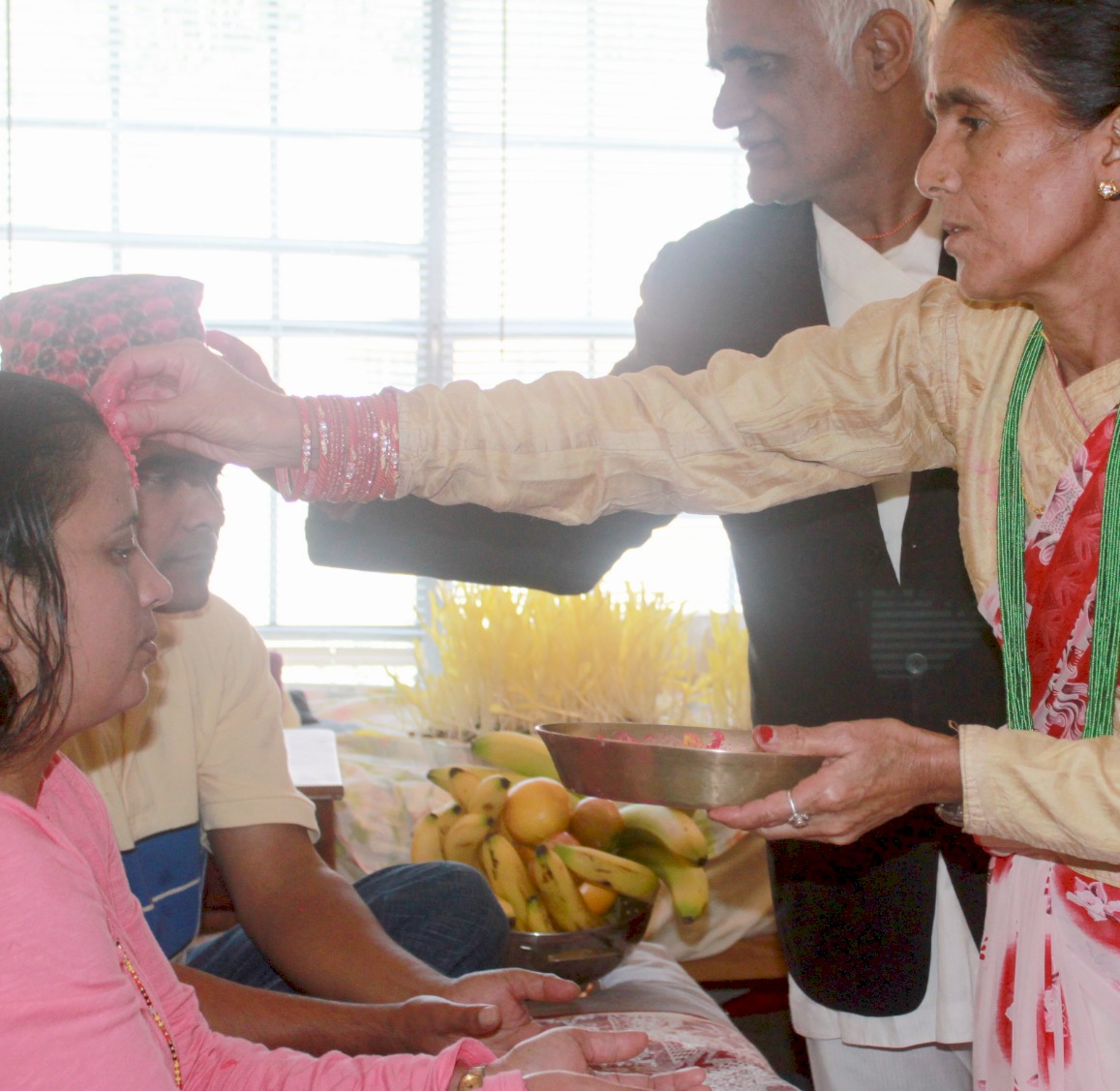
A Bhutanese family in Charlotte, North Carolina receives Tika in Dashain from their relatives in 2011. Photo/BNS archive.

Our traditional ways to celebrate Dashain and Tihar would fall under the “High Risk” gathering, defined by the CDC as, “Large in-person gathering where it is difficult for individuals to remain spaced at least 6 feet apart and attendees travel from outside the local area”. 

The actual Dashain celebration requires the oldest member of the family to offer a blessing to his/her children and grandchildren by putting tika. This might prove impossible while maintaining a six feet distance. Also, the oldest member of the family has to offer tika to all younger folks. The risk of contracting the virus or passing it on would thus be at a higher level. A person might not have the symptoms, but might be asymptomatic and not know they are infected thereby exposing others to the virus.

According to the CDC, older adults and people of any age with chronic medical conditions such as heart disease, lung disease, and diabetes, are at a higher risk if infected with the virus. Our community is also at risk because of poor health literacy and the lack of access to vitally important health information such as CDC’s festival guidelines due to language barriers. 

In low-resource communities like ours, community based organizations and health care professionals should continue to disseminate vital information about the virus. The agencies at all levels, including faith-based organizations, must take responsibility in informing the public and helping guide them about how the virus has changed the landscape requiring a new approach to maintaining our religious and cultural life.

Bhutanese community leaders must work with health care leaders and legislators on the public health issues that impact us while working to create opportunities through legislation, policy, or resources to improve the current situation.

And as the numbers of COVID-19 related deaths and cases continue to rise at an alarming rate, it’s time for us also to rethink how we are going to celebrate some of these festivals during this pandemic. We all should contribute, equally and unconditionally, towards saving as many lives as possible by strictly following the CDC guidelines.  

__
Bhuwan Gautam is a senior advisor to the Bhutanese Society of Western Massachusetts. He holds an MPA from Westfield State University.

Bhutanese-Owned Business Receives A Prestigious Award In Sydney

26,644

The Gentle Procedures Sydney, a business owned by former Bhutanese, has won the prestigious Penrith Local Business Award in the Outstanding Health Improvement Services category in Sydney, Australia.

Dr Naresh Parajuli and Dukka Pokhrel, the co-owners of the business officially received the award on October 13, 2020 at the Penrith Panthers Club where an estimated 400 people were present in the audience.

“We are so happy that our hard work and our dedication is recognized, appreciated and rewarded, said Mrs Pokhrel talking to BNS, adding- “We would like to thank our clients who voted for us”.

This a tough and competitive award, securing the win from amongst 295 finalists and among 16 vying for the plaque in the Outstanding Health Improvement Services category.

Through the Facebook page of the Association of Bhutanese in Australia – Sydney, Dr Parajuli generously dedicated the award to all youths and young entrepreneurs of Bhutanese communities spread across Australia and all over the world.

The Gentle Procedures Clinic is a dedicated provider of no-scalpel, single-puncture, minimally invasive vasectomy in Sydney.

___
Lakshmi Dhakal from Victoria contributed to this report.


Why And How We Should Celebrate Dashain And Tihar Differently This Year 

26,644

Let us celebrate our upcoming festivals in a different way, given the fact that the pandemic has already taken thousands of lives.

I recently started the campaign #differentDashain. The goal of this initiative is to help prevent a surge of COVID-19 cases within the Nepali-speaking Bhutanese community during the festival of Dashain and Tihar – which fall in the last week of October and second week of November respectively.

We celebrate both these festivals by gathering in both small and large groups, where a close physical proximity is unavoidable. The way we celebrate these great festivals is more than likely to increase transmission of COVID-19 from one person to another. 

Traditions and people’s outlooks change. The idea of Dashain is not entirely rooted in physical gatherings and parties. According to Hindu mythology, the true purpose of Dashain is to simply celebrate the victory of good over evil. These other traditions of physical gatherings were added in order to help us feel connected and united as extended families. 

However, unity and connections have transformed a lot since then, and  they no longer require physical presence. The feeling of togetherness, although not completely similar,  can be brought upon through numerous platforms such as FaceTime and Zoom, and therefore, it is now  possible to celebrate Dashain/Tihar while remaining physically distant. 

I want this message to go far and wide  within the Nepali speaking Bhutanese community. Let’s find creative and safe ways to celebrate this year.

We have a group of youth and a planning committee working collectively on this effort. Working alongside Bhutanese Community Association of Pittsburgh and  Allegheny County Health Department, we have made some great strides here in Pittsburgh regarding  the discussion of safe celebrations. So far, we have a Facebook page (Different Dashain), an Instagram page (hamro_public_health) and a  hashtag (#DifferentDashain).

Recently we also hosted a webinar for women in which we brought an epidemiologist and two nurses from within the community to speak about COVID-19, festivals, school safety, and social stigma. The webinar was a huge success as we received positive feedback from numerous attendees after the meeting. Many suggestions, such as celebrating outside with masks on or even only celebrating within immediate family, were presented and discussed. We have also organized webinars for youths. 

However, reaching out to seniors due to their lack of knowledge and familiarity in technology has led to some delays and complications. Despite that setback, we are in the process of creating customized masks with our hashtag. These masks will be distributed for free a week before Dashain. We hope that the mask itself will serve as a reminder for people to celebrate differently, as well as help promote our initiative. 

I am grateful to have received tremendous support and positive feedback from many members of our  community. If  you are interested in joining our team or want us to host a webinar for your local community, please feel free  to reach out to us via any of our social media platforms.