A Longtime volunteer and BNS Editor awarded

26,644

Rup Pokharel, one of the longtime community volunteers in Pittsburgh and managing editor of Bhutan News Service (BNS) is awarded ‘Community Health Partnership Champion Award-2015’ by University of Pittsburgh Medical Center (UPMC), Center for Engagement and Inclusion amidst an appreciation event, August 26, 2015, in Pittsburgh.

Rup Pokharel receiving award from Alieu Nyassi and Sandra Wells from UPMC, Center for Engagement and Inclusion

In the recognition note, UPMC, Center for Engagement and Inclusion noted:

“As a leader and President of the Bhutanese Community Association of Pittsburgh (BCAP), Rup has dedicated his time empowering the community newcomers as well as the community members that have been in the country for a while to grow personally and collectively, appreciating the cross cultural elements their new life has to offer. He has engaged UPMC by bringing our attention to challenges faced by his community in accessing quality healthcare services. He has participated in numerous lunch and learn events to educate UPMC employees on immigrant and refugee health.”

Pokharel works as a service coordinator in Jewish Family and Children Services (JF&CS) in Pittsburgh for a program-‘Immigrants Services and Connections’ (ISAC). Besides this, he also runs a popular program Refugee Support Group in the neighborhoods of Pittsburgh engaging seniors and persons with disabilities since November 2013, working with other community volunteers. This program has helped identifying problems of the community members and referrals are made to the related resources.

Pokharel with co-workers and friends from JF&CS during the event.  Photo: Harka Rai
Pokharel with co-workers and friends from JF&CS during the event.
Photo: Harka Rai

“This recognition is not just a recognition to an individual. This is the recognition given to a newest community by an esteemed institution like UPMC and is the outcome of the selfless services rendered by the community volunteers. I heartily appreciate the role played by the volunteers to ease the lives of the vulnerable families and individuals differently”, said Pokharel.

The note of recognition from UPMC further reads, “Bhutanese Community Association of Pittsburgh (BCAP) is solely dedicated to empowering their community not only to navigate this city but also to help them live in safe neighborhoods and grow with the beauties of the cross-cultural elements. Rup has helped the Bhutanese Community in need access different services and awareness programs. Some members of the community are UPMC employees, many of them began their careers as EVS and gradually advanced in their careers. Today, three new RNs from the Bhutanese Community have accepted employment at Magee Women’s Hospital. We are proud to have Rup and BCAP as a partner to Advance care for the undeserved.”

Pokharel being honored. Photo: Harka Rai
Pokharel being honored.
Photo: Harka Rai

BCAP is one in the list of successfully managed Bhutanese Communities in the US that has achieved ‘not-for-profit’ status in October 2014. BCAP is also the recipient of Ethnic Community Self-help Federal grant funded through the Office of the Refugee Resettlement (ORR), and Jefferson Regional Foundation a local grant. With those funds at hand, BCAP runs more than a dozen programs benefiting community in the areas of English Language and Civic Education, Women Empowerment, Parent-Child Club, Senior Engagement, Yoga for Healthy Mind, Community Gardening to name some.

Speaking to BNS, Kishor Pradhan, former president of the Bhutanese community in Pittsburgh said, “Rup has served the backbone of our community. I feel very confident that community projects will reach to higher limits under his leadership and this recognition to him is well deserved. I feel proud to have him as our community leader”.

Another Board of Director, Ashok Gurung shared a story: “Before I met Rup in 2012, we were known to each other by email and phone only. It was in early 2011 when I was working over the phone as an interpreter serving a client in California, I had to seek  Rup’s help as he was first resettled there.  As an interpreter, I could not disclose any information of the client to Rup, but I needed his help.  Without asking for any detail, Rup expressed his availability to help. It was so amazing to know later that the client got help and his prompt willingness brought differences. This describes how Rup is.

Looking at his dedication and passion to serve, the community has taken right decision by unanimously electing him as the president. We are just strong with him being in our team. So he deserves this award in the best interest of Bhutanese community in Pittsburgh”, Gurung further adds.

Seattle hosted Inter-City Soccer Tournament

26,644

Bhutanese Community Resource Center (BCRC) organized a one-day inter-city soccer tournament  in Washington Seattle, August 20, 2015 .

Winning team from Tukwila Photo: Tek Kafley
Winning team from Tukwila
Photo: Tek Kafley

Total of eight teams from Tukwila, Burien, Kent, Everett and Spokane participated in the tournament. The matches played in the Tie High School stadium entertained over 250 resettled Bhutanese from the city.

“This is the 5th year that the community is organizing soccer tournament annually for community engagement and providing access to youth to excel their skills. BCRC is hosting inter-state tournament in 2016 in Washington. From this tournament we are making a team comprising of selected players from different cities and that team is aimed to represent Washington State next year”, said Pralhad Gurung, President of BCRC.

Another senior Ram Adhikari said,” These types of engagement and recreational activities help reducing the sense of loneliness among the home-bound seniors in the community. Also engage youths and develop relationship- as well as they will have opportunities to exhibit their skills. Everything is new for most of us in this new home country. Through such games and events- talents of our children get exposure.There are instances some children from our communities in other states got selected for soccer training through some clubs in Europe. That is something we are proud of.”

The final match played between Tukwila and Everett ended in favor of Tukwila with 5 – 1.

Road to College Project – Series II

Launched in August 2015, 

Back to College is one of the projects of Bhutan Media Society (BMS), designed and aimed to encourage resettled former Bhutanese refugees in the Diaspora to achieve higher/college education. BMS shall undertake research, document success stories, conduct interviews and publish articles relating to the subject.

Generally observed phenomena, the rates of Bhutanese students enrolling into college education in the U.S., after completing high school is still low. The lower college enrollment is attributed to low level of motivation and lack of enthusiasm to pursue goals in life, the professional goals that demand higher academic performance, among others. This is the area BMS shall venture to investigate and act as medium to project role models and success stories of the community.

Click here for FAQs about the project.

In this series, two former Bhutanese refugees currently living in Manchester, NH, Mr Ganesh Sharma and Mr. Ashish Kharel, who are recipients of the Gates Millennium Scholarship chronicle how they received it, the application process and what it means for them to receive such a prestigious scholarship award. Mr. Sharma is majoring in Mechanical Engineering from the University of Vermont, while Mr. Kharel is undertaking four-year degree in Electrochemical Engineering from Wentworth Institute of Technology. Meanwhile, the duo also highlights the significance of pursuing higher/college education. This interview, which has been reproduced with due permission from the Hamro Awaz and its host Mr. Tilak Niroula,  serves as a part of the project run by Bhutan Media Society (BMS), and all articles/interviews relating the project shall be published in Bhutan News Service website (BNS- www.bhutannewsservice.com).

To learn more about The Gates Millennium Scholarship, visit this page – https://www.gmsp.org/

Bhutanese Seniors made DC tour

26,644

Bhutanese Students Group of Pittsburgh volunteered escorting 44 Bhutanese seniors to DC through a program named First Bhutanese Senior D.C tour this August 15, 2015.

Participants in front of Monument Tower, Washington D.C Photo: Ashok Gurung
Participants in front of Monument Tower, Washington D.C
Photo: Ashok Gurung

“As a part of our school’s curriculum and assignments, we visited many Bhutanese families in different neighborhoods. We interviewed many seniors in our visit. Based on interviews and surveys, we found mostly the seniors at home in different neighborhoods of Pittsburgh. To learn more about their desires, aspirations and experiences in the new country, we used a set of questionnaire. Most of the seniors are found feeling lonely in their apartments. They expressed limited access to recreation and socialization outside their apartments. So we, the high school graduates and college students, thought of this program that would recreate the elderly people”, said Yadhu Dhital and Narayan Phuyel, two of the student leaders of this program.

Speaking to BNS upon arrival from the tour, Hari Lal Khatiwoda, one of the participants, said, “I am in my 70s. I was born and raised in Bhutan. I worked in construction sites of many roads connecting different districts in Bhutan during my youth. I had a wish to see its capital Thimphu one day, but could not make it. Situation landed me to a refugee camp in Nepal. I stayed for  18 years in the camp. I attempted many times to visit Kathmandu, the capital city of Nepal. For refugee like me it was like a dream. Later my family opted for the third country resettlement. One day I and my family landed in Kathmandu on our way to the US. I just said- though I could not see the places of my interest at least could put my feet in Kathmandu.

Participants in the Museum Photo: Ashok Gurung
Participants in the Museum
Photo: Ashok Gurung

We arrived in the US and started the new life. I could not do anything here other than simply growing old in this vast land. I was unaware of where might be the capital city of my new home country. I began attending English language and Civic Education classes managed by our community organization (BCAP). Through the instructors I knew of Washington DC as the capital city of the US. One of my questions got the answer. But, I became so happy when I first heard about a group of students from our community planning to take seniors to the capital city of the US. I prayed for my luck. Finally I got a call stating my name was listed among the participants. I visited many places.  I cannot remember all the names, but I am carrying all the pictures in my mind. I am happy that one of my dreams is fulfilled.”

Another participant Chitra Singh Gurung shared his experience bit differently, “students from our community proved that they are getting real education here. I must bless all those students who in them have sense of care, love and respect towards the seniors in the community. This is how I wish our young generation should grow. I am glad that they provided me an opportunity to visit DC, which was almost impossible on my own. More than that, I am happy to see our children taking caring of us. The better days for the seniors in the community are  in the offing.”

Participants exiting the historical site Photo: Ashok Gurung
Participants exiting the historical site
Photo: Ashok Gurung

Hema Neopaney and Uma Gautam, two of the female volunteers speaking to the BNS informed that they managed to volunteer escorting our seniors to Smithsonian National Air and Space Museum, Washington Monument, White House premises and other sites of historical importance. “I learnt a lot from them all along the trip about their past life experience”, said Uma. While Hema Expressed, “I felt we were missing an important chapter in my life. Our seniors are really our living history. We became a good friend of many seniors in the trip.” They both were feeling a sort of incompleteness in not being able to take all the interested participants this time yet they are equally cared and stated that their desire shall be met. “We thank the sponsors Jefferson Regional Foundation, Barsha Jewelers and BCAP volunteers from the bottom of our heart in helping us making this first trip a successful one. We are happy for the good number of women participants in the tour, but bit disappointed on seeing less number of female volunteers. We wish more girls joined this type of services and learn.  We have more than 45 participants in the waiting list. We are looking forward to having some sponsors for the second trip”,they said.

Suraj Nepal, Bhagawath Phuyel, Sashi Timsina and Tul Odari assisted the overall management of the trip. It is learnt that a team of eleven volunteers escorted the senior’s D.C trip.

Can Nepal easily let go of the ‘Hindu’ Crown?

26,644

23678_105500872811014_4787646_n

For the sake of a line,” Nepal shall remain as a Hindu Nation” — struggling to get in within the lines of the new constitution, this small Himalayan nation, gradually recuperating from a massive earthquake a few months ago, is again overrun by series of street clashes, public demonstrations, cries and calls. While, one group is desperately demanding Nepal as a Hindu State the other lots mostly emanating from ethnic fraternities are vehemently opposing the idea and calling for a secular Nepal. The grim and degrading scenario has become the routine of the day leading to the obstruction of daily lives of the general mass. Indeed, Nepal is presently going through an incalculable spell of doom and uncertainty.

Scanning through the region, though Bhutan has a credible presence of Hindu population, it is still globally seen as a Buddhist nation. Beginning the decade of 80’s, the fourth King Jigme Singye Wangchuck maneuvered a policy of integration that candidly tightened royal grip on the prominence of Hindu cultural life in the south. The resentment that grew in the south unfortunately culminated into ethnic cleansing.

But today the scenario is of mending the fences. After transformation from absolute monarchy to constitutional monarchy brought about by the fourth king himself in 2007, a new lease of hope to continue the cultural and religious life, for the rest of the minor religious groups prevails. Interestingly, the new Buddhist King can be seen inaugurating Hindu temples and receiving blessings from the pundits (priests), often. A shiva temple in Samtse is built on generous sponsorship of the fifth King.

The Islamic Republic of Pakistan is built on a frame of Islam wherein all the minor and ethnic groups enjoy equal rights despite some sporadic disputes and violence unleashed mostly by terrorist outfits. Bangladesh, another giant in the South East Asia, has been able to accommodate all faiths and creeds in spite of having a Muslim majority. Hindustan, indigenous name for India, is all comfortable with the presence of all sects and beliefs, though faith-triggered violence at local level have dotted the history of India. Meanwhile, as a big brother and presumed caretaker of the entire region, India is also pulling hard to see Nepal as ‘an only Hindu State on the planet’—- for Nepal is not only recognized as a country of valiant Gurkhas and the Mt Everest, the tiny Himalayan nation is widely seen and understood as a center for consolidating and disseminating Hindu ethos, philosophies and values among Hindu populace all across the globe.

Sadly, and seemingly in an absence of extensive research and valid judgements, Nepal—also admired as a Shangri-La of the East—is again going through a series of religious turmoil with unpredictable odds.
Hardly any one realizes the fact that if there can be a hundred Islamic and Christian nations with their ‘Christian or Muslim only’ constitutional provisions for their head of the states; democracy and pluralism can still flourish in a royal Britain with a Church of England taking care of the faith officially and any US president taking oath on Bible without murmurs from citizens belonging to other denominations, why on earth, a lonely Hindu nation can pose such perceived threat to democracy and egalitarian values, while it ensured full freedom to all for propagation and practice of whatever they believed in? To spill the fact right here, over 80% of the population in Nepal remain Hindus.

Agreed, that the current spill of violence and frustrations are grossly alluded to the social imbalances and chaos emanating from the age long practices of untouchability, castes and classes which have been long embedded in Hinduism since time immemorial. Many in the lower echelon believe that the religion has suppressed and victimized a sizeable section of the followers creating social and economic gaps due to which they have not been able to rise and excel in the sea of ordinary humans. Many independent observers believe the caste-based segregation among the population might be the chief instigator leading to a number of offshoots, fragmentations and switching to other faiths from the mainstream Hindu. Moreover, in the context of Nepal, a few of the self-styled marginalized groups are quick to cry foul, openly propagating that Hinduism is a brain and power tool of some delusively bigoted and perceived segments, especially Chhetris and Bahuns to rule and dominate others !

Furthermore, as if like venting an ire to someone or paying an old score, some breakaway fanatics and converts are all out openly ridiculing our Vedic discourses without an iota of regard to other faiths. Almost every day, journals, broadsheets and other social networking outlets are washed with contempt, satires and pictorial pummels against Hinduism despite knowing the fact that besides being too liberal, this Vedic religion is also on the wheel of radical transformation.

However, as modern humans in a civilized world, it is also equally important to accept the fact that things are getting better. Yes, there are many ills and age long notorieties making inroad and infesting Hinduism which might have been the stumbling blocks within the social strata. But we, as modern Hindus, have also reached a stage where we can pick the right and discard the wrong. Reforms, refining and inclusions within the religion is steadily happening in a greater pace. Hindu scholars, pundits, theologians and think tanks are all in a lookout for feasible solutions to accommodate all and timely stem the staggering rise of dissenters, converts and off shooters within the Hindu denomination.

Hinduism is one of the oldest and major religions of the world, and given that the small and beautiful Himalayan nation bereft of her ‘Hindu’ crown largely in the name of secularism, Nepal—as an only Hindu State and the last bastion of Hinduism—will only lose her charm of being an universal epicenter of hope, charisma and divine relevance. Not only the larger populace in the country, perhaps all Hindus across the sphere, at this hour of impending doom are relentlessly praying not to see the last nail in the coffin—- the elimination of the iconic tab “Hindu” alongside Nepal in the upcoming charter of Nepal’s republican polity.

Editor’s note: The opinion expressed in this writing is solely of the author and does not reflect in any way of BNS.

17 year old student died in lake of woods Kenora

26,644

17 year Nishan Chamlagai and six of his friends did not know how soon they can return from their trip to lake of the woods in Kenora, Ontario, a four hour drive from Winnipeg, where their parents were resettled from refugee camps in Nepal.

Late Nishan Chamlagai

On Friday evening, all boys except one, under eighteen, gathered in a neighbor’s house for a sleepover. Next day, they all set off for a gathering in a park. For additional fun, they also wanted to go for swimming, driving almost four hours to Kenora.

At around 2:30 pm, Nishan’s friends came out of water to look for him, and did not see him around. They thought he headed back to car where they parked. But he was nowhere to be found. The six youths went back to the water where they swam again, and one of them located Nishan in deep waters.

The police was called, Nishan taken to hospital, but was dead already. The police suggested that the dead body shall be handed over to the police in Winnipeg, and the family shall be informed in one or two days. Police informed a relative of Nishan’s death by drowning.

According to a source in Winnipeg, Nishan’s body is not yet returned to the family and his funeral date not determined.  “The death of a son for illiterate parents has been traumatizing”, said the source.

Nishan is a high school student survived by an elder brother,  parents and grandparents. The Chamlagai family was preparing to move to Quebec as they face this unexpected loss of family member.

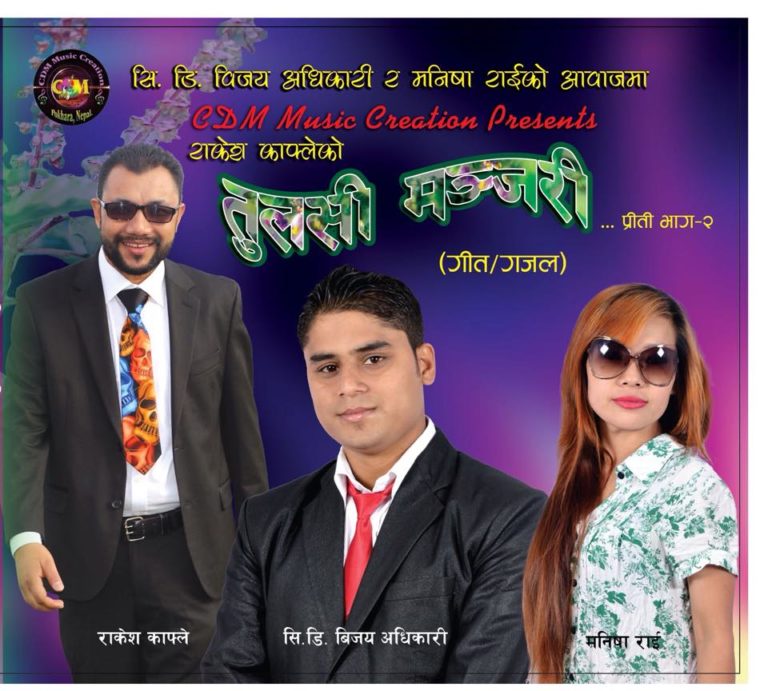
गीतकार काफ्लेको एकल एल्बम प्रकाशित

नेपालीभाषी भूटानी युवा गीतकार राकेश काफ्लेका एकल शब्दहरू र विभिन्न छुट्टा छुट्टै भावमा संग्रहित “तुलसी मञ्जरी” गीत तथा गजलहरूको संगालो एल्बम गत माहिना बजारमा आएकोछ ।

तुलसी मञ्जरीको आवरण
तुलसी मञ्जरीको आवरण

एल्बमकी प्रमुख प्रकाशक तुलसा रेग्मीका अनुसार उक्त सङ्कलनमा दुई श्रृंगारिक गजलहरू र पाँच समसामयिक आधुनिक गीतहरू रहेका छन्।

राजु कार्की, वसन्त सापकोटा, उमेश सुब्बा लगायतका संगीतकारहरुले सङ्गीत गरेका गीतहरुमा पोखराका युवा गायक-गायिका सिडि विजय अधिकारी र मनिसा राईले आवाज दिएका छन्।

२०१५ सालको जनवारीमा दिवाङ्गत भएकी गीतकारकी हजुरमुमा स्व. मनमाया काफ्लेप्रति समर्पित तुलसी मञ्जरी अमेरिकाको आइओवा राज्यबाट तुलसा रेग्मी र राजन छेत्री, मिचिगन राज्यका नन्दु दंगाल र ओहायो राज्यका यादव प्याकुरेको आर्थिक सहयोगमा बजारमा आएको हो ।

“वितेर जानु भएकी मेरी ममतामयी हजुरमुमा प्रति समर्पण र मलाई जन्माउनु हुने मातापिताको सम्मानमा यो एल्बम प्रकाशन गर्न पाउँदा म अत्यान्तै भाग्यमानी महसुस गर्दैछु । मलाई सहायता गर्नु हुने सबै प्रति कृतज्ञ छु ।” – भूटान समाचार सेवालाई प्रेषित सन्देशमा गीतकार काफ्लेले उल्लेख गरेका छन् ।

कला क्षेत्रमा सानैदेखि लगाव राख्ने काफ्ले पुनर्बास कार्यक्रमपछि पनि साहित्यमा निक्कै सक्रिय छन्। काफ्ले भूटानी ढुकढुकी कार्यक्रमका सञ्चालक पनि हुन्।

Hindu conference for uniformity and transformation

26,644

Bhutanese Hindu priests, volunteers and followers of Hindu faith from various states in the US and Canada attended the 2nd Bhutanese Hindu National Conference at Columbus, Ohio on August 9, 2015.

‘The oldest religion on planet Earth, Hinduism is better termed as ‘way of life’ that believes in philosophy of Vasudhaiva Kutumbakam, meaning the world is one family, has guided our lives and  shaped our way of living wherever we lived till now from the time unknown. The shared concepts and the spiritual values taught to the mankind by our pristine Vedas and Upanishads are but a vast science. It has become our prime responsibility to educate our children in this modern era to know the preserved values and beauties of the richest culture’, said Bhim Bastola one keynote speaker during his inaugural speech to the conference.

Pundits as the observer of the conference Photo: BNS
Pundits as the observer of the conference
Photo: BNS

Speaking on one of the topics of the conference-need of a national level organization, Kashi Adhikari, Chairman of the Vedic Welfare Society of Columbus, Ohio, said- ‘By birth our ancestors are the family members of the Sanataan Dharma,the eternal law and the very legacy entrenched based on our faith, belief, the way of performing rituals is  inherited onto us. Depending on where we lived, availability of the resources, type of governance we were ruled by and the level of education we achieved have prepared us and taught the way of following the principles of the Sanatan Dharma. Thus, people may see some disparity, inequality, and superstitious sounding culture among us, but the true essence of our culture is so pure and pious’.

‘We should not understand that sense of disparity and inequality is the spirit of Sanatan Hindu Dharma. No epics or our holy Upanishads carry any such clauses that encourages or patronizes inequality. The problems we are with are the outcome of the myopic views designed by the political rulers of the past. It will be a blunder to blame the philosophy. Philosophy is being misinterpreted and becoming cheaper’, Kashi further said.

Pundit Bhim Timsina addressing the conference Photo:BNS
Pundit Bhim Timsina addressing the conference
Photo:BNS

Speaking to BNS, on behalf of the organizing committee Bhuwan Pakurel said, ‘We had our own way of practicing religions while in Bhutan. We practiced the same in the refugee camps too. While performing some practices we have adopted modified ways little differently. In the refugee camps, situation taught us differently to cope with then existing environment. Now we are practicing the same in a new and advanced place. We are in the advanced place, but our way of thinking requires timely refinement or rectification.  The calendar that reads our important festivals and occasions is confusing us. Basically, the calendar we use is prepared based on the planetary positions calculated by the astrologers based on Nepal’s time zone and celestial positions. One of the efforts is to have uniformity in observing our festivals and special occasions. We should not confuse our younger generation any further. So had there been an organization of ours in the US that determines the appropriate dates and days- would lessen the confusion’.

So, we have gathered here on realizing the need of organizing a discussion among our Pundits (Gurus) and stakeholders to simplify or adopt some changes while performing some of the rituals and pujas. An individual or a selective group of people cannot make such decision. For an appropriate, long lasting and reasonable amendments on some of the important aspects of our practices we young generation seek guidance, suggestions and education from our reverent Gurus and Swamis. So we have regarded this conference- a warm-up session’.

Pundit Acharya Shree Bedhanidhi Subedi, Pundit Shree Bhim Prashad Timsina, Pundit Shree Ghana Shyam Regmi and Shree Ganga Ram Lamitaray applauded the initiative undertaken by the young generation in the quest of preserving the ancient Sanatan Dharma and its practices and divine values. They stressed in educating younger generation starting from home, festivals, pujas and ceremonies. Education is foremost for any types of developments. ‘The path to belief systems and practices our ancestors adopted is the foundation of all the sciences. Everything we practice has a scientific basis. Superficially, our practices may seem superstitious and many people see it so but are scientifically appropriate. Thus, the vast philosophy of the science is the Sanatan Dharma and timely simplification on modus operandi cannot be ignored and should always be par with our Upanishads’, they said.

Ad hoc committee member, Arjun Rasaily, addressing the conference Photo: BNS
Ad hoc committee member, Arjun Rasaily, addressing the conference
Photo: BNS

Arjun Rasaily, a member of the ad hoc committee and one of the noted artists in the diaspora speaking during question-answer session said, ‘I am glad to see the needed discussions taking place. We have some problems. We all have seen and endured. We all are witnessing. Yes, we have some areas in practices requiring changes. And, this type of healthy discussions, interactions, conferences and broader consensus will definitely minimize or bring to an end those issues anticipating amendments. Let us work together, think together and give a better and stronger foundation to our richest culture respecting the broad spectrum of Sanatan Dharma. Beauty lies there- where respect, discipline and values is given due care. Our esteemed Upanishads have directed us for what to do and what not. Let us follow the principles.’

Arjun Pandit, another speaker of the conference expressed his happiness, ‘something had to start for better and has now begun. Working and thinking together brings a good and lasting result. The three Pra(s) Prayash, Pratickshya,and Prarthana of thousands for decades is now in the course to its fruition. It will be always easy to find a middle path for any difficulties or problems and we can. Realization is the best remedy to real healing. We should learn to respect everyone’s wishes and move ahead collectively to take our already rich culture to its new height, I am thrilled to see this thing happening.’

One of the key persons of organizing committee, Kamal Subedi, presented the structure, mission and vision of the proposed organization. ‘Without a goal we cannot move ahead. The goal we have envisioned today may be replaced entirely by a new one or may deserve some changes. Something well pondered structure should come before us and that shall guide us to the defined tracks, so that our younger generation can easily cope with what our prime vision teaches us. Flexibility should be adopted while addressing the issues and shaping the vision to make everyone feel that no one is excluded and has something to be proud of,  but not at the cost of losing the divine thread that guided us spiritually to date and that is the true essence of Vasudhaiva Kutumbakam, Kamal Subedi said.

The conference ended by declaring an eleven membered ad hoc committee comprising of representatives from various states. The conference decided to assign Kamal Dhimal from North Carolina the coordinator of the committee.

Participants attending the conference Photo:BNS
Participants attending the conference
Photo:BNS

Kamal Dhimal, the coordinator of the ad hoc committee said, ‘ the main work of this committee shall be -to organize series of interactions involving Pundits, priests, scholars- to identifying areas of discussions and specific practices and problems,-to include people from diverse groups in the discussion,-to compile and document the outcomes and present during the third conference.

One of the main objectives of the third conference shall be to constitute a formal representative body in the National level and start working for addressing the issues documented from different states. The date and venue of the third conference shall be discussed and made public’.

The first conference was held at Charlotte, North Carolina in 2013 coinciding with a community organized Saptaha Puran (seven days long recitation and oration of Shrimadh  Bhagawad, a sacred epic of the Hindu Philosophy).

One day volleyball in MA

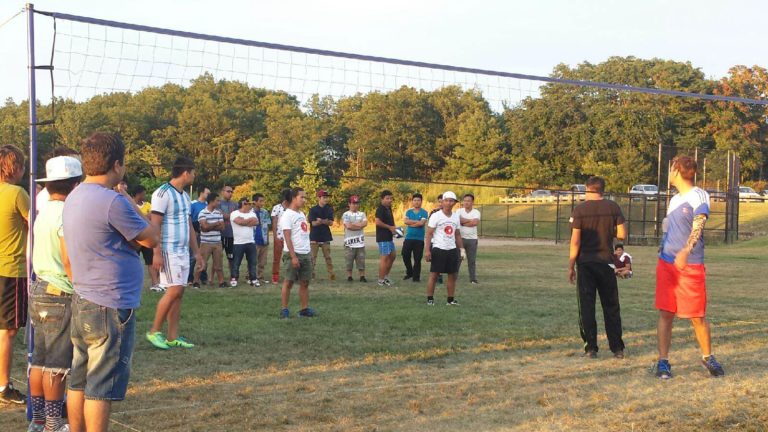
Coming a long way from other end of the globe, the Bhutanese refugees brought along sports, culture, talents and value systems to their new home in cosmopolitan cities of the USA. Soccer and volleyball are two sports and favorite pastimes for all ages of Bhutanese folks, which are gradually taking roots in the sports arena of US cities where Bhutanese are resettled.

Playing volleyball is favorite pastime for Bhutanese resettlers
Playing volleyball is favorite pastime for Bhutanese resettlers Photo:CM Nioula

Continuing such a tradition, Bhutanese community of Massachusetts (BCM) organized one day interstate volleyball tournament August 9, Saturday in Gill Hill park Worcester MA. Six teams from Worcester, lowell and New Hampshire contested the tournament.

Talking to BNS, Nandu Mishra, President of the community organization stated, “Our people feel loneliness, traumatized and are having hard time to cope up with the fast pace of life in this sprawling urban community. So, in order to have refreshment and interaction, we organized this tournament .”

Volleyball in action
Volleyball in action/Photo: CM Niroula

“The youth want gathering for sharing, and we need youth participation for social undertakings. By means of engaging them in the social service, we can easily bring positive changes in community. Therefore we organize such games to engage them and bring out more talents,” said Ganesh Gurung, the executive director of BCM

“Keeping ourselves at home, we may think of being alone, which result to some kind of bad thinking. But if we organize such kind of events regularly, at least people can socialize and get chance to engage in creative activity”, Mishra added.

Concord NH won the final to Worcester MA with 25-23, 22-25 and 25-23. The president and executive director of BCM thanked the volunteers and players.

Musical show in Des Moines releases a new album

26,644

As a part of promoting cultural values, art and music, Bhutanese Community in Iowa (BCI) organized Iowa Musical Show on July 25 in a space at Nathan Weeks middle school. Promoting and encouraging Nepali music and local artists was the highlight of the program, as could be evinced by mix of artists from North Dakota, South Dakota, Missouri, Nebraska, Ohio and Colorado pouring in. Tulsi Manjari, a collection of eight song, composed by emerging lyricist Rakesh Kafley was launched during the program. Tulsi Manjari,(literally the infloresence of sacred basil), is a collection of songs, sung by rising vocalists.

MC Bhola Siwakoti (Puranaghare) with other guests and invitees

Other attraction of the program was Yam Baral’s melody of his debut songs, Badaluko ghumto le, Nisthuri le chhodera. Many attendees of the program took to floor when singers on the stage performed.

Bhutanese artist Damber Khapoong Subba travelled to Des Moines from Fargo, while Bhim Gurung travelled from Nebraska and popular artists duo Manoj and Krishna Dhakal drove from Pittsburgh to participate in the event. Nepali folk songs and duet songs made more people to dance in the hall.

Participants engage themselves in a group dance

Among many others, the guests of the program were Mr. Duoa Lor, the Asian Outreach Resource Officer, Des Moines; Laura L.Douglas, Provost, Des Moines Area Community College(Urban); Mr. Vinh Nguyen, the ELL Supervisor of Des Moines Public School; Mrs. Sanjita Pradhan, the Executive Officer of Human Rights for Asian & Pacific Islander Affairs in Iowa; Mr. Nicholas Wuertz, the Director of the Refugee Services from Lutheran Services in Iowa; and Samantha Thomas, the CEO of the Global Arts Therapy.