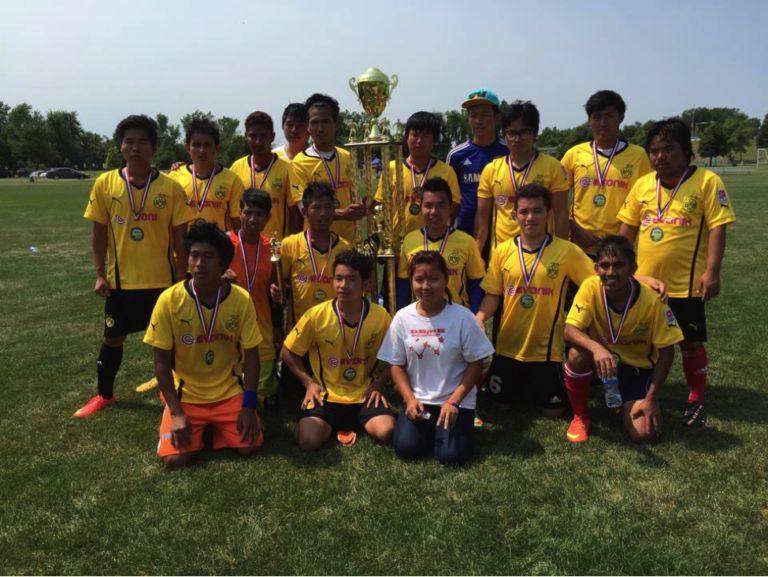
North Dakota team has taken home the first Midwest Youth Bhutanese inter-state soccer tournament, securing a victory of 3-1 goals against South Dakota during the final battle held on August 2, Sunday, in Sioux Falls, South Dakota.
Winner of the first Midwest soccer tournament 2015, North Dakota (Picture courtesy: Basanta)
The winner received a gold cup and cash prize of US $2001, while the first runner up was awarded with a silver cup and US $1001.
Meanwhile, Santosh Rana from North Dakota, who scored nine goals, received “man of the tournament and highest scorer”. Bal Paudyel from South Dakota was awarded the title “man of the match” by senior soccer player Buddhi Bhattarai from Minnesota, who came to encouraged the youths. Local certified referees monitored the entire games. The tournament was played in four different soccer fields.
Various 14 teams from North Dakota, South Dakota, Minnesota, Nebraska, Illinois, Iowa and Wisconsin participated in the two-day tournament hosted by the Bhutanese youth and community voluteers. President of Association of Bhutanese Community in South Dakota, Mr. Chhabi Neopaney, thanked organizers, supporters and youth engaged for making the soccer tournament successful. He also assured his full support from the community in future tournaments.
Launched in August 2015, Back to College is one of the projects of Bhutan Media Society (BMS), designed and aimed to encourage resettled former Bhutanese refugees in the Diaspora to achieve higher/college education. BMS shall undertake research, document success stories, conduct interviews and publish articles relating to the subject.
Generally observed phenomena, the rates of Bhutanese students enrolling into college education in the U.S., after completing high school is still low. The lower college enrollment is attributed to low level of motivation and lack of enthusiasm to pursue goals in life, the professional goals that demand higher academic performance, among others. This is the area BMS shall venture to investigate and act as medium to project role models and success stories of the community.
In this series, a former Bhutanese refugee currently living in Texas, Mr. Tika Acharya, 19, who is a recipient of The Gates Millennium Scholarship chronicles how he received it, the application process and what it means for him to receive such a prestigious scholarship award. He also highlights the significance of pursuing higher/college education. This interview is a part of the project run by Bhutan Media Society (BMS), and all articles/interviews relating the project shall be published in Bhutan News Service website (BNS- www.bhutannewsservice.com).
To learn more about The Gates Millennium Scholarship, visit this page – https://www.gmsp.org/
A seven day long prayer and religious oration, Shrimad Bhagawat Mahapuran Gyanmahaayagya began here in Salt lake city of Utah, held at auditorium hall of local Krishna Temple. Dr. Dinesh Patel, an entrepreneur and lifetime trustee of Ganesh Hindu Temple inaugurated the ceremony, which was attended by guests from resettlement agencies, religious and cultural communities, local government representatives and hundreds of devotees.
Devotees at the inauguration/Photo courtesy Khem Kafley
Speaking at the inaugural ceremony, chief guest Dr. Patel said, “The key to cultural heritage of any community is to preserve your language and your religions. The beauty of America is you can practice any religion; there are no restrictions.” Casey Cameron, Deputy Director, Department of workforce said to the audience, “Anyone who comes to this state has to be inspired from our pioneers who first came to this state. We have fewer challenges than what our pioneer might have when they came to Utah in 1847.”
Other special guests who addressed the ceremony were IRC Utah Executive Director Mr. Patrick Paulin, Mrs. Ze Min Xiao of Salt Lake County, Mrs Andrea Alcabes, Executive Director at Jewish Community Center and Rajendra Hyuju, a Nepali entrepreneur in Salt Lake City,Utah.
The President of Puran Organization Committee and Chairperson of the ceremony, Pandit Dhanapati Bhattarai, expressed his unlimited happiness for the huge support showed by the local government officials, support agencies, volunteers and from different community organizations and from within the Bhutanese community and asked for all kinds of support for the success of seven day puran(saptahaa).
Pandit Hari Prasad Adhikari, Pdt. Dhanapati Bhattarai, Pdt. Chetan Khanal, Acharya Devika Khanal and Mr Khem Kafley were also introduced during the ceremony as Pandits(priests) for accomplishing the 7 days Shrimadbhagawat Mahapuran Gyan Mahayagya.
Mr. Khem Kafley, briefly described about the realm of Hinduism and its universality.
The program aims to raise funds for constructing a community center for the Bhutanese resettled in Salt Lake.
Bhutanese youth of NH, an affiliate of BCNH, felicitated its youth soccer team in an open air event held Saturday August 1 Saturday at 133 Blucher street in Manchester NH.
The soccer team won a tournament held 18 and 19 July in Quebec Canada which was contested by five teams from USA and eight from Canada. Speaking at the felicitation program,Om Basnet, one of the organizers said,”this honoring program is organized to encourage our youth on sports and social activities.”
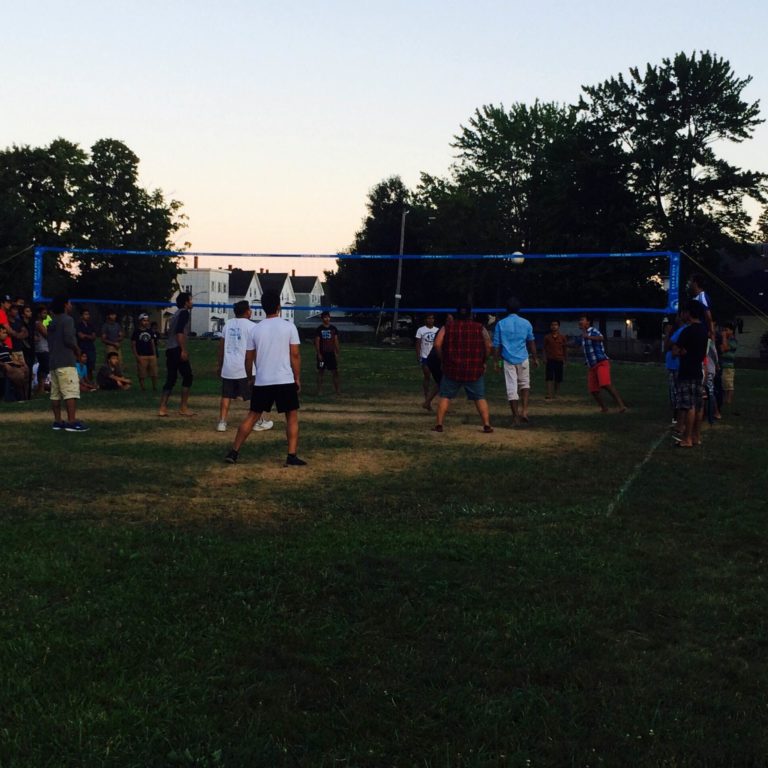
Friendly volleyball match/Photo CM Nirola
Team coach, Lal Bahadur Khadka said he and his team is thrilled to be felicitated and receive words of encouragement for future. He also said,”We will keep no stone unturned.”
Basnet told BNS after the program that they are working hard to engage youths in social activities which he believes to curb mental illness among youth and elderly people, stop feeling of suicidal thought, build up sense of “we” feeling among youth and reduce isolation. He also added, “we also like to keep youth engaged in sports and social activities to reduce drugs and substance abuse.
A friendly volleyball match was played between Manchester and Concord, where Concord won by 12-25 and 13-25.
Around sixty youths from Concord and Manchester city of New Hampshire attended the event.
Around 400 resettled Bhutanese Magar Bandhus (brothers) from various states in the US convened at Stone Mountain Community Center, Georgia for a two day long 1st Bhutanese American Magar National convention, 25th and 26th July, 2015.
Costumed with traditional Ghalyap, a scarf, Nar Bahadur Lhayo Magar, 86, and Chandra Bahadur Lhayo Magar,80, were the senior most amongst the gathering. ‘I am so glad to see our younger generation coming forward asking about one of the oldest ethnic cultures preserved amongst people of Nepali origin. Alike other ethnic groups and communities, Magar Samudaya (community) has inherited a rich culture from their ancestors’, said Chandra Bahadur Lhayo Magar with full of smile on his face pointing local artists performing folk dance on the stage.
Chandra B Lhayo (L) and Nar B Lhayo (R) Photo: BNS
‘Each community has one or the other unique culture. Living in a society with mixed culture is called a diverse community. I am getting old. I am forgetting many things. This is the time our young generation ask seniors- write, record and keep record and pass valuable messages and our shared beliefs for future use. Nothing is of less importance in its own form, anywhere- it is just a matter of how we make use of what we have inherited’, said Nar Bahadur Lhayo Magar, who talked to BNS together with Chandra Badhadur Lhayo Magar.
CK Pulami Magar, per organizing committee- founding father of Bhutanese Magar community, a former civil servant from Bhutan, a Headmaster in one of the refugee camp schools addressing the gathering said,-‘This type of meeting or the gathering, where youngest among the younger and the oldest among the older generation meet, listen and talk each other-is essential in each community to transform the rich culture to newer generations’.
‘We should not confuse anyone by wrongly defining religion and culture. We may fall under different religion but are under one culture. Culture is a shared belief, way of living and customs common between the members of a particular social group. It is an identity that distinguishes one society from another. Dress we wear, language we speak are the inherited assets from our forefathers. These are the ornaments of ours. So this convention is convened to encourage our younger generation to work on preservation and promotion of our rich shared culture’, Pulami further said.
Artists performing in Magar Costumes Photo: BNS
‘We have our own language (dialect) engrained from our forefathers. Later on some of our visionary leaders came up with the script and started documenting the terminologies, reforming the way of performing rituals and adding values to our one of the oldest considered cultures among the Nepali people. This initiative of ours is to strengthen and develop our scripts and give modern exposure so that our children will side by side grow with our Magar culture along with what they learn in modern ways’, said Sarman Samal and Gopal Samal during a chit-chat session.
It is said that the dialects Magars speak are rooted in the Bodic branch of Sino-Tibetan Family. Magars commonly use Magarkura, Khamkura and Kaikekura dielects as communicating language. They mostly believe in Shamanism and call Bhusal to their priests.
The first day entertained the audience with folk songs and dances from representing various ethnic communities.
Audience being entertained by the artists. Photo:BNS
The second day session of the convention included discussion session on various issues faced and raised by the community members from different states. And, elected through secret ballot Talman Pithakotay Magar as the president, Sarman Samal Magar as the vice-president, Badal Samal Magar as the secretary and Dhiraj Lungali Magar as the tresaurer of the Magar community.
The two day long gathering comprising of Magar Bandhus from California, North Dakota, South Dakota, Texas, Missouri, Ohio, Kentucky,North Carolina, Pennsylvania, Tennessee, New York, Georgia and Massachusetts ended with a get-together picnic at Milam Park.
Hartford public library has not been a place for an ancient poet of Nepal, neither any of his literary creation. But in the last weekend it was a chosen place for celebrating Bhanubhakta Acharya’s 202 birth anniversary, where verses from Ramayana, the Hindu epic believed to have been translated by Bhanubhakta from Sanskrit to popular Nepali was recited aloud.
Jasmati Rai playing murchunga/Photo Subash Subedi
The Bhutanese community of Connecticut organized the event on July 25, though the actual date of the poet’s birthday fell on July 1, according to Nepali calendar. The event popularly termed as “Bhanu Jayanti” was put together jointly by OBCA, Hartford library, and Bhutanese community of Connecticut and supported by Bhutanese welfare community of western Massachusetts, Hindu Sanatan Sewa Samaj.
The event was marked by recitation of various sub-genres of Nepali poem: Haiku, Gazal, ruwai by the participants from US, UK and Canada.
Over the Skype, Dr. Khagendra Luitel of Nepali Department, Tribhuvan University
participated as guest speaker, with with highlights of poet Bhanubhakta’s contribution to Nepali literature relevant to all sections of Nepali populace, and across boundaries in the Nepali Diaspora.
High school graduates of 2015 were also honored in the program felicitating them with khada and certificate.
Another attraction of the literary program was resonating traditional Nepali musical instrument, Murchunga, by 75 years old Jasmati Rai. The vibration produced by a string held one end in mouth and played by a finger to produce rhythms is indigenous to Nepali music.
Poem recitation/Photo Subash Subedi
Speaking at the function, Shankar Dhakal, the president of Nepalese Association expressed his appreciation to the Bhutanese community of Connecticut and OBCA for organizing such events to promote Nepali language, literature, music and arts.
He also welcomed a greater degree of collaboration between Nepalese Association and Bhutanese community for such events of common culture.
CEO of Harford public library, Matt Poland applauded the Bhutanese community for bringing a rich linguistic and cultural heritage.
The Association of Bhutanese in America (ABA) held its 8th annual convention July 25 and 26 in Des Moines, Iowa. The convention was hosted by members of the Bhutanese community of Des Moines and attended by resettled folks in Iowa and nearby states.
Address by Vishwanath Chhetri/Photo: aba-usa.org
Various guests addressing the convention, included San Wong, Director of Iowa Department of Human Rights; Sanjita Pradhan, Member of the President’s Advisory Commission on Asian and Pacific Islanders; Samantha Lee Thomas, Director of Global Arts Therapy in Des Moines; Zeljka Krvavica, Director of the Bureau of Refugee Service; Dilip Biswa, a Bhutanese human rights activists; Parmananda Khatiwoda of Bhutanese Community of Minnesota and Mangala Sharma, a longtime woman activist in Minnesota.
Lourdes Stevenson and Lara Hanson of Primary Health Clinic in Des Moines, Rekha Basu of Des Moines Register, Nicholas Wuertz of Lutheran Service in Iowa, and Rohey Sallas of USCRI also attended the two day session of discussion on issues facing immigrants and refugees, focusing on resettlement of Bhutanese refugees.
Parangkush Subedi from the Office of Refugee Resettlement’s Division of Refugee Health and Dr. Chhabi Lal Timsina provided very helpful sessions on facets of mental health situation across all ages of Bhutanese refugees resettled in the US.
Participants of the convention/photo: ba-usa.org
Aaron Acharya, a volunteer trainer for ABA provided a training on organizational development focused on the ethics, culture and philosophy of nonprofit organizations and the systems and structures required to develop an effective community organization.
A representative of Bhutanese Community Association of Pittsburgh (BCAP) shared an informational sessions focusing on its success stories and the challenges faced during the initial establishment as community organization.
The convention was interspersed by cultural programs presented by the youth and children of the Bhutanese community and Mahesh Budathoki, a Nepali folk singer. A movie named ‘Desh Khojdai Jaanda’ was also screened. A musical video, Maya by Manish Adhikari was also launched during the convention with a live song by its vocalist, Kiran Gajmer.
A raffle was drawn to raise funds for the convention. The winning numbers were 783709 in the first place, 783367 in the second place and 783670 in the third place.
Jit Bahadur Magar, shot and killed in Rochester by unknown gunmen outside a convenience store Sunday, is a father of seven kids, aged 2 to 18. The oldest son is 18 years. According to a source in Rochester, he was approached by three unknown men who intended to rob him. But he apparently tried to call police, that made the robbers to pull trigger at him.
Friends and co-workers are pouring support to his family by means of donating fund through gofundme site. The Bhutanese community of greater Rochester has called upon the donors to donate money to be deposited in the bank. In one gofundme site created by Chet Timsina, $1,134 is collected, while on another created by Sarah Allen Long the donation reached to $14,566.
It is also learned through unconfirmed source that his travel loan is waived on the request of resettlement agency in Rochester.
Jit Bahadur Magar was resettled in Rochester with his family in May 2012. He is originally from Mainatar of Gelephu Bhutan.
A week long Srimad Bhagavat Saptaha Maha Gyan Yagya concluded in Concord, NH on July 14, 2015. It is the second time that such a spiritual congregation organized in the Granite State.
The cultural event was organized by the Hindu Faith Trust of New Hampshire as a means to offering spiritual healing to those who have been separated for years, way to reducing culture shock to new arrivals from Bhutan, Nepal and India, calling to maintain global peace, and promoting emotional wellbeing, brotherhood and spiritual enlightenment.
Kalash Yatra to mark the beginning of Puran/ Photo Tilak Nirola
Pundits Laxmi prasad Niroula and Haribinod Adhikari led a team of four priests to accomplish the Purana.
The event was open to public from 9:00 am to 7:00 pm where devotees listened to the spiritual discourse, chanted kirtans and bhajans, participated in spiritual dialogue, and danced throughout the event.
The event started with Kalash Yatra where around 200 devotees walked the neighborhood chanting Kirtan and Bhajan wishing everyone’s good health, peace and prosperity.
The Executive Councilor, Collin Van Ostern, Bill Gillette, the Dean of Business School of the Southern New Hampshire University and other high profile personalities from the receiving community graced the event. Speaking in the event, Bill Gillette said, “Your presence in our state has added cultural values. The culture that you have brought is very rich and the work that you have done to promote this culture is phenomenal”.
Singer Hari Maya Khatiwada and professional Tabala player, Prem Sagar Khatiwada made the event lively for seven days. A team of veteran Nepali musicians from Massachusetts including Ranjan Budathoki, a flute artist and sarangi maestro, Shyam Nepali, became center of attraction who offered melodious Nepali folk instrumental music that spellbound the audience.
The chief coordinator of the event, Rohit Subedi remarked that in average about 400 devotees were in and out per day throughout the event.
Pundit Haribinod blowing the conch/Photo: Tilak Nirola
“ We were honored to organize this event because it truly served as a therapeutic treatment. Additionally, the overwhelming participation of devotees from different nationalities made us feel proud”, said he.
One of the event organizing committee members, Bhagirath Khatiwada expressed gratitude to all the priests, devotees, musicians, volunteers and sponsors for their dedication, support and commitment for making this event a success.
Four outstanding sponsors and the advisors of the event were honored for their continued support. Likewise, in an attempt to encourage and motivate youths to volunteer in community events like this, hard-working volunteers in the event were also honored on the final day offering holy scarfs.