The Australian ambassador to Bhutan, Harinder Sidhu, and, the honorary consul for the UK in Bhutan, Michael Rutland, formally opened the new joint Visa Application Centre in Thimphu, Thursday.
According to a joint statement, the new Visa Application Centre (VAC) would enable Bhutanese nationals to apply for either their Australian or UK visa in Thimphu, rather than having to lodge their applications in India.
“The VAC is a joint venture between Australia, UK Visas and Immigration and VFS Global, their commercial partner. It is hoped that the new VAC will encourage more Bhutanese to visit both Australia and the UK,” said the statement.
The statement further said, Sidhu was pleased the new centre would improve access for applicants from Bhutan seeking to visit Australia for study, work or leisure.
“Australia and Bhutan are long-time friends and we are pleased to have been able to make a major contribution by assisting Bhutan’s development over many years. Education is the backbone of this connection,” she said.
“We welcome many Bhutanese students to Australia, who return to make an important and influential contribution to their homeland. This new facility will help streamline the visa process for those students and others planning to visit to Australia,” added she.
The British High Commissioner to India, Sir Dominic Asquith KCMG said: “I was delighted to announce the opening of the UK’s first Visa Application Centre during the successful visit of the Duke and Duchess of Cambridge to Bhutan last month.
“This new application centre will make it much easier for Bhutanese visitors to get their visas and I hope it will encourage more visitors to come to the UK,” he said.
“Their Royal Highnesses thoroughly enjoyed their visit to this beautiful country and were overwhelmed by the warm welcome they received. I am sure that Bhutanese visitors coming to the UK will also receive a warm welcome and have a fantastic time exploring our country.”
Royal Government of Bhutan revoked the much debated and unpopular ‘Ada rachu’ rule last night. But, the government’s official version of the decision is yet to come.
The rule, said to be made by Dzongkhag cultural officers during their sixth annual conference, was brought to the public through Home Ministry. The imposition brought last April was widely criticized in the public forums.
The government has shown good gesture of democratic government that respected the public opinion against the rule. This action of government has warned those cultural officers to think before deciding anything related to the matter of public interest and constitutional norms and values.
Photo: Sangay Khandu’s Facebook
Introducing new rules so hastily to earn cheap popularity and attempt to draw royal attention by the officials in Bhutan is not new. And, so was the Ada Rachu rule.
Sangay Khandu, Member of Parliament at National Council of Bhutan, writes on his Facebook page referring Lekey Dorji’s twitter message Tengye Lyonpo as saying Government has rescinded the adda rachu order issued by the, Ministry of Home and Cultural Affairs, (MoHCA).
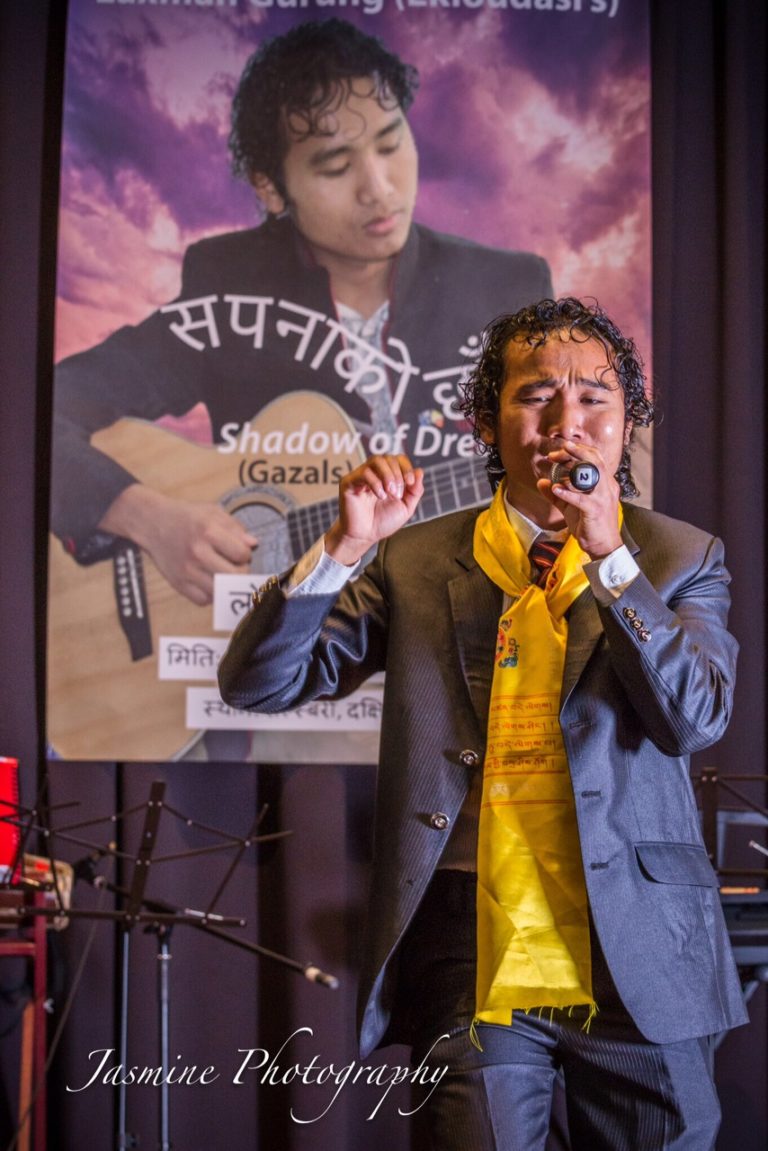
The first solo music album “Shadow of Dream” of rising music star from the Australian Bhutanese community Laxman Gurung aka Ekloudasi, was launched amidst a special function organised in Adelaide earlier this month.
Artist Gurung performs at the album releasing event organized in Adelaide (Picture courtesy: Jasmine Photography)
This is the first gazal music album by Australian Bhutanese whose lyricist are all Bhutanese writers.
Similarly, in all seven songs included in the album, Gurung himself has given the melodious music.
Gurung performed two songs from his album at the launching ceremony and unveiled another
through a music video produced in Nepal, featuring Nepalese movie artists. Other Afghan,
Bhutanese and Nepalese artists also performed at the launching ceremony.
Popularity of Gurung as a singer and musician in the Bhutanese community was demonstrated by presence of community members who did not find space to sit.
Speaking at the event, chief guest and former chairperson of Bhutanese Australian Association of South Australia (BAASA), Jogen Gazmere, stressed the need for financial,
moral and all other forms of support to be given for new and rising music stars of the Bhutanese community in diaspora.
This is the second musical album from Australian Bhutanese, first being by brother duo Narad and Taken Dahal, who also hail from Adelaide.
The album is immediately available for purchase at $10 excluding shipping cost, according to singer Gurung.
Sherab (name changed) joined a group of friends to fly for Qatar in 2014 to help government fulfill its pledge-6000 overseas jobs per year. Along with his friends he got into trouble with their employer when he did not get the same job as promised before boarding the plane. Now, the same group of workers including Sherab is not paid the salary for the work they are doing. Are they not doing the right job?
PM Tshering Tobgay and Minister for Labour and Human Resources, Ngeema Sangay Tshempo. Photo: Ministry of Labour and Human Resources
The report was widely read and shared in and outside Bhutan. Ministry of Labor and Human Resource (MOLHR) defended in pretext, “No formal complaints have been received in this regard.” Global Recruitment Overseas Agency, the manpower company in Thimphu that sent these young men to Qatar wrote to BNS warning not to write anything what the agency does.
The Global Recruitment Overseas Agency since recently got suspended for good.
Sherab contacted BNS again from Qatar saying, ‘It is time to help again. Many of our friends are denied salaries by the companies. We know very well that Ministry of Labor and Human Resource in Thimphu is well aware of this, but hesitant to do what it should. We hear officials in the ministry as saying- those who assume with the problem should report us in person or through proper channel. What a rule!?’
Once the issue got surfaced through the relatives and friends of those workers in Bhutan, social media joined the line to inform government.
Dargo Tashi, admin of the social media group – Breaking the News-Bhutanese Social Media -that has around 22K followers writes on May 4, 2016, ‘This is the kind of thing that we should be worried about, not the color and patterns of our Racchu. I think it’s high time that our people demand accountability from the government because they sent these people there despite knowing that such things are happening there and has already happened to our people in the Middle East before.’
Tsehwang Dorji, a parent of one worker in the Middle East adds a comment on Dargo Tashi’s post saying, ‘Quite a worrying factor for parents like us who has children in the Middle East. Think govt. MOLHR should do more than what they think they are doing. We urge ministry to do better and stop promising what they cannot fulfill.’
A dream to prosper?
The job seeking youths flew to Qatar and other Middle East and South East Asian countries as a part of government’s bid to find foreign employment to at least 6000 youths a year.
Sherab sent back almost every dinar to his family that was just enough to pay off the loan he has taken for arranging the flight to Doha and as a processing fee charged by the agency in Thimphu, pay the employment company and meet other expenses. He told BNS, “Seven months from now, if everything goes well, I am planning to save the rest.”
Something is better than nothing
When Bhutanese society is reeling under the paradox of problems –alcoholism, substance abuse, mental health and suicidal behavior, unemployment, massive rural urban migration- choosing to enter foreign employment market is a Hobson’s choice.
The number game in school is quite tricky to predict any worthwhile career path the students can take. The number of seats available in government schools is sheer limited, which can absorb only 40 percent of the passing students, which in turn determines the intake valve for admission to government colleges. In 2016, 5,410 students who passed grade 10, could be taken into government schools for secondary education. Rest students left to find way to some of the Indian cities or expensive private schools in the country. According to Bhutan Council for School Examinations and Assessment, a total of 11,323 students sat for the exam from 39 higher and 73 middle secondary schools.
While, in 2015, private schools too had limited seats to take all students who did not make the threshold of 61 percent aggregate! Total students passing tenth grade last year were 5972.
With this stark reality of booming youth unemployment, opening of overseas job for aspiring job seekers is something better than nothing. But, the unscrupulous manpower companies in Thimphu and the employer companies in Doha seem to have colluded to add more hardships to the workers. “They have not fulfilled their promises,” says Sherab’s roommate in Doha. Quality Hyper Market in Doha is one that has not paid its employees since March.
Back in the country, the clear demarcation of blue collar and white collar jobs has added stigma to all educated youths to take up even the skilled or semi-skilled job like masonry, construction worker or plumbing. People are cultured to look at such jobs as low ranking and associated to their prestige.
A Kuensel report of October 21, 2015 says, “A masonry trainee at the TTI, Thukten Jamtsho said societal pressure and stigma are the biggest challenges for Bhutanese youth who take up vocational education.”
In the same reporting of Kuensel, one official at a vocational training institute is quoted, “Even now most students pursuing vocational trainings here are from humble families since well-off parents discourage children from taking up blue-collar jobs.”
The way Royal Civil Service Commission picks from the pool of graduates applying to government jobs has created enough frustrated lots.
Those RCSE disqualified but merited students see only an option- to be the ambassadors of the nation and try their luck in the Middle East and Malaysia. On the other hand, the government’s ambitious pledge gives way to agents and manpower companies mushrooming in Thimphu.
Taste of change – a test
There is a change in the system of governance in Bhutan. The fourth king Jigme Singye Wangchuck has gifted democracy to His people and the throne to His son Jigme Khesar Namgyel Wangchuck. But, people haven’t seen required change in the modus operandi of the leaders and bureaucrats in terms of misusing the power.
General public blame unchecked corruption as the triggering factor for unemployment.
The very first democratic government led by Jigme Y Thinley was anticipated to change the course of Bhutan’s participatory development philosophy, opening new road to progress and prosper. The people were dismayed and the nation put on shame when elected high officials like the Speaker of the National Assembly and the Home Minister, were found to be the accomplices in Gyalpoizhing land scam.
The second elected government now led by Tshering Tobgay suffered a backlash when one of its cabinet ministers, Rinzin Dorji, was found to have risen to power through corruption. Before taking to the political race, they all were trusted bureaucrats in the eyes of common people.
Bhutan’s corruption watchdog, Anti-Corruption Commission (ACC) too isn’t far away from people’s criticism. It is blamed for baiting only the small fishes and has no access to the ponds with bigger fishes. The confusion surrounding the formation of ACC and appointment of its chief sent tremors to Transparency International as per December 10, 2015 report. And, the Transparency International has cautioned Bhutan in this regard.
Dasho Neten Zangmo, former ACC chief, also called a fearless leader told to BBS, May 8, 2015 “Corruption is deeply and widely entrenched within the national system inside and outside Government. It is not a here and there cases of corruption. Corruption has become part of national trait of doing things.”
The current ACC chief has tough road to walk through.
ACC has to really go after the questions: who is becoming the richest at the cost of public resources? Who all are the competitors behind the scene? Why a nation with just around 650,000 population has to send 6000 fresh graduates overseas annually?
Albeit, no country in the world is corruption free, this tiny nation can easily materialize a dream to become the first corruption-free nation on earth. What stops? It is just a matter of proper use of the system and making strong laws to penalize the perpetrators. ‘20th by 2020’ vision of Bhutan towards cleanliest list is easily achievable-provided each one becomes accountable to what they do. Recently introduced E-receipt system is the harbinger in the nation for that good beginning.
Remittances: will it improve?
From recent figures in Kuensel, status of remittances to Bhutan from foreign employment is seen encouraging: Non-resident Bhutanese remitted various currencies worth Nu 508 million from January to December 2014, according to the Royal Monetary Authority’s monthly bulletin of February. This was an increase of Nu 164M from Nu 344.6M in the previous year during the same period.
Bhutan last year received Australian dollar (AUD) 4.24M, which is roughly Nu 203M at the current buying rate. Remittances received from the US amounted to USD 4.15M or Nu 261M. (Kuensel March 14, 2015)
Remittance from Australia has doubled from AUD 4.24M in 2014 to 8.73M last year. In 2013, remittance of AUD 240,000 was recorded. United States of America (USA) is another country from which inward remittance is quite high. Last year, about USD 6.6M has been sent from USA compared to USD 4.5M in 2014 Kuensel on March 10, 2016 reports.
However, these figures do not account for the very meagre amount of remittance sent by these workers in Qatar or Korea or Thailand.
Bhutanese people begin to understand- a huge variance exists in disbursement of available resources vis-à-vis the population it serves. Foreign aid, remittances, taxes, revenues, and sale of hydropower besides other sources make the national income. The distribution system has not been proportional, people assume, with unseen leakages. People mostly hear about insufficient funding or lack of budget in the development projects from the official media but if a firm system is to dig out the truth, it can bring out unpleasant news to many.
Hope within woes
What did you learn besides hardships and being a victim of deception from your own people in Thimphu?
Sherab says, “Every misery has silver linings. I got education that people in Qatar want their country to develop, in Bhutan people in power want to develop. I see Bhutan far richer than where I work, naturally. Should corruption to bring to an end in Bhutan and proper system planned-it will not take time for Bhutan to hire manpower from overseas. I should not be sweating here. My country deserves my sweat than anywhere.”
Does it mean?
Government failed to patch leakages and loopholes in the departments, ranks and positions with transition from active monarchy to the gifted democracy, or Government sees nothing in the vicinity to utilize the potent energy of the youths. And, to minimize the crowd in the cities- crowd of the disqualified merited youth- government lures them to overseas employment that ultimately ditch them into miseries. The government’s pledge for 6000 overseas employment per year is already in trouble! The crowd in the cities is still rising. The defending statements from the MOLHR against the plea of the suffering youths from overseas speak in volume.
May Sherab’s dream for a prosperous Bhutan come true provided system of good governance is ingrained properly and corruption is systematically wiped out.
For many in the Western Buddhist world, Bhutan has become a quasi-mythical land. Bhutan is an officially Buddhist Kingdom with ties to internationally popular Lamas. It has become famous for it’s lauded vision of “gross national happiness”. In 2006, it was named the happiest country in Asia and the sixth happiest in the world in a survey based on the Gross National Happiness index inspired by Bhutan itself. In 2012, as a result of an initiative of the Bhutanese government, the UN named March 20 “The International Day of Happiness”. More recently the environmental media declared Bhutan one of the few countries in the world to be not just carbon neutral but carbon negative.
Bhutan is venerated for resistance to modernization and westernisation. The fact that it is difficult to even visit Bhutan due to its limitations on tourism only increases its mystique. In addition many Western students of Vajrayana dream of retreats in the green mountains and valleys of the “land of the dragon”, where pure teachings of the Kagyu and Nyingma lineages are still to be found.
Gross National Happiness
In the 1970’s the Bhutanese King Jigme Singye Wangchuck began instituting his vision of “gross national happiness (GNH)”, which included strong measures to protect Bhutan’s dominant ethnic culture and the religious tradition of Vajrayana Buddhism (which it shares with Tibet). In the 1980s, the Bhutanese government was worried about illegal immigration and preserving the country’s cultural identity in the face of Nepali influence as well as the power of it’s neighboring giants China and India. Bhutan adopted a “one nation one people” policy and introduced mandatory Driglam Namza, the ancient code of social etiquette practised by the dominant ethnic group- people from west Bhutan, who are of Tibetan origin. The government decided to deport thousands of people of Nepali ethnicity, many of whom had lived in the south of Bhutan for generations and are known as lhotshampas (“southerners”). The government passed laws requiring people to wear traditional Bhutanese dress and banned the Nepali language in public, and, human rights groups say, tortured Nepali Bhutanese, who spoke out.
In a harrowing 2013 NY Times article Vidhyapati Mishra wrote an account of the expulsion of his family from Bhutan. He recalls an idyllic childhood on a farm that grew “maize, millet and buckwheat, a cardamom garden, beehives and enough pasture for cows, oxen, sheep and buffaloes.” After the 1989 declaration of the “one people, one country” policy things began to change. Hindu seminaries were closed, “traditional Bhutanese” customs were imposed on all and Mishra’s elementary school, which served the Lhotshampa population, was closed down. One day in 1991 Mishra reports, men in uniform came to his house and seized his father. After insisting he put on his bakku (traditional Bhutanese dress), they dragged him from the house kicking and slapping him. As Mishra describes it, “My father was held for 91 days in a small, dank cell. They pressed him down with heavy logs, pierced his fingers with needles, served him urine instead of water, forced him to chop firewood all day with no food. Sometimes, they burned dried chilies in his cell to make breathing unbearable. He agreed eventually to sign what were called voluntary migration forms and was given a week to leave the country our family had inhabited for four generations.” At the time of writing that NY Times article Mishra had been in a refugee camp known as Beldangi 2 for 21 years.
(The article has been reproduced with due permission from hashkata.com. Matthew is a freelance journalist and writer from Canada. He has been contributing for the Forward, the Jewish Independent, Tikkun, Elephant Journal and elsewhere. He can be reached at [email protected])
An adventure company has set its sights on reaching the peak of an unexplored mountain in Bhutan to get a glimpse of one of the highest unclimbed mountains in the world.
Secret Compass will lead a team of amateur adventurers on the expedition, trekking to the 5,400-metre peak of an unnamed and previously unclimbed Himalayan mountain in 2017.
A view of Gangkhar Puensum Photo: Secret Compass
From the peak the team will get a clear view of Bhutan’s highest mountain, known as Gangkhar Puensum. It is nestled among the jagged Himalayas and stands at an elevation of 7,570 metres.
Tom McShane, operations director at Secret Compass called the expedition unique and ambitious, “This expedition doesn’t strive to be an Everest-styled box-ticker,” he said in a statement. “It’s unique and ambitious, it’s far from the madding crowds of Everest base-camp and it will attract people who enjoy pushing their own boundaries in unusual, culturally fascinating and little-visited destinations.
The 5,400m peak is what we call a ‘trekking peak’ and this physical part of the expedition is achievable by fit amateurs rather than technically competent mountaineers.
The real aim of this pioneering expedition is to explore a hidden corner of the Himalayan world in this remote and isolated Buddhist Kingdom, achieving something extraordinary in a quiet, low-impact way in one of the world’s wildest untouched places.”
Mountain expeditions have been rare in Bhutan since the government prohibited anyone from climbing mountains higher than 6,000 meters in 1994. The ban was part of an effort to respect local spiritual beliefs and aimed to prioritize the country’s conservation efforts.
In neighboring Nepal, the effects of mountain tourism have become a major environmental issue. A large amount of waste has been left behind on trails around Everest and tree lines have been reduced due to firewood being burned for heating and cooking.
Many of Nepal’s Sherpas have urged their government to temporarily limit access to areas surrounding Everest so the area can be cleaned and reforestation and conservation efforts can be put in place.
Speaking to the BBC, Lindsay Griffin, chairman of the Mount Everest Foundation screening committee said: “The Bhutanese are very keen on protecting their own people. They just looked at what was going on in Nepal with Everest and decided that they’re not going to be part of that.”
Secret Compass previously traveled to Bhutan when they supported the production of a British television show called Walking the Himalayas. The show followed the journey of TV adventurer Levison Wood as he made his way across the long stretch of mountains on foot.
Before summiting the 5,400-metre peak the expedition team will make their base-camp in the same remote valley as Wood when he visited Bhutan in the climax of the TV series.
नेपाली कथानक चलचित्र ‘देश खोज्दै जाँदा’ दादासाहेब फाल्के अन्तर्राष्टिय चलचित्र महोत्सव छैटौमा दिल्लीमा अफिसियल छनौटमा परेको थियो । चलचित्र दुई विधामा अन्तिम प्रतिस्पर्धामा पुगेको थियो ।
फिचर फिल्मतर्फ नेपालबाट ‘चलचित्र देश खोज्दै जाँदा’ बेस्ट एक्टर र बेस्ट चलचित्रको नोमिनेशनमा पर्न सफल भएको थियो । जुरीको दुई हप्ताको निर्णयबाट संसारभरका सात सयभन्दा बढी फिचर फिल्महरुबाट अफिसियल छनौटमा चलचित्र ‘देश खोज्दै जाँदा’ चुनिएको हो ।
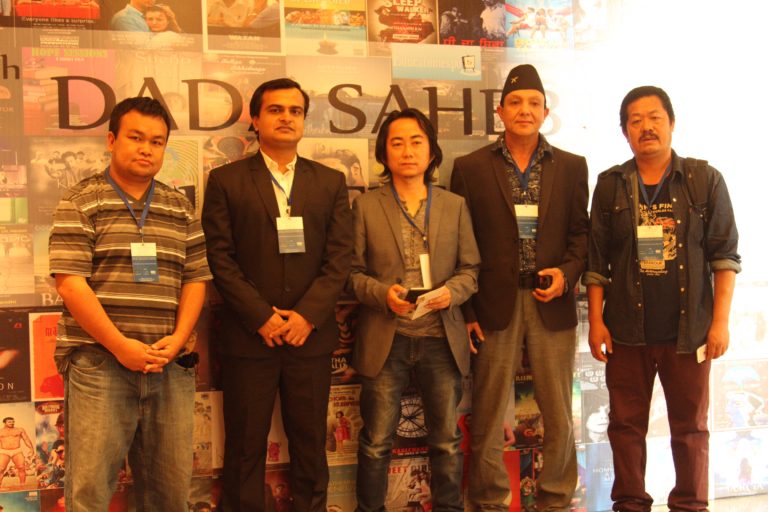
दादासाहेब फाल्के अन्तर्राष्टिय चलचित्र महोत्सवमा सहभागी ‘देश खोज्दै जाँदा’ चलचित्र समूह (सौजन्यः ‘देश खोज्दै जाँदा’ परिवार)
दुई हप्तासम्म चलेको महोत्सव फाल्केको जन्म जयन्तीमा अप्रिल ३०, २०१६ शनिवारका दिन टिभोली ग्रेन्ड होटल एन्ड रिसोर्ट, नयाँ दिल्लीमा एक भव्य समारोहबीच समापन भएको हो ।
दादा साहेव फाल्केलाई भारतीय सिनेमाका पिता मानिन्छ । भारतमा सर्वप्रथम चलचित्र भित्र्याएका उनको वास्तविक नाम ढुंडीराज गोविन्द फालके हो । यस वर्ष दादासाहेबको एक सय सत्चालिस औं जन्मजयन्ती पनि परेको थियो ।
उक्त महोत्सवको अन्तिम सेमिनारमा सहभागिता जनाउन नेपालबाट कलाकारहरु हेमन्त बुढाथोकी, पटकथाकार उपेन्द्र सुब्बा, लेखक/निर्देशक प्रकाश आङदेम्बे र अमेरिकाबाट आर्ट/पोस्ट प्रोडक्सन डाइरेक्टर प्रल्हाद गुरुङ आएका थिए ।
चलचित्र ‘देश खोज्दै जाँदा’ भूटानी शरणार्थीहरूको नेपालको शिविर बसाइको वास्तविक कथामा आधारित छ । यस चलचित्रमा हेमन्त बुढाथोकी, बाबु बोगटी, अरुणा कार्की, मिना कोइराला, एलपि जोशी, केशव आचार्य, शिवशंकर थापा, टंक विकल्प, प्रताप सुब्बा, प्रकाश बुढाथोकी आदिले अभिनय गरेका छन् । चलचित्रको फाइनल पोस्ट प्रोडक्सनको कार्य कर्निज इफ स्टुडियो क्यालिफोर्निया (अमेरिका) मा भएको हो ।
छनोटमा परेको नेपाली कथानक चलचित्र “देश खोज्दै जाँदा”
लेखक/निर्देशक आङदेम्बे भन्छन्, ‘यो चलचित्र हाम्रो पहिलो प्रयास हो । पहिलो कार्यले नै यति ठुलो चलचित्र महोत्सवमा अफिसियल छनौट र दुई विधामा अन्तिम प्रतिस्पर्धामा आइपुग्न पाउँदा खुसी लागेको छ । चलचित्रका सम्पूर्ण सदस्यहरू प्रति आभारी छु ।’
प्रत्येक दश वर्षमा मात्र आयोजना हुने यो फेस्टिबल केही वर्षदेखि वार्षिक रूपमा हुँदै आएको छ । छोटो चलचित्र, वृत्तचित्र, विज्ञापन, गीतको भिडियो, एनिमेसन र फिचर विविध विधाहरू महोत्सवमा सहभागी रहने गर्छन् ।
यसका अलावा बाजिराहो मस्तानी (भारत), स्विट गर्लस् (स्विजरल्याण्ड), माझी द माउण्टेन मेन (भारत), मृगनभि (भारत, आसामिज), समर लिफ डफ (जापान), द पिउर हार्टेड भिलेन (तमिल), जन्जस (अर्जेन्टिना), उन हम ल मर (बेल्जियम), द रिर्टन (इरान), एडभन्चरर्स अफ अप्पु एन्ड गप्पु (अमेरिका), मिराकल्स अफ लाइफ फोर्स (जर्मनी), द बुक (युक्रेन) पनि महोत्सवमा सहभागी थिए ।
महोत्सवमा लाइफ टाइम एचिभमेन्ट अवार्ड अभिनेता मनोज कुमार, फाउण्डेशन अवार्ड बलिउड अभिनेत्री प्रियंका चोपडा तथा उन्नाइस पटक गिनिजबुकमा नाम चढाएका रामरहिम सिंहलाई दिइएको थियो ।
What, if someone says you are not allowed to wear one particular kind of clothing. What in a country, if some officers decide to choose the pattern on a piece of fabric you must have? Because that you are woman, you do not have the absolute right of presenting in front of officials with descent dress of your liking. No irking. This is no ancient tale of a king who exiled his youngest daughter to a jungle-for not complying to his orders of marrying to a particular suitor. One may ask, “Should I believe my ears? Aren’t my eyes undergoing optical illusion?”
But this has gone real in GNH country. Women are awestruck by the circular disseminated by the Ministry of Home and cultural affairs doffing their rights. All the ordinary women in the nation are warranted not to wear Rachu with patterns (Rachu is a piece of long belt like scarf women wear along with Kira hanging back and front resting on the shoulder). The classic patterned rachus are meant only for the Royal family members. This is what nowadays dzongkhag cultural officers in Bhutan are reported to be interpreting the circular in different offices and cities and soliciting women.
Before this change became public through Kuensel on April 27, it was being candidly enforced by the officials in the public and some of the government offices. The Kuensel report has not mentioned any nature of penalties for not complying with circular.
One of the female officers had to change her rachu immediately as soon as the circular was out. ‘I bought an Ada Rachu (non-patterned) from the town as the cultural officer asked me to change my rachu’, Kuensel has quoted the female officer as saying.
The decision said to be made by Dongkhag cultural officers during their sixth annual conference and brought to the public through Home Minister’s office has already gathered enough mosses of criticisms through social media.
Trend in the past There are already ample instances in which handful of officials brew the ideas, discuss closed doors, make laws locally and impose on the civilians and then present the falsified report before the King. They are never ashamed in misinforming the king that such ideas are wished by the people. There was a time all the farmers were mandated to wear Gho and Kira while working in the field even during the odd seasons, climbing the trees (dangerous from safety point of view) or working at the construction sites. It was then presented before the King as people’s wish. There were instances where people were forced to pay heavy fines for not complying with the locally coined laws. No receipts were issued as a proof of paying the fine. Later, His Majesty the king understood the sufferings of the people and simplified the use of gho and kira mandatory in or while visiting government offices and during public festivals of national importance and as school uniforms.
What people say Thinley Penjor, a former civil servant in Bhutan who currently lives in the US writes on his face book status, ‘In the 1970s, law was passed and repeated circulars were issued by the home minister for disallowing Bhutanese women to keep long hair and the royal families were not included to follow the rules. When civil servants holding higher portfolio and minister’s daughters took to showing their right to keeping long hair, all the rest of the women in Bhutan gradually followed the suite.’
Sangay Wangchuck, cultural officer in Tsirang dzongkhag is quoted by Kuensel on April 27,2016 as saying- ‘that they have started to implement the circular as soon as they received it. Tsirang dzongkhag female officials are allowed to wear only ada rachu (non-patterned or plain) which he said is strictly being monitored.’
Dorji Tshering, on his facebook wall writes, ‘We already have a clear, working way of distinguishing our Royals from commoners by the way Rachus are worn. So, then why do we do need another? Such a rule will not only destroy the livelihood of our hardworking weavers but will snuff out the much required creativity in our textile industry.’
Namgay Zam on her Facebook status updates, ‘Sometimes, I wish we would devote our time to doing more productive things like creating job opportunities and preventing Bhutanese from killing themselves by alcohol, drugs, and suicide. But, no! The patterns of our Rachu need immediate attention. Driglam Namzha is not cultural tyranny. What in the world are you thinking, especially in this day and age? (Now, I know it will also be some time before we do anything about alcohol abuse since it is such a big part of Bhutanese tradition and culture as well. It would be so wrong and against our culture to change our drinking habits!)
And what do we do with all our old rachus? Open a museum of rachus!!’
One of the former National Assembly members requesting anonymity told BNS that there are certain things in the country that do not fall under the radar of democracy. There are exceptions (but not mentioned in the constitution) that we care our Royal families more than anything else. As far as the circular on rachu is concerned-now the ball is on government’s court. Anything done bypassing the due procedure is sure to resonate and fall against the norms of the type of democracy we have. “I can only assume that who is going to bear the accountability of ‘liquidated’ money already invested on thousands of patterned rachu in the nation?”, he said.
What the constitution says on culture Article:4(2): “The State shall recognize culture as an evolving dynamic force and shall endeavor to strengthen and facilitate the continued evolution of traditional values and institutions that are sustainable as a progressive society.” Article: 4(4): “Parliament may enact such legislation as may be necessary to advance the cause of the cultural enrichment of Bhutanese society.”
In this case neither the move is in any sense an endeavor to strengthen and facilitate a progressive society, or even the spirit and desire of people as guaranteed by the constitution is respected nor the matter connected with half of the population is mentioned in the circular as discussed in the esteemed parliament.
Everyone’s eyes towards the Queen Patterned Rachu is directly linked to Her Majesty the Queen and female members in the royal family. For whatever reasons the so called dzongkhag cultural officers might have thought restricting common women from free choice of ‘rachu’, has now rested upon the queen. The queen has such a reverent profile in the nation and outside world for being an ideal woman figure. The queen has been showing her prolific care towards women by introducing epidural labor analgesia in the hospitals throughout the nation to allay the pain of women in labor.
Women from all walks of life now vest their trust on Her Majesty the Queen to nullify this irrelevant circular. Home Ministry should equally weigh if the move is at par with the constitution and doesn’t outweigh the bond between the King, Queen and the people.
Dzongkhag cultural officers’ flaws How can such a personality (queen) choose to discriminate half of the population to show pomp and power by privileged wearing of patterned Rachu by herself and royal women only? Dzongkhag cultural officers should have well considered the royal intent and parliamentary procedures prior to arrive such an impacting decision. This is obviously a quest for cheap popularity by these officials to draw royal attention.
Besides making such abrupt utopian decision these officers should have actually thought about addressing other genuine issues by means of cultural harmonization. Unemployment is killing citizens. Uncontrolled use of alcohol is sickening the entire nation. Corruption has become the cup of tea. Poor sewage management system has flooded the premises of schools and hospitals.
Dzongkhag cultural officials should educate people to speak-up against the age-old culture of corruption that has become the culture not to speak. Educate people not to bow down their heads to the knees while speaking their plea and grievances. Making someone speak with head stooped to the knees can never be claimed as cultural enrichment in the democracies.
Making women victims of handful of bureaucrats’ immature decision can never be a rational culture nor an essence related to the parameters of GNH. GNH should educate that culture where each individual speaks from heart and with head held high.
The essence of GNH lies in the measure of women’s empowerment in all sectors of national development and educational enrichment.
Even after so many decades these fine lines of Rabindranath Tagore find relevance.
“….Where the mind is without fear and the head is held high…
Where words come out from the depth of truth…
Where tireless striving stretches its arms towards perfection…
Into ever-widening thought and action
Into that heaven of freedom, my Father, let my country awake.”
Senator Jeanne Shaheen, member of the senate foreign relations committee sent a concern letter to Tshering Tobgay, Prime minister of Bhutan, through Bhutan’s permanent mission in New York April 25, 2016. The letter is confirmed received by the mission’s Kunzang Namgyal, according to an email received by BNS.
Suraj Budathoki, Executive Director- International Campaign for Human Rights in Bhutan with US Senator Shaheen.
The letter states the concern over human rights issue of the Lhotshampa people inside Bhutan and also the refugees in Nepal who want to return Bhutan. Calling for the PM’s attention on this matter, Senator Shaheen writes, “…to ask for your attention to a matter of importance to me and my constituents in the state of New Hampshire- that is the status of Bhutanese Lhotshampa refugees in the countries surrounding Bhutan, mainly Nepal, as well as the status of Lhotshampa who remain in Bhutan but are not afforded the same rights and privileges as your other citizens.”
In regard to the status of refugees in camps, Senator Shaheen writes, “I understand that our State Department is working with your government, the Nepalese government and the United Nations High Commissioner for Refugees to find durable solution for these individuals that includes a mix of repatriation and local integration.”
According to Suraj Budathoki, the executive director of International Campaign for Human Rights in Bhutan, a great deal of advocacy and correspondence is involved in sending this letter to Bhutan through a senator serving in the foreign relations committee has been working with multiple senators at state level and in the White House to raise the cause of human rights issue in Bhutan.
On July 30, 1993 Congressional Human Rights Caucus of US House of Representatives had also written a letter to the fourth king Jigme Singye Wangchuck stating,’…we ask that your government do everything in its power to end any practice of pressuring ethnic Nepalese to leave their homes in Bhutan, and we ask that you work with the government of Nepal to facilitate to return to Bhutan who have been forced to flee..” It is believed that the letter played vital role and the eviction process was brought to an end. Otherwise, the home ministry’s order to southern administration was all destined to empty the districts inhabited by Lhotshampa.
Suraj is hoping to get a response from Bhutan, but he also hopes to resolve some pertinent human rights issues remaining even after resettlement is at the terminal point. The fight is for justice that has been denied for generations, per Suraj.
Suraj says, “Our attempt is also to open up a diplomatic relationship between Bhutan and the US.”
The letter to Bhutan’s PM does not mention anything about former visits by US officials including senator John McCain and undersecretary Maria Otero.
The letter also speaks on the travel of Bhutanese American to their ancestral land in Bhutan, asking the government to allow visa to the naturalized Bhutanese so that they can unite with their families left behind. BNS has learned that couple cases of visa application has been denied and the initial charges of application not returned.
Meanwhile Hillary Clinton’s letter to Suraj Budathoki mentions about continuing her unfinished task of defending human rights. It mentions- Issues specific to Bhutanese refugees were at the top of our bilateral agenda with Bhutan during my tenure as Secretary of State.
Suraj wrote to BNS, “Many of us who arrived here as refugees have now become citizens of this great country. We enjoy rights that we did not have in Bhutan. We admire efforts made by the US to encourage universal human rights around the world. While we are no longer in our country of origin, we deeply care about the happiness and rights of everyone in Bhutan and among those who were exiled. Senator Shaheen’s letter to Bhutan’s Prime Minister, we hope, is a step toward resolving the many issues that face us.”
Nirajan, a former refugee from Bhutan and currently residing in Pittsburgh, Pennsylvania received numerous calls from an unknown caller on April 16, 2016. The call was made from 206- 745- 0760 and the calling location is appeared on the screen as Shoreline, WA. He ignored few calls. But the caller did not stop calling.
He received one of the calls and a man on the other end started talking rapidly without letting Nirajan speak. An Indian accent English speaker introduced himself as an official at IRS and his name as Williams. He explained that the call was regarding the recent income Tax- Reporting made by Nirajan to IRS for the year 2015.
In between the blabbering, Nirajan managed to tell Williams that he is a person with limited or no English. Williams then quickly connected Nirajan to a Nepali speaking guy-who introduced himself as Govin Sharma. According to Nirajan, Govin Sharma is not so fluent in Nepali and mixes some Hindi. Govin Sharma explained Nirajan that, this is not a fraud or any scam that he might have heard from other people. ‘It is so nice of you that now IRS has someone who speaks your language’, says Nirajan as Govin told to him. If you ignored this call simply assuming a scam you will be in trouble. This is a curtesy call to allow you a chance. The amount you are supposed to receive as your Tax return is on hold because of some additional information needed from you.
For Nirajan it sounded true, as he was waiting for his tax return. Nirajan was asked to send right away $995.00 and he was instructed to go to Wal-Mart and purchase gift cards worth the warranted amount, scratch for the Pin at the back of the card and read for them. Nirajan was given an hour time. Nirajan did follow as they said. He revealed he was warned not to disclose this deal to anyone. “If you disclose this to anyone-we have all your information and for doing that you will be in another trouble”, came the warning. He was also told that right after paying the required amount they would provide him with a confirmation number and be notified about how much amount he is going to receive as his Tax return for the year 2015. Nirajan, paid the warranted amount right on time. After that Williams and Govin Sharma went loose. He attempted calling the number for few more days.
Nirajan contacted BNS almost wailing but requesting for help. ‘I became the victim of fraud and I want to tell others not to believe in such calls. He requested to withhold his real name. Nirajan says, ‘I am surprised to see our innocence is used. Now they have started speaking our own language to rob us.
I became the victim and I have no idea that from where they got my contact number and name. Now they have all my information and I am robbed. I assume, like me there might be many people already became the victim or may fall prey to those scammer.’
This is not the first time someone is heard become the victim of such fraud. This is unique that the scammer now have started using someone who speaks the language of their target.
Some tips that may help:
IRS never makes phone calls for any types of tax related issues. IRS notifies the concern person in the form of official letter send through mails.
IRS doesn’t ask anyone to buy gift cards from Malls and seek Pin numbers.
If anyone receives such calls and if you are nearby your computer first step one can do is ‘Google’ to see comments made on that number. Many other people might have received such calls from the same number and have lodged complaints or commented. You may also record the conversation. If you want somebody to hear what they say- be polite to the caller and ask for some time to arrange the amount. In between- find a friend, case worker, community volunteer or a teacher to listen what they say. As soon as you understand the way how you are being cheated, tell your friends circle and relatives.
Today it is you. Tomorrow can be your relatives walking on your shoes. SPEAK UP Do not believe in such calls !!!





 For many in the Western Buddhist world, Bhutan has become a quasi-mythical land. Bhutan is an officially Buddhist Kingdom with ties to internationally popular Lamas. It has become famous for it’s lauded vision of “gross national happiness”. In 2006, it was named the happiest country in Asia and the sixth happiest in the world in a survey based on the Gross National Happiness index inspired by Bhutan itself. In 2012, as a result of an initiative of the Bhutanese government, the UN named March 20 “The International Day of Happiness”. More recently the environmental media declared Bhutan one of the few countries in the world to be not just carbon neutral but