Bhutan News Service (BNS), engineered informally in 2004 by a small group of Bhutanese refugee youth, has come a long way by now. The tireless dedication has enabled our team members to partially meet our goal affecting thousands of Bhutanese refugees and the Bhutanese diaspora. Reflecting back those thirteen years, we felt that a little justice has been done to the people silently suffering both inside and outside Bhutan.
This news portal has become a blessing in disguise for the public with internet access in Bhutan.
However, all the achievements and milestones we have reached have come at a great cost and sacrifice. By virtue of being in challenging circumstances and time of their life, the management and its editorial team have gone through a series of ups and downs. We are able to share this story of success due to the moral support we have received from our supporters, partners, valued readers as well as contributors like you. For the last thirteen years, we have had the privilege of working with many volunteers, reporters, writers who have made our portal rich with treasure, made precious by its value in terms of changes it engineered for our fellow Bhutanese in Bhutan. We are highly indebted to all of them.
We must state that in the beginning, our primary goal was to serve our community members with current news and stories. There weren’t many options other than the Nepalese FM radios around us. A print newspaper would not be expected to make rounds of the earth! We realized that those dramatic changes in information technology with the added blessings or curse of the social media cannot be ignored. Last year, our team was silent for a brief time; yet we were busy evaluating all these and our options to cater to the public and thus, transitioning into a new model of delivering our services, has become inevitable.
Beginning in 2018, this portal’s primary focus will be to document the success stories surfacing in the diaspora after resettlement. In the past, we, as a community, have not done a fair job of documenting the forgotten history. Our future goal is to document “oral history” of former Bhutanese refugees. We know that it takes time, efforts and a lot of financial resources to get there; but we are determined and we know that we will get there sooner than later. We’ll count on your support. Collection of “diaspora stories” is just the beginning. The site’s second priority will be to give continuity to news dissemination under the “community events” section. Aside from these, we welcome editorial contents. BNS has a vast diversity of readers and contributors from across the world. Currently, BNS has contributing articles/reports from ten different countries, including Bhutan. Since we are a non-profit, a registered entity under 501(c)(3) tax exemption status, we always welcome any forms of donations, sponsorships, and advertisements to serve quality articles to our readers. We were never perfect. We are not perfect now either. But we’ll do the best we can to serve the community we live in.
___
We also hope you’ll visit our webpage regularly. Our tech team is working round the clock to give final touches to the design of this website. Please excuse us for any interruptions. How is our new website coming along? Do you want to volunteer at BNS? Reach us at: [email protected].
In 2008, Dilip Dahal was among the first Bhutanese-Nepali to be resettled in the United States.
Today, as the owner of three gas station/convenience stores in metro Atlanta, Georgia, he prides himself more on his community involvement than his formidable business achievements.
Dahal, now 38, arrived here with $23 cash and a dream of a better life beyond Beldangi 1, where he lived with his parents and siblings in Sector E1, Hut 40.Memories of fleeing his birthplace and family home in Chirang, Bhutan in the dark of night when he was 12 never dimmed.
But he was focused on making his way in America.To him, U-S-A had one meaning: “U-Start-Again.”
With loving support from a former refugee from Somalia named Sofia Zama, Dahal learned to acclimate to daily life in the United States.He credits another woman he met early on, Beth Jordan, with teaching him how to work hard.
Dilip Dahal, Atlanta (Photo : Dilip)
For his first job here, he rode two buses and a train to work as a housekeeper at the Georgia Tech Hotel and Conference Center in midtown Atlanta.
Next, he landed work as a cashier at the DeKalb Farmer’s Market, where he eventually met three Nepali men who helped him achieve his dream of business ownership.
Together, the four men opened a grocery store focused on South Asian goods.
Though Dahal didn’t have cash to contribute to the venture, he did possess an abundance of drive and enthusiasm.He managed the store, and after 18 months, had saved a large chunk of cash in order to buy out his business partners, borrowing the rest.
After four years, he sold the store, all the while continuing to volunteer to help others in the diaspora as they arrived in the Atlanta area.(This good deed had a life-changing side benefit: He met his wife, Shanti, while helping her family to resettle.)
His next business was, in his words, more mainstream—a 24-hour gas station/convenience store.
Now, he owns three stores, and employees 10 people.
Not everything Dahal has touched has turned to gold.Along the way, two businesses he helped to start—a sports bar, and a pool hall—failed.
And he doesn’t like to be called a success.He’s happy to be running his businesses, and to serve as the president of the Organization of Bhutanese Communities in America.
“As compared to other resettled refugees,” he said, pointing to the presence of Bhutanese-Nepalese in 42 states and 200 cities around the nation, “our community is growing very fast.”
In 2015, he was honored to be asked to return to Nepal to mark the resettlement of the 100,000 Bhutanese.On that trip, he met the President and Prime Minister of the country where he lived in flux.He thanked them for giving him, his family, and so many others safe harbor.
Visiting Beldangi 1 after so many years proved emotional, he admits.
Today, the grand home he purchased in Snellville, Georgia bears no physical resemblance to that hut where he lived for close to 18 years.But with his parents, his wife, and two young daughters all under the same roof, it’s filled with love—and continued possibility.
Current Chairperson of the Bhutan Media Society, Napoli, a veteran journalist, has spent time as a volunteer in Bhutan and is the author of two books, Radio Shangri-La and Ray & Joan. Learn more about her at: lisanapoli.com.
___ Tell us your success/resettlement story, or if you know someone you think should be featured here feel free to reach out to us. Such stories will inspire others and keep the diaspora informed. You can write your own story too. Email us at: [email protected] OR [email protected].
The Bhutanese population now scattered around the world is undergoing an exasperating struggle of identity, longing, and extinction. The Bhutanese society is no more confined to Bhutan or a geographical location but has reached Nepal, India and the first world countries. Those in Bhutan live in suffocation with their identities acculturated by the Drukpa rulers’ one race hegemony imposed on all the citizens. Bhutanese struggling for survival in Nepal and India live either as refugees-if they are recognized and counted by the United Nations High Commission for Refugees (UNHCR)- if not are stateless. The third group is the latest batch of people who were purged from the refugee camps in Nepal to the core group countries. They neither have the ways and means to retain their Bhutanese identity nor the flexibility to shun the former and adopt the host identity. The new generation growing up in Bhutan is Drukpa Camouflaged, in Nepal is Nepalized non-Nepali-citizen, and in the first world countries is a chimera of old and new identities that fit neither.
Background In the 1990s, about one hundred thirty thousand Bhutanese Citizens were purged out of Bhutan through a systematic depopulation exercise carried out to create and retain a sustainable majority of the anti-democratic forces of the ruling regime. The Drukpa Government run by a few elite families in the name of Royal Government of Bhutan (RGoB) designed and carried out a phase-wise expulsion. The counter-effect was immediate. People resorted appealing to the power centers for citizens’ rights. The rulers used the appeal as a tool to sieve the people- those supporting the appeal from others supporting the expulsion. The appeal supporters were aligned against the expulsion supporters. The rapid increase in the number of victims of phase-wise expulsion gave a mass strength to the extent that hundreds of thousands of otherwise silent, suppressed, voiceless people took to streets loudly expressing their discontents. They demanded the end to inequality and introduction of reforms and respect. The mass demonstration that made the power centers insecure was alleged anti-government, anti-nation and anti-monarchy. People participating in or supporting the movement and their relatives were scrapped off their citizenships making them nude of any rights. Most of them were expelled en-masse, others had their citizenships revoked. The expulsion from Bhutan began the internationalization of Bhutanese nationality and their issues of identities in the world. India that separates Nepal from Bhutan acted as a valve facilitating the movement of people from Bhutan to Nepal only. Bhutanese thus landed up as refugees in Nepal.
There were sequences of dialogues and negotiations between the governments of Nepal and Bhutan; both governments denied accepting the people as the subject of their responsibilities. They were treated as the objects increasing friction coefficient between the two states. United States Government (USG) with diplomacy behind the curtains, intervened the deadlocks, scattered the Bhutanese refugees from Asia to different parts of the world in such a way that they never make a majority anywhere. Today, the Bhutanese society randomly crumbled and scattered in more than ten countries is in a transition of identities.
The Identity Present-day Bhutan was inhabited since time immemorial. But the written history- more especially the publicly available written history – shows the peak of an iceberg from a distance. People moved in from different directions. Most of the written history that has appeared until now had passed the censorship of the rulers and have shaved off the history of the existence of nationalities other than the ruler’s families. The country carries two names Bhutan used by the Bhutanese people, and Druk by the Drukpa people. The world betters know the country as Bhutan. At the present, there are more than twenty different ethnic, indigenous and tribal groups using at least forty dialects and languages. However, ongoing conflict is between the Bhutanese and the Drukpas- both claiming majority. Drukpas by virtue of being in the center of power for the last four centuries has been positioning themselves as the maker and owner of the nation sidelining Bhutanese and other tribal, indigenous and ethnic groups.
National Identity People passed through civil wars and survived wars with the neighbors. The wars with the then British in India confined the land within a limited boundary giving birth to a state. One state with two names, Bhutan and Druk, came into recognition with present set up of the population with reduced but ongoing migration to and from alldirection. Drukpas ruled over the Bhutanese. Drukpas in power center began a gradual to the forceful acculturation of the nationals of all backgrounds into Drukpahood. The term Bhutan and Bhutanese outstood more flamboyant than the terms Druk and Drukpas. As a natural consensual evolution Drukpas held the power centers and term Bhutan and Bhutanese were used to designate the state and it’s descriptive. While it started as a check and balance that Drukpas got to rule and the country’s name was Bhutan. By being in the power for a long time, Drukpas and people with their phenotypes began to be known as both Drukpas and Bhutanese and separate Bhutanese identity was at stake- fast dissolving. They had to either stay identity-less or rise to prominence. The rulers designed several new identities to name the Bhutanese people. They were called Southern Bhutanese (Lhotsampa in Dzongkha). It meant either the Bhutanese identity was reduced from the national to a regional identity or they were treated as the newcomers yet to be upgraded to Bhutanese by default. Rulers positioning themselves as the only native of the land began to see other citizens as latecomers, lesser citizens, unequal citizens, competitors, and enemies. They began to demand an absolute obedience of a master-slave relationship. Drukpas began to act as celestial, God-appointed rulers and considered the Bhutanese as their de facto servers. The plurality of Bhutan was lost to the one-nation-one-people policy of the Drukpa rulers.
Linguistic Identity Bhutan has millennium old dialects but no native languages. The Drukpas migrated from Tibet with several Tibetan dialects.Bhutanese have several dialects and use the Nepali language as their lingua franca. Based on the language too, Drukpas began to feel acculturated. New language by name Dzongkha was developed between 1950 and 1970 monde greening several Tibetan dialects and regional languages.Dzongkha is thus the youngest language of the country. The new language was nurtured forcibly silencing other national languages. Discriminated based on the use of Nepali language, the Bhutanese people were further marginalized from the central power linguistically. In 1953, when the national assembly was formed, four languages Nepali, Tsangla, English, and Dzongkha were used in the parliament. Nepali was removed from the official usage; from school curriculum since 1990 and from the parliament since 2008. Even today, people speaking Nepali language are marginalized. The power-holders consider Nepali an invasive language and have designed to control its usage. Dzongkha is promoted as one of the two official languages- the other is English- and the only national language. Several high-level positions in powerful policy-making bodies are reserved for the native Dzongkha speakers thus sidelining other languages as unimportant and non-national. The sentiments of other language speakers are never considered. The rulers profess and enforce that all people accept Dzongkha happily after renouncing their own traits. The concept of equality is that all people must act like Drukpas to feel and be equal. Dzongkha means the language of the palace dwellers. The law demands the people who live outside the palace follow the language of the palace- the Dzongkha.
Acculturation if Not Expulsion A wave of democracy in the world and rise of political consciousness in people made the rulers wary of democracy and the rule of the majority. The rulers had been enjoying the privileges based on the birth. The rulers’ families, though it is said to have a celestial beginning, actually rose to the power centers through bloodiest and the most merciless civil wars, hooliganism, deception, murder and brutal control over the vanquished. The present rulers who inherit the roles and responsibilities of their forefathers to rule also inherit the legacy of bloodbaths and the rule of tyranny. As they reap the benefits from their ancestral harvest, it’s also their duty to correct their forefathers’ mistakes. Should people get a fair opportunity to select their leaders, they would select people of their phenotype, language, culture and background than the people born to certain families. This concept is a threat to the people enjoying higher position in the power pyramid based on the birth in the families accepted as close by the rulers. The need and fear of majority come to play. The power holders and power-privilege holders would be a minority among the minority. They didn’t want to surrender their privileges. They categorized Bhutanese people into seven categories as per their ‘divide and expel’ policy and asked them to leave the country phase-wise according to their whimsical classification. Only the Bhutanese people were categorized for expulsion. The Drukpas began to promote the ethnic nationalism. They were crowned as the only Chauvinist nationalists to save the country and Bhutanese people were targeted as intruders, colonizers, and parasites to their benefits. Drukpa youths were instigated, brain-washed, and supplied with arms to expel their fellow citizens. Families were divided and members of a family had to leave the country in different phases.
Bhutanese people asked their representatives and influential leaders closer to the power centers to intervene on the categorization and expulsion. The power centers took the appeal as a hindrance to the expulsion. The leaders were given ultimatum either to support the rulers or leave the country. The people’s representatives and local leaders had to choose between the loyalty to tyranny to remain in the country and enjoy the privileges that came from the mercy of the rulers or support the voiceless, suppressed, marginalized people and share their fate. Bhutanese society was split into two- loyal to the power centers and loyal to the people. Those loyal to the people were expelled from the country. The result was what the powerful ruler had wanted. Both the splits of Bhutanese society were the losers. The rulers didn’t allow the Bhutanese people loyal to the power centers their freedom. They had to adopt the rulers’ language, culture, costumes, and customs. The Bhutanese culture, their language, tradition were banned. Drukpa traditions, language, and culture were enforced through one-way legislation. Those who were expelled landed in neighboring India and were later dumped into Nepal citing the proximity of the language they speak. It wasn’t a mass migration for a better life but a rampant run for lives. The people in power assume the role of a sole owner of the country and impose their hegemony to replace the identity and even the existence of other weaker communities, minorities, and groups. The minorities in Bhutan are living a disguise life. They present themselves before the powerful rulers; express artificial satisfaction at assuming rulers’ identity as their own. They hide the pain of losing their identity with the happiness of imposed false identity. About half of the Bhutanese people remained in the country at the cost of their identity. They have sacrificed their cultural identity at the altar of the power hegemony. The other half of the population that landed up in the exile as refugees had their identity and freedom but no state and rights of a citizen. They became more vulnerable, voiceless and support less. They had to be dependent on donors for survival. The Government of Nepal, under compulsion, was supportive to the refugees.
Nepal Bhutan Diplomacy of Rejection Both the Nepalese and the Drukpa government refused to accept the refugees. Drukpas had several accusations that the people had left Bhutan on free will, left after harming the country, and were not fit to be the Drukpa nationalists. Besides they emphasized that since the majority of refugees spoke the Nepali language they fell on Nepal’s responsibilities than the Drukpas who has banned Nepali language and imposed Drukpa nationalism across Bhutan.
Nepalese government that kept changing frequently was adamant on the repatriation for the refugees were Bhutanese citizens and were expelled from their Country. Besides, there are more than fifteen million people outside Nepal who speak Nepali as their first language. If Nepal has to accept other nationalities on the basis of their first language, Nepal would be too small to hold them. Imagine the situation if all Americans with English as the first language are dumped in Britain.
Refugees lived in the camps for a long time. They were pushed to the lowest stratum of the global population. They lost the sovereignty of independent survival. They depended on donors and international support for food, protection and voices. Their dependence made the donors and supporters decide their fate. The supporters and hosts had either to find a way to end the support or nurture them forever. There were fifteen rounds of official dialogues between the governments of Nepal and Bhutan.The refugees were again categorized as objects. While in Bhutan they were divided into seven categories as the phases of expulsion. With new criteria of verification in the camps the verified refugees were divided into four categories. Thus, by permutation, there are twenty-eight ways to characterize the refugee population. It was done to create complexity in the issue and evade it. All options and strategies failed. The refugees continuously tried returning to Bhutan. Each of their movement for repatriation was prevented by the Indian government in favor of the Drukpa government. Each time refugees attempted to cross India for their homeland they faced interception, incarceration, harassment, torture, and death.
It became evident that the meek, weak, and powerless refugees were influence-less to the extent that if they are kept in the same situation for centuries they would neither make RGoB repatriate them all nor can make the GoN accept them all. It was a cancerous collection of Bhutanese citizens in Nepalese soil. The USG made several short and long-term understanding with the Bhutanese and Nepalese governments to change the status quo of the refugees. They must be taken to different places for exposure, education, awareness, and empowerment to the extent that they can gain strength, power and influence to pave their own destiny, the USG issued messages to the refugees. Once again, the refugees were not consulted. This time they were treated as pets- better than objects. All the doors were closed and one aperture- of third-country resettlement- was opened and refugees were compelled either to use it as an exit or to continue to suffer in the refugee camps. The supplies and support to the refugees were withdrawn further compelling them to resort to the TCR as a Hobson’s choice. In less than ten years more than one hundred thousand refugees were resettled in USA, Canada, UK, Norway, Denmark, Netherlands, Australia and New Zealand. Initial proposition of the refugee accepting countries grouped with a name of Core Working Group on Bhutanese Refugees in Nepal, in short, ‘Core-Group’ was that the resettlement was a humanitarian assistance and the basis of prioritization would be the vulnerability of the refugees. At the end of the resettlement exercise, the remaining people in the camp are those who are the most vulnerable, less literate or illiterate. The old, sick, disable, torture-victims, crime-accused and those with communication disability are left behind. Those either adhered to the bamboo poles of the refugee huts in Nepal or scattered in Nepal and India have the status of neither citizens nor refugees in a situation worse than that of the two.
Nepalizing the Refugees Whether the refugees are consulted for formality or not the decisions on the fate of refugees are taken by the government of Nepal (GoN) and the UNHCR. There were attempts from different sections of the refugees- who were divided into different ideological, political, class, caste, race, groups and sectors by different stakeholders and refugees themselves- to preserve and promote Bhutanese identities, culture, and traditions including the national and cultural traits imposed by Drukpa regimes in Bhutan. There were attempts to learn Dzongkha, wear Drukpa costumes, and celebrate the establishment of monarchy and birthdays of monarchs. There was no support from the stakeholders. Rather such moves were opposed or ignored. The children carried from Bhutan or born in refugee camps have to learn the Nepalese curriculum in refugee schools inducting Nepali nationalism in Bhutanese refugees. The GoN that imposed Nepalese nationalism through school curriculums never mulled over availing Nepalese citizenships to the refugees. The Bhutanese refugees Nepalized through education, unaccepted as citizens will have difficulties fitting in Bhutan and they’ll fit nowhere.
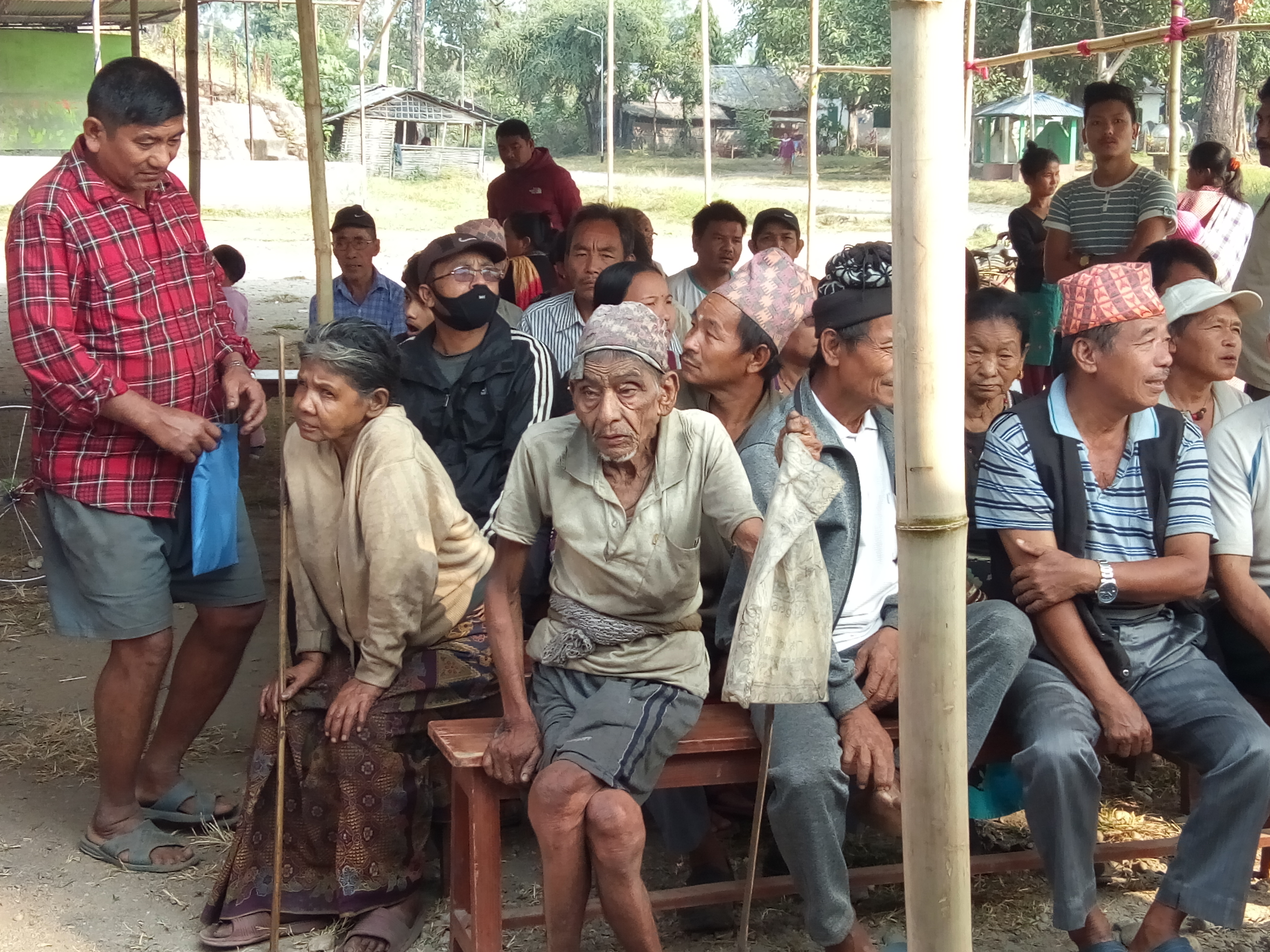
A section of the Bhutanese refugees who are untouched by the good of third country resettlement program / Photo : Author)
The people survived under the protection of the Government of Nepal, UNHCR and several other international organizations, as refugees in Nepal. The Nepalized non-Nepalese people are barred from working officially in Nepal. The presence of more than thirty thousand Bhutanese people scattered in Nepal and India- stateless and voiceless- is not acknowledged by the UNHCR. They are the Bhutanese refugees who are either not on the UNHCR’s list or are excluded from the list. There are Drukpa refugees either registered or not registered in Nepal. There may be a solution to the registered refugees. All doors are shut before the non-registered folks. The only option left for the non-registered refugees is to surrender before the nearest government; either the RGoB or GoN, as soon as possible.
Identity in Transition During expulsion and stay in the camp, refugees were more than often compelled by different forces to shun the Bhutanese identity and take up auxiliary identities.Several of them were promoted through the division of refugees into groups.Auxiliary terms such as ethnic Nepalese, when there are no ethnic Nepalese people even in Nepal, Bhutanese Nepalese, Nepalese Bhutanese, Nepali speaking Bhutanese, Southern Bhutanese, and Bhutanese of Nepali origin were used to differentiate and marginalize them from the de facto Bhutanese society. In the new land, their identity is constantly negated to compel them to shun the Bhutanese identity in toto. The Bhutanese identities in core group countries are under threat of extinction for lack of support to nurture them; people who shun the identity and take up new identity are modeled as examples. Still, the people are struggling to establish and adapt to the new environment.
Although the resettled people who pass the strict criteria for citizenship are granted naturalized citizenship, in reality, it is not naturalization but its acculturation to extinction. In naturalization, members of the society in the new settlement have enough individuals to intermarry to continue the identity of the society. In none of the core group countries, Bhutanese have the environment to continue intermarriage and carry on the Bhutanese identity. There is a limited choice of partners for the youth at marrying age. Bhutanese youths who can manage expenses travel to India and Nepal- due mainly to the proximity of identity- to find partners to wed. The situation in the resettled lands is leading to a forced acculturation. The global force has been to make the Bhutanese identity extinct- the sole mission of the Drukpa government. If the core group countries and India had spent on repatriation a fraction of the resources and influence they spend on resettlement, people would have been in their country enjoying their natural habitation. It may take a long time for the people scattered across the globe to come to a united mission of conserving their identity and securing their rights- if at all. The world history is yet to conclude if the identity of Bhutanese people- a minuscule population on the globe- vortexed in an international political churner cuddles or transforms into cream. One of the distinctive characteristics of the weakest and the most vulnerable section of the human society is their lack of collective decision. It is always easy to influence and fragment weak, poor and marginalized population. This weakness is capitalized by the rulers and stakeholders with vested interest to divide such a population and impose their agendas and missions.Bhutanese refugees were not spared. They were divided into multiple fragments, segments and units. Refugees got divided on the basis of ideologies, consciousness, family names, families, religions, phenotypes, languages and beliefs to the extent that even caste-biased discrimination, untouchability, and religious fanaticism rose to dominance. Refugees got regrouped into as many, small groups as possible and often played against each other. The fragmentation continues in the resettled countries. It will continue until the point the majority of the people gain awareness, socio-eco-political strength and greater identity consciousness. The Bhutanese people scattered across the world are at the lowest strata of population in resettled countries. They have multiple challenges to overcome to adapt in the new environments. It is not sure how long it takes- if at all- for the people to be aware that they are being divided at others interest.
Political Identity Bhutanese people had a long quest for and awareness of democracy, democratic values, and the peoples’ leadership. Their political consciousness was a threat to the Drukpa families in the power. Political parties are banned and political leaders, activists, and cadres are either silenced or they escape into exile. Political parties were formed in the 1950s and in 1990s by the Bhutanese people. The parties have the names Bhutan- such as Bhutan State Congress (formed in 1952), Bhutan Peoples’ Party (1990) Bhutan National Democratic Party (1993), Bhutan Gorkha Liberation Front (1993), Bhutan National Congress (1994), and Communist Party of Bhutan (2003).
Since 2005, the rulers began to choose people of their bastion and gave them consents to form political parties. They had to be Druk-named, Drukpa based, and Drukpa led. The Drukpa parties such as Druk Phensum Tshokpa, Druk Nyamrup Tshogpa, and Druk Chirwang Party were permitted limited political exercises inside the country. There were two exceptions in the names. Bhutan Kuennyam Party and People’s Democratic Party are both Drukpa led and Drukpa based parties, one has Bhutan and other has neither Bhutan nor Druk in their names.Not all Drukpas have the privilege if they are not related or loyal to the power centers. Drukpas not related to the power centers and those who speak for the mass, marginalized and suppressed people lose their privileges. Two parties formed with Drukpa leadership and Druk names namely Druk National Congress (1994) and Druk National Congress- Democratic (1998) are not recognized in the country on the pretext that they were established without prior consent from the rulers. The political parties must submit absolute devotion to the ruling regime, never question the higher authority and on that condition, they are permitted to seek the mandate from the people. The rulers have decreed the ruling parties to work against the expelled people and the opposition to maintain silence on the issue. The limited opportunity to form political parties and collect mandates from the people came from the power centers. The opportunity is conditional- only regime supporters can have it. The rulers have been instrumental in mobilizing voters in favor of the party they want to get elected. Two governments were formed after the introduction of ‘one adult one vote’ parliamentary system introduced in the name of democracy in 2008 in place of ‘one family one vote’ system that existed before. Both the governments continued the ‘one race one culture’ policy of the earlier racist regime. The Drukpa identity has shadowed the Bhutanese identity.
Conclusion Bhutan has become a laboratory to study how one minority race in power for a long time develops mechanisms to keep the majority under its dominance and commands obedience. Racist groups across the world are funding the research for a holistic strategy to apply in their countries. The Bhutanese people, Drukpas sidelined and ruled by the power centers, enslaved citizens and victims need awareness of the reality and options to overcome them. The people have to struggle against the multiple suppressive and divisive factors – nationally and internationally for their nationality, rights, and identity- from the lowest strata of the global population by rapidly up-scaling their awareness.
Govinda Rizal, the contributing editor of the Bhutan News Service, is the author of the book ‘A Pardesi in Paradise’.
The first time Lok Pokhrel boarded a plane was when he left Nepal for the United States with his family in December, 2009.
He wondered how this “big metal bird” could possibly take off the ground and fly.
When he arrived in Denver, Colorado, he was at first mystified by the speed at which life unfold in his new hometown. No one seemed to talk to one another, even in very close quarters, like on a bus.
Lok Pokhrel, 27. Photo credit: David Sidorenko
Today, as a newly minted pilot, Pokhrel understands intimately how planes work—and he is accustomed to travelling at intense speeds himself, up in the skies.
Earning his commercial pilot certificate was a feat that required intense hard work and training over a series of years—and an investment of over $60,000.
Last May, he graduated from Metropolitan State University in Denver with a degree in aviation and aerospace science. He currently works as an air tour pilot in Guam/Northern Mariana Islands, logging hours, and hoping to some day become a captain for a major airline so he can fly jets like the Boeing 737 or Dreamliner 787.
Along the way to earning his certification, Pokhrel worked as a financial aid advisor for his university, as a cook for Burger King and a cashier for Chipotle.
When he left Beldangi 3 camp for resettlement, he had a sense that the ability to fly would allow him to see his friends, soon to be scattered around the world on different continents, again. Maybe one day, he dreams, he’ll be able to go back to his ancestral home of Bhutan some day, too—the airport in Paro is considered to be one of the most difficult flying patterns in the world.
Pokhrel’s hopes for the future are much brighter than when he first landed in the US after eighteen years in the camp, where he’d moved as an 18 month old.
At age 27, Pokhrel is also a certified ground instructor, which means he can teach theory to student pilots.
There’s another reason he’s pleased with his profession: “I see an opportunity for helping others by flying an aircraft with relief and medical supplies to those who are in a disaster or crisis situation.”
His family has resettled in Ohio, and Pokhrel feels he is now living a dream that inspires him to jump out of bed each day. “On the road to success,” he’s said, “the rule is, always to look ahead, so that you may reach the destination.”
Current Chairperson of the Bhutan Media Society, Napoli, a veteran journalist, has spent time as a volunteer in Bhutan and is the author of two books, Radio Shangri-La and Ray & Joan. Learn more about her at: lisanapoli.com.
___ Tell us your success/resettlement story, or if you know someone you think should be featured here feel free to reach out to us. Such stories will inspire others and keep the diaspora informed. You can write your own story too. Email us at: [email protected] OR [email protected].
The Organization for Hindu Religion and Culture (OHRC) honored twenty-five Bhutanese-Americans seniors amidst a ceremony held on January 21 coinciding Sawaswati Puja in Harrisburg, PA.
According to OHRC, the organization has kept a trend of honoring new citizens particularly those who never had any kind of formal schooling.
New Bhutanese-American pose for a group photograph (Photo: Tika Rizal)
Around 300 individuals attended the ceremony and Sarawati Puja. Pandit Sitaram Adhikari conducted the puja, while OHRC board member Thakur Ghimirey introduced Nepali alphabets to dozens of small children.
OHRC President Tularam Neopaney thanked and honored all former board members for their dedication and hard work to the community members.
“We were able to purchase a big land where we’ll build our own Hindu temple,” Neopaney said, “I am very proud that our dollar-a-day is going very well. We already have over 100 members and this is going up.”
According to Neopaney, OHRC is also planning to commence the next Nepali class from March this year. “We aim to conduct Nepali classes up to the fifth grade beginning this year.”
Addressing the gathering, Ashok Rai, president of Bhutanese Community of Harrisburg, hoped that his organization was looking forward to promoting the Bhutanese culture and social values. He also thanked OHRC for organizing such an event.
Tika Rizal from Harrisburg, PA contributed this report for BNS.
आफू रहेको समाजमा भोगेको एउटा पक्षमाथि प्रहार गरेको यो मुक्तक लेख्नुभएको हो, नेपाली-भाषी भूटानी सर्जक राकेश काफ्लेले । यो उहाँको मुक्तक-संग्रह ‘परिवेश रोएको बेला’ का २ सय ५५ मुक्तकमध्येको एउटा हो । यो १६ अप्रिल २०१७ अमेरिकाको आयोवामा लोकार्पण गरिएको हो ।
पुस्तक भूटानी शिक्षक स्वर्गीय एनपी रेग्मीप्रति समर्पित गरिएको छ । रेग्मीले भूटानमा र शरणार्थी शिविरमा नेपाली–भाषी भूटानी बालबालिकालाई भाषा र शिक्षामा अग्रसर गराउने अथक प्रयास गर्नुभएको थियो ।
पुस्तकको नाम ‘परिवेश रोएको बेला’ भए पनि संग्रहमा परिवेश रोएको मात्र छैन, कृतिकार काफ्ले कहीँ यथास्थिति स्वीकार्नु हुन्छ भने कही विद्रोह गर्न खोज्नुहुन्छ । गल्ती देखाउन औंला ठड्याउने प्रयास गर्नुहुन्छ । लेखनमा बेलाबेला उहाँ वाक्क हुनुहुन्छ । कहीँ दंग भेटिनुहुन्छ । थोरै राजनीतिक चेत पनि पाइन्छ, उहाँको लेखनमा । कतैअभाव, कतै पूर्णता छ । लेखन निकै गहन छ । पढुँ पढुँ लाग्ने छ । एउटा पढिसक्दा ‘अर्को मुक्तक कस्तो होला ? कस्तो होला ?’ हुन्छ । मुक्तकमा व्यङ्ग्य पनि गर्नुभएको छ, कतै उहाँलेः
बुद्धिमा बिर्को लाएर
मपाईंत्वको गीत लाएर
गन्तव्यमा पुग्छौं के तिमी ?
पूर्व जानलाई पश्चिम धाएर ।
मुक्तकः इतिहास, माटो, देश छोड्दाको बेदना, शरणार्थी जीवनका नरमाइला क्षण, प्रेमका वर्णन, केही हाँस्यरस, तेस्रो मुलुकमा भोगेका पल, जाति–धर्म–संस्कृति–परम्पराको सन्दर्भ, भोलीको चिन्ता आदि विषयमा लेखिएका छन् ।
काफ्लेको यो पाँचौं कृति हो भने पहिलो मुक्तक–संग्रह । कृतिकारले ‘परिवेश रोएको बेला’लाई नेपाली–भाषी भूटानीले लेखेको प्रथम मुक्तक–संग्रह भएको बताउनु भएको छ ।
यस संग्रहका शब्द–शब्द केलाएर नेपाली-भाषाका शिक्षक डा. देवी नेपालले कुशल कृति–व्याख्या गरेका छन् भने नेपाली-भाषी भूटानी स्रस्टा पुरानाघरे (भोला शिवाकोटी) ले सम्पादन गर्नुभएको छ । शुद्धाशुद्धिमा ध्यान पुर्याइएको छ ।
आवरण रङ्गिन छ, अलि आकर्षक छ । भित्री पृष्ठ साधारण छन्, राम्रो बनाउन सक्ने जति गरिएको छ । आवरण–चित्र नवल खतिवडाको छ भने आवरण डिजाइन सुरेश वाग्लेले गर्नुभएको छ ।
अमेरिकाको ओहायो राज्यको कोलम्बसस्थित पाथीभरा ज्वेलर्स यसको प्रकाशक हो । मुद्रण भने सुनगाभा अफसेट, नेपालमा गरिएको हो । यो किताब २०१७ मै छापिएको हो । पहिलो संस्करणमा एक हजार १ प्रति निकालिएको उल्लेख छ ।
करिब ८ इन्च लम्बाइ र ५ इन्च चौडाइको यो किताब भित्री १६८ आवरण ४ गरी १७२ पृष्ठको छ । किताबको मूल्य १० डलर (नेपाली रूपैयाँ २५०) छ ।
Breaking: Heavy and incessant rain with strong wind for three days damaged huts and flooded camps to cause evacuation of affected families to high surfaces. According to Sanchahang Subba, 25 to 30 trees have fallen, affecting most in the Beldangi extension camp. 80% of the camp is inundated, 10 to 15 huts damaged completely. According to him, LWF is providing assistance to the affected families.
It is the second year now that Bhutanese Society of Kentucky has been hosting the international
Cincinnati players posing for photo/Photo: Chandra Dahal
memorial soccer tournament in memory of three youths killed in train crash accident in 2015.
Today nine teams including two from Cincinnati and one from Tennessee of various ethnic organizations met at a metro park in Buechel area to play one day soccer tournament with a message of safe driving for youths and teens.
The players in action/Photo: BM Dhakal
In the first match played between Kentucky FC and Tennessee YStar, the latter scored a goal just in three minutes, challenging Kentucky FC to contest. Kentucky FC won the game by six goals against two.
While the tournament was played in most friendly atmosphere, the umpire offered few yellow cards.
The final game played between Kentucky FC and Red Hawks, both of Louisville, was fair and professional. Kentucky FC won the game by three goals against one by Red Hawks.
The players in the field/Photo BM Dhakal
The final contesting team were awarded medals, trophy and cash prize of $300 to runner up.
The tournament was supported by the Louisville Metro parks, C.E&S Foundation and Access Daycare.
Late Suk Man Rai, Chita Chuwan and Nagin Thapa were killed in tragic train accident in 2015. Kismat Mishra, the lone survivor watched the tournament and shared his memories with his soccer loving friends.
Bhutanese refugee delegation led by Tika Ram Rasaily, camp secretary of Beldangi refugee camp appealed the government of Nepal to facilitate on local assimilation and dignified repatriation of those remaining refugees in Beldangi and Sanischare camps in eastern Nepal.
Delegates meet former PM Baburam Bhattarai/Photo: Yubaraj Sampang
In a week long visit that began on July 24th in Kathmandu, the delegation held discussions with Home Minister Janardhan Sharma, Deputy Prime Minister and Foreign Minister Krishna Bahadur Mahara, Former Prime Minister Dr. Babu Ram Bhattrai, Human Rights Activists and some prominent political leaders and appealed them to quicken a dialogue with the government of Bhutan to uphold and protect the fundamental human rights of the remaining refugees who wish to return their homeland, allow the remaining refugees to integrate locally and receive necessary administrative assistance to complete the formalities for acquiring citizenship and accelerate the resettlement process to ensure the family right to unification.
According to Yuba Raj Sampang, a member of delegation, the committee has submitted a petition to the government officials, and human rights activist, and the officials at National Coordination Unit for Refugee Affairs (NUCRA) which they believe will reinstate the long-lost dialogue between Bhutan and Nepal. “Home Minister Sharma guaranteed to resolve the Bhutanese refugee problem sooner than later”, Sampang added.
“Majority of the Refugees have been resettled despite their willingness to settle in the western world. Now, only a small chunk of the refugees languishing for the dignified return to their homeland, Bhutan. As the Host country, Nepal Government is here by trustfully appealed to bring dialogues involving all stakeholders including the representative from the Bhutanese Refugees” petition reads.
According to United Nation High Commissioner for Refugees (UNHCR) Nepal, the United States, Canada, Australia, New Zealand, Denmark, Norway, the Netherlands and the United Kingdom have jointly resettled about 110,000 refugees and now 9,500 Bhutanese refugees are residing in Camps.
The seventh national annual convention of the Organization of Bhutanese Communities in America (OBCA) concluded Sunday July 30th charting out its action plan and emphasizing the formulation of the national managerial structure.
The participants had held discussions on various issues including the woeful situation of Bhutanese refugees languishing in camps, strategies to address their needs, and organizational expansion throughout the country.
Appreciation for Karen’s work by OBCA/Source: Padam Bharati’s facebook page
Karen Parde, chief coordinator of ORR (Office of Refugee Resettlement) Nebraska updated the convention participants on refugee statistics for the state of Nebraska, current ORR programs for refugees, and mentioned that Bhutanese refugee population is one of the fastest integrating & adjusting community into the US mainstream systems.
According to a press release issued by Krishna K. Sapkota, the Press & Publicity Secretary, OBCA honored some prominent individuals and organizations during the convention. Dilli Adhikari, CEO of Intra–National Home Care Services LLC received ‘Best Selfless Contribution Award 2017’ for his notable contributions in the community. Similarly, Bhutanese Community Association of Pittsburgh (BCAP) received ‘Best Community Organization Award’ of the year. Gopal Gartoula, Karen Parde, David Keiz, Jitu Basnet, DJ Khaling, DS Ghaley received letter of appreciation during the event.
Aita Rai from Massachusetts was elected as vice-chairman of the organization. Likewise, the convention elected Jiden Rai – Secretary; Padam Bharati-Treasurer; Krishna Sapkota- Press & Publicity Secretary; Jitu Basnet-Youth & Sports secretary; Karna Gurung- Language, Literature & Art Secretary. The convention empowered outgoing chairman DB Rai and NB Gurung as Board of Directors. DJ Khaling, DS Ghalay and Kumar Gurung are elected to advisory board. Ram Rai from Kansas, Bhim Gurung from Nebraska, Nisha Mabo from Iowa, Bila Angandgbe from Ohio, Sujit Magar from Virginia are inducted as respective state representatives.
The press release states, ‘Besides OBCA’s convention agenda, Inter-State Women Soccer Tournament and hosts of other cultural events were also part of the three-day long event. In final match, North Dakota “Shining Star” defeating Minnesota with four goals against three bagged the victory of the tournament. Trophy distribution and recognizing the teams, coaches, and judges became another menu of the event’.
OBCA officials posing for photo/Source: Padam Bharati’s facebook page
Newly elected chairman, Dilip Dahal stated, “Making Bhutanese communities in the United States of America stronger through cooperation, collaboration, and empowerment will be the most important issue of his job. “The new board of OBCA already met to come up with a clear plan of action for next 2 years. OBCA will go to work on these plans immediately after the convention. Details on this plan of action, remaining organizational positions that are not filled at the time of this press release, will be finalized and shared after OBCA’s first conference call”.
He also indicated the need to change some of the existing policy of organization. “OBCA will reach out to every city & state based Bhutanese community organizations to collaborate and to work together towards the common vision”, he concluded.
Gopal Gartoula, reporter at Himal Khabar Patrika and Ujayalo Network, who was one of the invitees from Nepal to attend the convention, presented a report highlighting the current situation of refugee camps in Nepal. Based on Gartoula’s report OBCA board held discussion during the convention and has decided to assign a committee to work on addressing the issues in near future.
The three day convention was organized in association with the Bhutanese Community in Nebraska (BCN).