Lexington team wins memorial soccer tournament

26,644

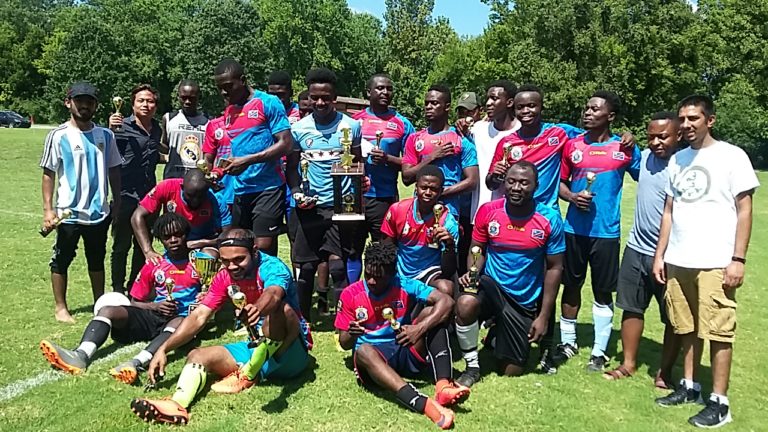
In a two days match played between twelve soccer teams of former refugees from Iraq, Myanmar, Bhutan, Congo and Somalia, Maila Don team of Lexington won the final match against Louisville Rising star club.

The third youth memorial soccer tournament was played in Thurman Hutchins park on River Road 11th and 12th August.

         Rising star team/ Photo; BNS

Twelve different teams from Lexington, Cincinnati and Bowling Green registered and payed entry fee of two hundred dollars to Bhutanese Society of Kentucky, the organizer that managed the ground and other logistics for the game. Three teams from Louisville registered to play.

The game was opened with a US national anthem and a tribute to the three youths – Chita Chuwan, Sukman Rai and Nagen Thapa- who died when their car was hit by train in 2015. Every year BSK hosts the memorial tournament as a tribute to these soccer star of their schools in Jefferson county, Louisville.

The final game played on 12th that started almost forty-five minutes later than the stipulated time kicked off with a ball rolled by Nar Bahadur Thapa, father of deceased Nagen Thapa.

Briefing by Bhim Koirala of BSK/ Photo :BNS

Jitu Basnet, Amrit Regmi, Stevens and Bikram Subba served as officials of the final game.

Cash prize of eight hundred and five hundred dollars was awarded to winner and first runner-up teams along with trophies, and man of the match prize donated by Nar Bahadur Thapa.

Chief of Metro Parks, Seve Ghosh distributed the prizes and trophies.

BSK has been organizing the game every year involving players of international populations in Louisville. The program director of BSK, Bhim Koirala says, “ this tournament is gaining momentum as more soccer teams are participating from neighboring cities.”

Hindu religious sermon in Louisville for Nepali classes

The first weekend of August was a busy schedule for Hindus of Bhutanese community in Louisville thanks to the three days religious event of preaching, lecturing and discussion on basic tenets of Hindu philosophy, alongside the rituals of Shrimad Bhagawat Puran and other religious texts.

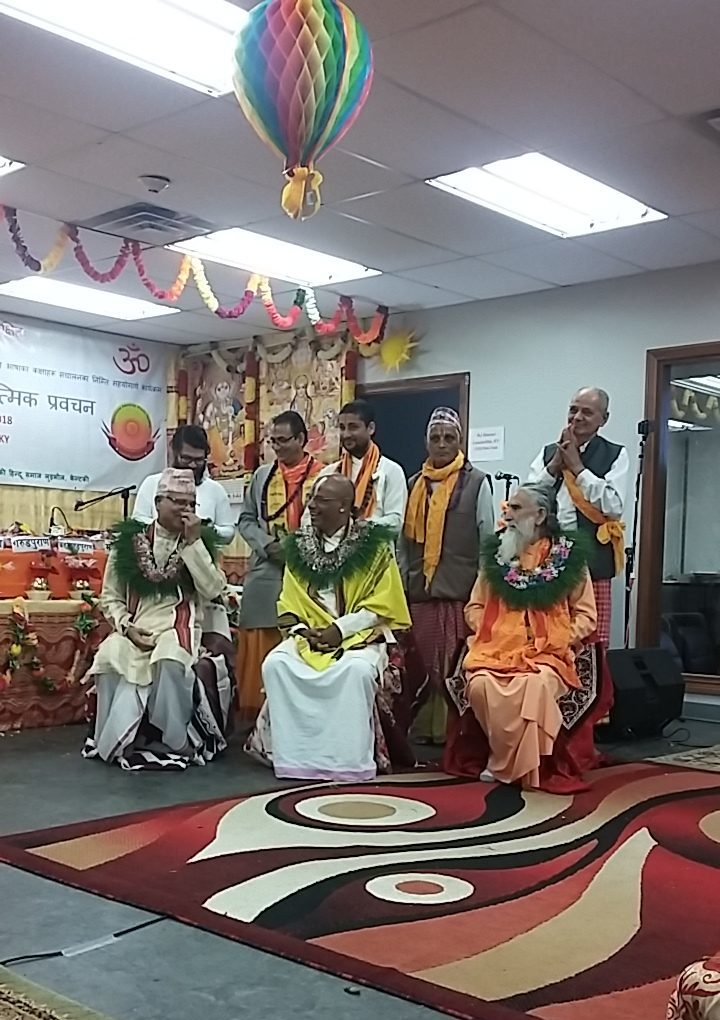
In the big hall of Freedom Adult daycare, a raised makeshift platform was well decorated by colorful drapes, silk robes and photographs of respective Hindu deities, gurus of Kirat, Manav dharma, Lord Buddha and infront sat the eighteen puranas visibly captioned each.

The religious congregation hosted jointly by Bhutanese American Hindu Society (BAHS) based in Louisville and Global Bhutanese Hindu Organization (GBHO) aimed at raising funds to support Nepali language classes run by BAHS.

For three days, August 3-5, devotees thronged to the facility of adult day health care located at 4511 Bardstown road to listen to the sermon of some distinguished religious gurus including Puroshottam Sapkota, former host of Dharmik karyakram at Radio Nepal.

The first day opened with kalash yaatra, offering of prayers and lighting diyo by all religious groups- Manav Dharma, Kirat and Buddhist – included in Omkar spectrum of eastern faith. Swami Chakrapani Prapanna (Sita Ram Adhikari) led the sermon. Dr. Laxmi Narayan Dhakal, a noted linguistic activist delivered his lecture on the ways to promote use of Nepali language and its pedagogy.

The second day was marked by presence of pundits, young and old, from across the states. Most remarkable was Pundit Mohananda Ghimirey’s explanation of practical aspects of Bhagawat Geeta, its implication on the lives of modern human being, the power of Geeta knowledge continuing to influence people’s actions.

The wisemen: Pundits Bedanidhi Subedi, Sita Ram Adhikari, Purushottam Sapkota (sitting) with other priests(standing at the back). Photo: BNS

Pundit Bedanidhi Subedi and Pundit Purushottam Sapkota highlighted on more philosophical underpinnings of Shrimad Bhagawat Puran relating to various anecdotes described in those holy texts.

The sermon on third day by Pundit Arjun Shankar produced vibration of inclusive nature of Hindu Philosophy not merely within the sects of Hinduism but advocating on universal brotherhood across religions. According to him, some superficial explanations of Bhagawat Puran and Bhagawat Geeta has created fissures within the society; that division does not have any basis to rely on.

In a closed door conversation with BNS, the organizers claimed that this was the first ever kind of inclusive Hindu religious sermon among Bhutanese community. Bishnu Pokhrel, president of BAHS is satisfied that it worked well, all volunteers worked hand in glove and no untoward incident occurred.

In the same conversation, Buddha Subedi, secretary of BAHS enlisted plans to operate the Nepali language class with more inputs of materials and incentive to the volunteers. He, however, did not mention the ways and methods to be used for improvement of language learning. According to him, manuals will be developed for the volunteer teachers, every penny raised will be used only for operating the classes.

Devotees on second day/Photo : BNS

Both Buddha and Bishnu claimed that the class is open to everyone whether to learn just the language or learn cultural and religious components of Hinduism.

“We have been talking to all sections and head of ethnic groups to send their children to class, purely for learning Nepali language but not for other cultural training,” Bishnu emphasized.

GBHO handed over a check of 5000 dollars to BAHS for this noble endeavor of running Nepali class. GBHO president Kamal Dhimal was optimistic about the change of socio-cultural attitude and behaviour of many people of Bhutanese descent. “So many anomalies of cultural affair prevails, we need to correct this, which otherwise will cause harm to our societal bond. It is however not a radical change of society akin to left ideology but reinventing the unbiased principles and colorful fabric of vedic knowledge,” he said to BNS.

“We are very much exalted and encouraged by the success of this inclusive religious event, so we are going to handover research materials to young people to find more truth of Hindu scriptures and teachings of vedas or geeta. That will definitely encourage our younger folks to be the torch bearer of cultural and religious traditions we have lived through ages.”

Had it not been the Yoga session led by Ghanashyam Regmi and his brothers on 4th and 5th, there would not have been so much energy among those elderly attendees for digesting the hot humid languor of ninety degrees temperature.

The congregation concluded almost one and half hour later than stipulated time with appreciation certificates and saffron shawls to all volunteers, dancers and management team members. Auspicious lakh baati (one hundred thousand cotton wicks) was lighted wishing for global peace and harmony among all human beings.

GBHO president Kamal Dhimal announced a donation of five thousand dollars to BAHS in his concluding address to the congregation.

Cars and vans packed with religious singing and music groups poured in from Pittsburgh, Columbus and Reynoldsburg of Ohio, Nashville TN, Cincinnati and St.Louis, Missouri.

The excellent quality of the sound system provided by Raju Rasaily and his dedicated volunteer work all three days made the event lively.

Food was prepared and served on the venue with bulk of the materials donated by individuals and Nepali and Bhutanese businesses in Louisville.

विशाल र आनन: मेरो डान्स कप र मेरो भ्वाइस कपका विजयी

न्यु ह्याम्सर । मेरो डान्स कप तेस्रोमेरो भ्वाइस कप पहिलोको उपाधी क्रमश: विशाल राई र आनन राईले जितेका छन् । दुवै प्रतियोगिताको अन्तिम चारबीचको प्रतिस्पर्धा (ग्य्राण्ड फिनाले) अगस्त ४, २०१८ शनिबार ओहायो राज्यको एक्रनमा भएको थियो ।

मेरो डान्स कपतर्फ सुमन विश्वा फर्स्ट रनरअप, अञ्जु तामाङ्ग सेकेन्ड रनरअप र कामना पोखरेल चौथा भए भने मेरो भ्वाइस कपतर्फ प्रकाश सिलवाल फर्स्ट रनरअप, विवेक दियाली सेकेन्ड रनरअप र टिका घिमिरे चौथा भए । सन् २०१६ पछिका सबै नृत्य प्रतिस्पर्धामा महिलाहरूले मात्र जितेका थिए, उनीहरू: जर्जिया एटलान्टाकी पूर्णी गुरूङ्ग (२०१६), र नर्थ डकोटाकी मनिता मगर (२०१७) हुन् ।

विजयीहरू आधा एसएमएस र आधा निर्णायकबाट छानिएका थिए । विजयीले १० तोला सुनको कप, ३ हजार डलर नगद पुरस्कार आदि पाएका छन् । फर्स्ट रनरअप, सेकेन्ड रनरअप र चौथालाई पनि नगद र अन्य पुरस्कार प्रदान गरिएको थियो । यस वर्षका यी दुई ठूला प्रतिस्पर्धामध्ये मेरो डान्स कपको पहिलो प्रतिस्पर्धा २०१६ मा भएको थियो भने मेरो भ्वाइस कप यो वर्ष पहिलो हो ।

एजे स्टुडियोको प्रस्तुति रहेका दुवै प्रतियोगितामा भाग लिनेले गत मार्च १० देखि अप्रिल १५ सम्ममा आवेदन दिएका थिए भने अप्रिल २७ देखि मे २६ सम्म उनीहरूको अनलाइन राउन्ड भएका थिए । एक महिनाको विश्रामपछि जून २६३० मा भ्वाइस कप र जुलाई १५ मा डान्स कपको लाइभ राउन्ड छायाङ्कन भएका थिए । जुलाई ६ पछि पालैपालो गर्दै जुलाई २८ मा दुवै प्रतियोगिताको लाइभ राउन्ड सकिएको थियो ।

अनलाइन राउन्डबाट १२ जना छानिएकामा लाइभ राउन्डबाट क्रमश: ८ र ६ हुँदै ४ अन्तिम प्रतिस्पर्धी आएका हुन्,” फिनाले शुरू हुनुअघि भूट्निज अमेरिकन म्युजिक एशोसियसन (बामा) को बोर्ड सदस्य तथा मेरो भ्वाइस कपको संयोजनमा लागेका अम्बर तुम्बापो सुब्बाले बताए । तर बामालाई औपचारिक निम्तो थिएन,” बामा उपाध्यक्ष खेम रिजालले बताए, ”मलाई भूटनिज कम्युनिटी अफ सिन्सिन्याटीका कार्यकारी–निर्देशकका रूपमा निम्तो थियो ।

पहिलो मेरो डान्स कप विजेता पूर्णी गुरूङ्गले यसपटक गतिलो प्रतिस्पर्धा भएको अनुभव गरिन् । उनलाई प्रशिक्षणका केही अंश र श्रृंगारको काम जिम्मा दिइएको थियो ।

मेरो डान्स कप तेस्रोका अन्तिम चारमा प्रतिस्पर्धी नम्बर २, , ८ र ११ का क्रमश: अन्जु तामाङ्ग, विशाल राई, कामना पोखरेल, र सुमन विश्वा पुगेका थिए । यसका चार निर्णायकहरू: दिलिप रायमाझी, नन्दिता केसी, डिबी गुरूङ्ग, सुनिता राई, र नरमन राई हुनुहुन्थ्यो । डान्स कप कार्यक्रमका सञ्चालक सुनिता गुरूङ्ग र लक्ष्मी अधिकारी हुनुहुन्थ्यो ।

मेरो भ्वाइस कप पहिलोका अन्तिम चारमा प्रतिस्पर्धी नम्बर १, , ९ र १२ का क्रमश: आनन राई, विवेक दियाली, प्रकाश सिलवाल, र टिका घिमिरे पुगेका थिए । यसका चार निर्णायकहरू: गायकहरू रामकृष्ण ढकाल, जगदिश समाल, रिमा गुरूङ्ग, र अर्जुन रसाइली हुनुहुन्थ्यो । भ्वाइस कप कार्यक्रमका सञ्चालक रिमा विश्वकर्मा र प्रजित राना हुनुहुन्थ्यो ।

फाइनलमा करिब २ सय जना स्वयंसेवक खटाइएका थिए भने करिब ३ हजार जना दर्शक अटाउने ओहायोको एक्रनस्थित इजे टमस हलमा कार्यक्रम भएको थियो । कार्यक्रमको व्यवस्थापन औसत थियो भने साउन्ड सिस्टमले निकै धोका दिएको थियो ।

नेपालीभाषी भूटानीतर्फ प्रताप सुब्बा, महेश थुलुङ, अर्जुन रसाइली, मनोज ढकाल, सुचिता गुरूङ, किरण गजमेर आदिको मुख्य रूपमा अगाडी देखिनुभएको थियो भने अमेरिकामा नेपालका धेरै कलाकार एकथलोमा देखिएको संभवत यो पहिलो कार्यक्रम रह्यो । यसमा राजेश हमाल, दिलिप रायमाझी, केकी अधिकारी, नन्दिता केसी, रिमा विश्वकर्मा, बाबु बोगटी, रामकृष्ण ढकाल, सत्यराज आचार्य, स्वरूपराज आचार्य, जगदीश समाल, रिमा गुरूङ होडा, इन्दिरा जोशी, श्याम नेपाली, सुशील विश्वकर्मा आदि उपस्थित थिए । कार्यक्रममा भूटानी मूलका कलाकारहरू अल्पमतमा परेको झल्को पाइयो ।

नृत्य र गायनका यी दुई ठूला प्रतिस्पर्धाको मुख्य प्रायोजक इन्ट्रानेशनल होम केयर थियो भने अमेरिकेयर हेल्थकेयर सर्भिसेस, जोर्सहिमाल ज्वेलर्स (रोचेस्टर, न्युयोर्क), पाथिभरा ज्वेलर्स (कोलम्बस, ओहायो), इरि इन्स्योरेन्स / गौतम इन्स्योरेन्स एजेन्सी (कोलम्बस, ओहायो), इभान्जेलिना ट्याक्स सर्भिसेस (कोलम्बस, ओहायो), केलर विलियम्स रियाल्टी (एक्रन, ओहायो), इजन फेसन (कोलम्बस, ओहायो), फेसन रेकन (कोलम्बस, ओहायो) आदि सहप्रायोजक थिए ।

(कोइराला, अक्षरिकाका सम्पादक पनि हुन् ।)

परिवार नै मेरो हौसला: मिस भूटान युएस २०१८ सुचिता

न्यु ह्याम्सर । गत साल ठूलाबाकी छोरी सुजना फर्स्ट रनरअप हुनुले पनि मलाई हौसला मिलेको हो,” मिस भूटान युएस २०१८ सुचिता प्रधानले भूटान न्युज सर्भिससँग भनिन्, ”बुबाआमाले शिक्षा पूरा गर्ने मौका पाउनु भएन । तर मलाई जे राम्रो हुन्छ, म जेबाट खुशी हुन्छु, त्यो गर है भन्नुहुन्थ्यो । यो नै मेरो प्रेरणा पनि हो ।उनी गणेश र इन्द्रदेवीकी जेठी छोरी हुन् । उनका दुई जना बहिनी छन् ।

ओहायोको कोलम्बसमा जुलाई १९२२ आयोजित उक्त प्रतियोगिताकी विजेता प्रधान नर्थ क्यारोलाइनाका सार्लोट वासिन्दा हुन् । प्रतियोगितामा अस्मिता सुब्बा, मोनिता सरू, बेनिता द्यौराली, दुर्गा कटेल, सुचिता प्रधान, गंगा दुलाल, निर्मला दाहाल, नर्वदा गौतम, शितल अधिकारी, कुमारी माझी र निशा आचार्य गरी ११ जना थिए । ११ बाट ७ हुँदै अन्तिममा ३ जना पुगेका हुन् । सुचितालाई पछ्याउँदै दुर्गा कटेल फर्स्ट रनरअप र गंगा दुलाल सेकेन्ड रनरअप भए । उनीहरूले क्रमश: २ हजार, १ हजार ५ सय र १ हजार डलर नगदसहित अन्य पुरस्कार पाए ।

प्रतियोगिताका लागि हामीले अन्तिमका ७ दिन निकै मेहनत गर्‍यौं । तालिम बिहान ७ बजे शुरू हुन्थ्यो र बेलुका ५६ बजे सकिन्थ्यो । आजभन्दा भोली कसरी राम्रो गर्नु भन्ने हुन्थ्यो । अन्तिम दिनको तयारीसम्म निखारिनु थियो,” पाँचौं मिस भूटान युएस प्रधानले भनिन् । प्रतियोगिताकी अफिसियल कोरियोग्राफर नेपाली चलचित्रनायिका प्रियङ्का कार्की थिइन् ।

मिस भूटान युएस सन् २०१४ मा पहिलोपटक ह्युस्टन, टेक्ससमा भएको थियो । त्यसपछि हरेक वर्ष क्रमश: टेनेसीको न्याशभिल, ओहायो राज्यको क्लिभल्याण्ड, पेन्सलभेनिया राज्यको ह्यारिसवर्ग र यस वर्षको पाँचौं संस्करण ओहायोको कोलम्बस आइपुगेको हो । यसअघि सन् २०१४ मा प्रकृति राई, २०१५ मा नुमा लिम्बू, २०१६ मा विमला शिवाकोटी र २०१७ मा आरती घिसिङ तामाङले मिस भुटान युएसको उपाधि जितेका थिए ।

मैले यसअघिका विजेताहरूसँग पनि कुरा गरेकी थिएँ,” प्रधानले अगाडी भनिन्, ”अनि यसपटकका ११ प्रतिस्पर्धीबीच घुलमिल अवसर मिल्यो । हामी सम्बन्ध निकै सुमधुर रह्यो ।प्रतियोगिताको निर्णायकमण्डलमा नै सन् २०१६ को मिस युएस भूटान विजेता विमला शिवाकोटी थिइन् । शिवाकोटीबाहेक निर्णायकमण्डलमा गायिका इन्दिरा जोशी, डिजाइनर पुनम गौतम, नेपाली नायक जीवन लुइटेल, डिजाइनर शुभेच्छा भँडेल थिए । कार्यक्रमको अन्तिम दिन जुलाई २२ मा ६ जना जति गायकको प्रस्तुति पनि थियो ।

सत्रदेखि २८ वर्षका युवतीमाझ मिस युएस भूटान छान्ने यो प्रतियोगिता हिमालयन फेस्टिभल युएसए (एचएफयुएसए) ले आफ्नो एक इभेन्टका रूपमा आयोजना गर्दै आएको छ । एचएफयुएसए, क्यालिफोर्नियामा गैरनाफामुखी संस्थाका रूपमा दर्ता छ ।

कार्यक्रम निकै रोमाञ्चक भयो,” सुचिता भन्छिन्, ”यसले मलाई आत्मविश्वासी बनाएको छ । बलियो बनाएको छ । मेरो भविष्य निर्माणमा सहयोगी हुन्छ भन्ने लागेको छ ।

On the Way to Hell

 In the vastness of our new home and through the shared experience of a challenging past, the Bhutanese community tries to remain close knit, and our solidarity is particularly evident in difficult times. 1 Last month, about a hundred of us, were laying Shanta Kumar to rest. Shanta and his immediate family are Christians while many of us present are not. The burial started solemnly with a minister, a white man with a trace of an unrecognizable accent, telling us that he was referring to the Corinthians, and speaking the God’s words. “Brother Shanta has not died; we are just burying brother Shanta’s body. Brother Shanta is with Lord Jesus Christ. Only we and only Christians will go to Heaven and meet with brother Shanta. The other people will go to hell, where they will be tormented by fire, serpents and boiling oil. Like Heaven is real, Hell is real. TODAY is the day, my friends, brothers and sisters, to accept Lord Jesus Christ as your Savior. Then, you will see Heaven and be with Lord Jesus Christ like brother Shanta. This is your opportunity.”2 The white minister announced his verdict across the deadening calm of the cemetery. And he meant what he said. He stomped his foot when he pronounced the words “real” and “hell,” and with the TODAY, he shook his finger at the attendees. He was fierce, loud and relentless in his cause. A Bhutanese pastor was interpreting for him in Nepali. In addition to the meticulous interpretation, the Bhutanese pastor added his own share of how the abiswasi (non-Christians, the term meaning non-believers) remained confused with their many gods and that the ultimate doom awaited them. He then produced a Nepali Bible and went to read more verses from the Corinthian. The white minister, red by now, moved aside and let his interpreter take over the show. Somehow the Lord in the Nepali Bible sounded more wrathful and more desperate than the English speaking Lord, condemning the sinners and yet pleading with them to join the Church. In the 90 plus degrees heat, people waited to bury dead Shanta Kumar. And I stood there, right next to the coffin, with thousand thoughts racing in my head. I stood there with a poker face. I had forgotten my shades in my car.

I have come to pay my respect to Shanta Kumar, a gentle person who knew no harm. I admired the man. I have tried to be culturally sensitive, and I have come properly attired in black.3 I have come in respect and in support of the family, and I get scourged to hell? I cannot be getting upset. I have been always taught by my mother to remind myself of death, at least once a day, and I would instinctively try to be a better human. And here I was, in presence of death. Impermanence, I told myself. But my ego is hurt4. As soon as I thought of ego, I was reminded of my summer readings. What would the great thinkers say of my standing here trying to make sense of what was happening? How does Sigmund Freud’s thanatos play today? What would Karl Marx think of our gathering? What explanation would Jacques Lacan have? Would Michel Foucault approve my silent participation? I displaced myself to the readings, trying to remember what these scholars and the others like them said.

The Bhutanese take pride that even in the refugees camps, education remained our priority. Teaching and learning continued in the shade of trees; mothers and grandmothers who had no opportunities in the villages back in Bhutan found themselves learning to hold a pencil for the first time. The point to be noted is that the education system relied on western education. Yet all of us (including the priests of all religions) conveniently forget the metaphysical and epistemic roots of western education. Did we not learn the powers of reason, and did not train ourselves to arrive at knowledge using the method of observation and assessment through use of reason? We have earned degrees in western education, but we are yet to be enlightened. We carry smart phones, but we are yet to come out of our primordial caves. We allow ourselves, time and again, to be reduced to mere subjects of carefully thought-out system of oppression. We accept fear and hope (hell and heaven), and forget that man made religion and that religion did not make man. In our vulnerability, we make the next mistake, the mistake of idolizing the promisors of heaven and validating the meaning they create for us. We encourage these mouthpieces of God to act upon their belief as they alone possess knowledge, and they alone are the intermediary between God and us. It is not surprising then that the priests of all religions are looked upon as the highest type of man – kings and emperors bow down in their presence; no other authors’ works are considered wiser than the holy books; no stately offices outshine their working spaces in forms of churches and temples. And yet, often these idolized selves (whose sole existence depends on being idolized) condemn others for idol worship.

The voice of these condemners is loudest if the voice is targeting people from his own community. One can argue that we have been rendered refugees because we did not have a voice, and that having a voice, actually a loud one, is we making progress. But what is disappointing is that these so-called representatives of goodness dared not think of making good the many evil tenets of Hindu customs like caste system and untouchability. When they were Hindus, they chose to remain silent, and when they are no longer Hindus, they find the loudest voice to constantly worry about the rest of us going to hell. If a fraction of their concern was about the living and not the dead, human rights abuses happening in the name of culture and traditions could be mitigated.

But why would any one want to get involved in human rights advocacy and humanitarian works? Having worked in those fields for more than ten years, I know first-hand how monetarily poor this field is. Always seeking for donors, begging. On the other hand, religious organizations, in the name of God, are godly rich. We have heard of the opulent papal treasury, and lately we have watched Rajneesh, the Guru who loved his Rolls Royce in Wild Wild Country (Netflix documentary) fetishizing wealth. I am not denying commodification of human rights activities (yes they are, the number of clients served is equal to this many amount of dollars), but religion sells at a higher costs. If you do not give a cow, a complete set of furniture, gold string pulled to the height of your dead father, he may not find his path to heaven. If ten percent of your wages is not given to charity, you are not heeding God’s words (I do not remember reading this in the Bible, but who am I? I am only a heathen). On the other hand, I do understand the necessity of remuneration of the busy-ness, and the effort it takes to send people to heaven or hell.

Is this obsession about death a displacement of desire to return to the sea of yolky enjoyment? Like in the mother’s womb, time before knowing God was quieter even if gods were many – the rain god, the sun god, the destroyer god, the creator god, the goddess of wealth, the goddess of knowledge, the goddess of strength, and so on. The females are goddesses of passive subtleties and the males are active forces, and even with this glaring disparity, together they represent Nature. And in Nature, there is no authority. And Nature does not discriminate, but instead encompasses all. However this equilibrium was lost long ago when we allowed the priests to pollute it in the name of religion. Authorities were established, winners were declared and soon mega products like Hinduism and by-products like Shiavaism, Viashnavism were in the market. And the market had its own rules. Labor was divided, and one was not allowed to do any other work than what was prescribed. The ones tasked with menial labor could not come near other task-makers lest they contaminate the space around. Hierarchical social groups were thus born. While this process of reification of Nature into religion was taking place, and the world was being made to mean, there came the colonizers with their own sets of beliefs. Theirs was this one God and his one son who died for our sins so that we can join the God in heaven. What simplicity! Someone had already sacrificed for us to be compensated with an unsophisticated life and a guaranteed afterlife. This straightforward religious rhetoric would have appealed to many even if not forced upon. The marginalized most probably would have inadvertently used Christianity to renegotiate their social standing, but humans cannot become good without making others evil. How can you prove right without making somebody else wrong? Proselytizing therefore went hand in hand with condemning the others. If my God is divine, your God has to be demonized. Consequently a new subaltern group of new Christians is formed- although Christians, this group can never be equal to their colonizer Christians, and they can never be equal to fellow society members because of their newly adopted religion and also because they may have already existed as a subaltern group in the society of caste hierarchy. In the case of the Bhutanese, remaining subjugated as refugees for nearly two decades kept us at the bottom of social strata. Some found hope in Christianity and used their newfound religion to navigate the complexity of the society, but they, like the colonized Christians, found themselves living in the same herds as before. They unconsciously come to realize that imitating the colonizers or the proselytizers do not transform human reality. What they went through is a symbolic change, from Hindu to Christian. They forget that the “I” behind remained the same. This unconscious awareness that there is no escape from the desire for recognition and the desire of meaning brings much suffering, and the only hope is death, hence this huge obsession of death. If not for the guaranteed heaven after death, death would also restore an earlier state of things, the homeostatic quiescence of Nature where one could share the blissful oceanic feeling of being one with the universe.

Christian death, in addition to the promise of heaven, is the simplest process than any other religions I know. If you are a Christian, when you die, you cross over. If you are a Bhutanese Hindu, when you die, your family will have to go under arduous diet restrictions and physical isolation (no touching with any other living being) for thirteen days to assist you with your crossing over.5 If you are a Buddhist (Tibetan Buddhism), when you die, your family will have to offer prayers through priests for forty-nine days to assist you with your crossing over.6 And yes there are heaven and hell in both Hindus and Buddhism, with hells equally vehement and heavens equally grandiose like the Christian minister’s. We all know that no one has actually seen heaven or hell, and that these are metaphors used as a means to reinforce an impression. Great are the artists who first imagined heaven and hell, and then employed these imageries to familiarize the unfamiliar. We recognize this symbolic significance, but we have been conditioned to accept the existence of heaven and hell, not just any heaven or hell, but only our own version of heaven and hell (either the one that comes guaranteed or the one after thirteen days of salt-less diet or the one that comes with forty-nine days of sleepy incomprehensible chants). The ideology of heaven and hell has been hardwired in us (all religions), and made indispensable to our how we behave in our every day life, and how we react to something as natural as death. Had the prescription of this ideology remained to only one’s self, it would have served humanity well. I need to go to heaven, so I need to be good, and likewise, I do not want to go to hell, so I should not be bad. Imagine! However, the very nature of ideology encompasses us all. We members of heaven-and-hell-believing society are interpellated by the ideology as subjects. Thus as subjected beings, we submit ourselves to higher authorities that prescribe the ideology. We may understand that heaven and hell are metaphors to clarify the unknown by means of the known, but enslaved by the ideology, we still use heaven and hell to hide from the truth7. And anybody trying to shed light on the effects of ideology is condemned blasphemous and sent to hell.

It is this act of threatening to send/sending to hell that does not sit well with me. Otherwise, heaven or hell, no matter which priest says what, to me is the most magnificent piece of imagination ever succeeded by humans. Think of all the art, architecture, and literature that depend on theme of heaven and hell, and think of culture and history derived in the name of heaven and hell. Imagination and the awareness of our own mortality are two of the few traits that set us apart from animals. Products of imagination like heaven and hell give meaning to humans to be humanized. How many of us remember hearing stories of heaven and hell even before we knew the concept of death and/or religion? Since then, our future actions have been shaped by those stories. Meaning has been fabricated. Remember the consistent rhetoric of “you should be good,” “you should be kind,” “you should be helpful,” “you should be grateful,” and so on. If you had courage to ask why should you be good, the answer would be “papa will be happy” (“God will be happy”), and if you pressed further, “then papa will take you to the zoo/movies/mall” (“God will take you to heaven”). Young animals are not told any of this because they do not have to be animalized. This, according to Jacques Lacan, is because of our “specific prematurity at birth.” He explains that we are born premature compared to all other species and we do not spent enough time in the womb, as we should. Therefore, we are not fully humans at birth.8 The human child in the next few years (sometimes for the rest of the life) has to learn to be human. He learns more as he is rewarded with more “that’s my good boy/girl.” As a grown up, you still keep being good, hoping to hear the same appreciation of “that’s my good boy/girl,” and not because you truly believe that you will go to heaven. And as a grown up, when you condemn others to go to hell, you are forgetting that you too were inadequate at birth like all of us humans, and that you are also in the process of learning to be a human. Thus you, like everyone one of us, are totally incapable to sending anyone to a metaphorical place.

I do understand that everything is contradictory and the world must be made to mean, and that there is no right or wrong meaning. However I do not think meaning must be made by dehumanizing the people who do not interpret like you do, and especially not by demonizing who do not see meaning the way you do. To my fellow Bhutanese (former refugees), I suggest that we stick together in solidarity as Bhutanese, as we had done during the darkest of our times. We can only do so by refusing “the comforts of fixed meaning, [and by] swearing off absolute knowledge” (Ten Lessons, 81). We are first humans (hopefully), then Bhutanese, then our religious identity (if necessary). Let us not allow ideology to drive a wedge amongst us. Let us learn to “make sense of human reality as a montage of the imaginary and the symbolic, as a rich tapestry of ambiguous and conflictual fictions – suspended over the void”.9 Let us keep finding meaning by taking different routes, but let us not mud-sling ourselves blind; the tapestry, in its ambiguity and fictionality, is indeed too beautiful to be missed.

References used:

  1. http://www.unhcr.org/en-us/news/latest/2007/11/473088d84/bhutans-refugees-resettled-nepal-months.html?query=Bhutanese https://www.cdc.gov/immigrantrefugeehealth/profiles/bhutanese/background/index.html
  2. I did not record the exact words, but this is a compilation from at least five different burial attendees. The words may have been spoken in different sequences.
  3. While Buddhists do not have a dress code, Hindus wear white. There were a few of us in black.
  4. Going forward, all the words in italics have philosophical and theoretical significance; I am going to explain only a few of the references, with an assumption that the readers already are knowledgable.
  5. There is not much scholarship on specific Nepali Hindu death rituals. However, Professor Jonathan Parry’s article below is relevant to the subject matter at hand. Jonathan Parry. “Death and Digestion: The Symbolism of Food and Eating in the North Indian Mortuary Rites,” Man, 20:4, (1985), 612-30. https://www.jstor.org/stable/2802753.
  6. Robert E. Goss Dennis Klass. “Tibetan Buddhism and the Resolution of Grief: The Bardo-Thodol for the Dying and the Grieving,” Death Studies, 21:4, (1997), 377-95. DOI: 10.1080/074811897201895
  7. Nietzche’s “On Truth and Lies in an Extra-moral Sense.” What then is truth? A moveable host of metaphors, metonymies, and anthropomorphisms: in short, a sum of human relations which have been poetically and rhetorically intensified, transferred, and embellished, and which, after long usage, seem to a people to be fixed, canonical, binding. Truths are illusions which we have forgotten are illusions; they are metaphors that have become worn out and have been drained of sensous force, coins which have lost their embossing and are now considered metal and no longer as coins. Calvin Thomas. Ten Lessons in Theory, p.203.
  8. Thomas, Calvin. Ten Lessons in Theory, p.34-36.
  9. Ten Lessons in Theory, p. 86. I thank Dr. Thomas for giving me permission to quote him in my publication. I am in awe of these lines. I would not give justice to the eloquence of Dr. Thomas’s words if I only paraphrased the idea.

Narmaya: a life lost in time and space

Narmaya’s marriage to Dahal’s family has always been a heavenly gift. She was treated as the daughter with immense love and affection with no pinch of indifference shown customarily to daughter in-laws of those time. Narmaya didn’t face the age-old practice of giving unwanted troubles and extra loads of work to daughter-in-laws.

The Dahal family was relatively literate and well cultured family. Her father in-law, the great mason was very holy, kind and humorous man. He built lots of local structures like water spouts, Chautras – the resting places, planting trees (बर पिपल), stone pillars, temporary bridges for public welfare. Within a span of twenty-five years Narmaya became the mother of eleven children – nine sons and two daughters.

In that age of typical patriarchal society, the couple shared even the simplest matter of interest, the practice very rare in other families. As a result, they had bought about 10 acres of land at subtropical Homakhola and planted mandarins. They had also opened a general store at Goshi bazar on early 70s in their private house. It was a herculean task to run a store at Goshi, that was not connected by roads. Every merchandise had to be commuted from Kalikhola on animal or human back.

After opening of Goshi School , education to children became a priority for Dahal family. By 1980s two of their sons were serving the Royal Government of Bhutan at different capacities and the youngest son was attending National Institute of Education (NIE) at Samchi. And for other sons, the couple had given the fair shares of their property and all had settled self-sufficient at different locations of Dagapela.

Turmoil and torture

As can be surmised for a preemptive situation of a political turmoil, Narmaya’s youngest son did not remain untouched by the pro-democratic movement of 1990 in the country. For many youths, year before the movement had become the ‘enlightened’ period especially in the higher educational centers of the country. While he was a trainee at National Institute of Education in Samchi, he got engulfed by the idea of democracy for Bhutanese people. The degree of social injustice targeted to minority group by the rulers had touched his heart. The Dahal family remained uninformed about the fleeing of their son, drifted by the movement.

But her son was soon captured by the Royal Bhutan Army personnel in India and imprisoned at Chemgang central jail in Thimphu. When the parents got this news from Maj. Chachu Drukpa who was the acting commander in makeshift detention center at Goshi Junior High School, they were dumbfound as if all the sky was falling on their head. The parents never understood the reason as why their son joined the movement. They cried a lot and began knocking the doors of almost all the offices requesting for the release of their son.

The same Major called the family and told them that if they want their son to be released from the prison they have to leave the country. What a justice system of this Buddhist country? An individual of 24 years committed a crime according to its traditional law, but the whole family to face the consequence?

Sometimes the emotional decisions rule out the logical ones for love of parents towards their children. And without consulting other eight sons, the parents signed their willingness in a voluntary migration paper. The conditional agreement- the government would release their son from the prison only if they (whole Dahal family) agreed to leave the country immediately. Very cunningly, the government ployed the idea to evict such families. The Dahal family was asked to leave the country within a week, but their son was released after four years, understandably serving all the punishments for his wrong doing. Intriguing is the unfair means used to cover other family members under eviction drama. The question seeking justice – why other sons who used to make a separate living from the parents have to surrender their citizenry? Nearly fifty people from Dahal family had to bear the unpleasant punishment of Lord of Treason.

Life in lost azimuth

When the third country resettlement package was opened, Kharga and Narmaya were against the idea. They had a firm belief to return to Bhutan and live there with respect and dignity. But things didn’t happen as they thought and most of the trusted people in the community had already left the camp. Even though it was not their choice, they decided to sacrifice their life for the happiness of coming generations. In 2010, the family showed their intent to resettle in USA but as their case was forwarded for the process, Kharga Dahal (husband of Narmaya) passed away. The very incident created scars of deep sorrows for Narmaya and other hardships to overcome. Nevertheless, she was resettled  in Virginia with a grandson and later migrated to Akron, Ohio in 2014.

It was hard to digest the larger picture of celestial movement, the concept of day and night across the hemisphere. Narmaya never understood as why there is day here at USA and at the same time night at Bhutan. She gets confused as there is snow fall on the plains of Akron, Ohio. She conceptualizes that for the snow, it has to be mountain- a higher altitude.

During Teej of 2016, I was driving her from Akron to Cleveland, Ohio. On the 45 minutes driving she made many inquiries and asked few questions. Among many the most striking was that she was confused as where she heading. Meaning she thought that she was going from Goshi to Powang or Lalidhapper as her bother was at Powang. She reminded to me to stop at Deurali so that she could pick some leaves and flowers to the goddesses of Deurali and offer them. I was so touched when she told that. Literally I couldn’t reply her instantly. I reminded her that we were not in Bhutan. She didn’t believe me. She also asked me to stop at Samakhola so that she could wash her feet and drink the fresh running water. All her inner soul (Aatma) was roaming over that place and nothing could ever replace that. How much she felt humiliated, defeated, entrapped or destroyed she couldn’t frame it properly but I saw all in totality. I don’t know whether the feelings of such soul will ever hurt those wrong doers. If so, the perpetrator should have suffered on every inhale of breath. But a belief is spiritual aspect of human society and may not affect the reality of substance.

Nar Maya shared her story when she first saw a radio at 40 years of age in Bhutan. Her sister-in-law’s husband (Tiwari) bought the radio from Kalimpong and all her relatives used to gather to listen to the music from Radio Nepal.

Our community especially the senior citizen lived a very simple and common life in the thick and thin of those Himalayan foothills. But the complexity of life in the megalopolis region is eventually killing us. And at the descending phase of her life, without doubt this should be her most stressful time. She isn’t happy and satisfied with the mode of life. She doesn’t see her neighbor walking and talking to her. She never made a single friend here. And she doesn’t understand why people keep the pet animals and care them so much. Whenever she sees a stranger she assumes the caste of that particular person. She’s unaware of other religion and caste-less community.

With a single case, the sample size may be too small to generalize the conclusion of integration versus assimilation for our elderly population but this may open the door for further discussion. The integration process is very tough. The worldwide spread of family members and inadequate accessibility of the frequent visit to them is adding further bitterness. The elderly citizen cannot meet their community folks frequently for interactions due to highly sparse pattern of settlement of our population in the city.

Narmaya have no sense of place, time or  her daily life interactions of immediate past, but possesses an engraved memory of life in Dagana. She is naturalized to US citizen in 2016.  She has three cataract surgery to clear her vision, but do not recognize her visitors unless they relate some piece of connection to her. She can hear well to this age.

Her eldest, Gopilal Dahal is resettled in Australia, two daughters left behind in Bhutan and rest taking roots in the US.

बिएएससी फुटबल प्रतियोगिता २०१८ सम्पन्न

न्यु ह्याम्सर । जर्जियाले किशोर र नर्थ डकोटाले किशोरीतर्फ विजय हासिल गर्दै बिएएससी फुटबल प्रतियोगिता २०१८ ओहायोको सिन्सिन्याटीमा सम्पन्न भएको छ । यसपटकको प्रतियोगिता किशोरतर्फ आठौं र किशोरीतर्फ चौथो प्रतियोगिता हो । यसअघिका प्रतियोगिताहरू: टेक्सस, सियाटल, मिनेसोटा आदि स्थानमा भएका थिए ।

भूट्निज अमेरिकन स्पोर्ट्स काउन्सिल (बिएएससी) ले गराउँदै आएको यो राष्ट्रिय फुटबल प्रतियोगिता (नेसनल सकर टुर्नामेन्ट) वर्षेनि हुन्छ । यसपटक भूटनिज कम्युनिटी अफ सिन्सिन्याटी (बिसिसी) को आयोजनामा भएको थियो ।

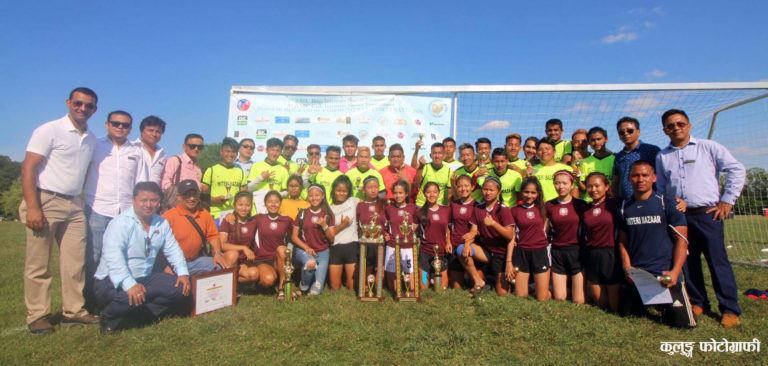
प्रतियोगितामा सहभागी कूल ३५ समूहमध्ये अमेरिकाका २८ र क्यानडाबाट १ गरी २९ किशोर समूह तथा ६ वटा किशोरी समूह मैदानमा उत्रिएका थिए । जुलाई ६, , र ८ का दिन स्थानीय जोयस पार्कमा भएको खेलको फाइनलमा किशोरतर्फ जर्जिया र क्यानडा तथा किशोरीतर्फ नर्थ डकोटा र केन्टकी समूह पुगेका थिए । प्रतियोगितामा उत्कृष्ट खेलाडी पेमा तामाङ्ग तथा उषा मगर भए । खेलका लागि १५ जना प्रमाणपत्रप्राप्त भूटानी रेफ्रीहरू देशभरबाट भेला भएका थिए ।

आउनेजाने गरी दर्शकको कूल संख्या ४५ हजार पुगेको अनुमान र खेल प्रतियोगिताको जम्मा बजेट ५० हजार डलर भएको आयोजक संस्थाले जनाएको छ ।

युवा पिढीको आकर्षणलाई जारी राख्न हामीले यसपटक होस्टमा हैंसे गरेका हौं,” आयोजक संस्था भूटनिज कम्युनिटी अफ सिन्सिन्याटीका कार्यकारीनिर्देशक तथा पूर्वउपाध्यक्ष खेम रिजालले बताए ।

प्रतियोगितालाई एसके फुड्स, सुगर क्रिक, अमेरिकेयर, जेफ वाइलर, ग्यालेक्सी ग्रोसरी, नेपाली स्पाइसी ग्रोसरी, ओम दर्नाल ज्वेलर्स, हाम्रो ग्रोसरी, डिपी फेसन स्टोर, सगरमाथा ग्रोसरी, स्टार वान, हिलम्यान, जाकोआ आदि व्यवसायी संस्था तथा अरू धेरै व्यक्तिगत सहयोग प्राप्त भएको थियो ।

सन् २०११ मा स्थापित भूट्निज अमेरिकन स्पोर्ट्स काउन्सिल (बिएएससी) सन् २०१६ मा गैरनाफामुखी संस्थाका रूपमा दर्ता भएको छ ।

Dozens sickened after attending birthday party in Charlotte

26,644

Dozens of people from the Bhutanese community were reportedly sick after attending a birthday party on Sunday afternoon in Charlotte, North Carolina.

According to Mecklenburg County Health Department, at least 18 individuals including some small children were admitted in Novant Hospital and Atrium Hospital.

Of those admitted, some with serious symptoms of Shigella bacteria were treated in ICU (Intensive Care Unit) with antibiotics. At least two of those in the ICU were children, the health department said.

Though the exact mode of transmission of Shigella bacteria was not clear, the department suspected that someone with the bacteria either prepared or touch food, and eventually transferred to individuals at the party.

While addressing a media gathering on Monday, Mecklenburg County Health Director, Gibbie Harris, said that her department estimated that at least 40 individuals out of 100 attending the party were sick.

The department also requested anyone who still has food from the party to contact Environmental Health at 980-314-1660. The attendees have been urged not to eat any surplus foods from the party.

Shigella develops diarrhea, fever, and stomach cramps starting a day or two after they are exposed to the bacteria, according to the health department.

Several attempts made by BNS to reach out to the Bhutanese family who organized the party became unsuccessful.

Unreal reality of Nar Maya Dahal, as it happened

Journey of paranoia

I just picked up this orphan baby of 18 months and left Bhutan risking my life. Nobody was there to escort me to cross Bhutan’s border. I was the last one to exit from my house. But you look here, now that same baby has become the father of two children and he’s taking care of me.’ She was showing Laxmi Narayan, the grandson from her eighth son Mr. Chudamuni and made those soliloquies. Truly, Laxmi Narayan’s mother Sabitra had passed away from post-delivery complication just three months before their expulsion.

As I was leaving my house, I heard the chorus of bleating goats. Our two horses were staring at me and snuffing frequently. All those animals were showing some abnormal behavior and they might have sensed something unusual about their masters. I don’t remember the pigeons but the roosters were in queue as if I were feeding them.  We had a female dog and two beautiful cats. I forgot the exact number of cows but our milking cow Dhyani was still tied on the cattle shed. Suddenly I felt of killing or ending my life there itself. But one cannot perform such inhumane act and has to live for others. Anyhow, I had to live for that innocent being. Then I unleashed those two horses from the stable to let free in the cornfield. I opened the door of the barn and goats ran away without caring me in the blossoming millet field. Around that barn was our beautiful orchard. There I picked one green orange from the tree, looked at it and threw it on other big jackfruit tree. I couldn’t eat instead cursed my fate and sang few holy hymns in my mind to console my emotions. I was literally subconscious. Didn’t you see my backyard bamboos beside the creek that we used to fetch the drinking water? We used to harvest about 100 muri (approximately 8 ton) of rice each year and the crop was almost ready to harvest. During the harvest season or closer to our festivals, our rice field resembled an earth covered by gold in the Suntoley ridge. What a fate!’ Nar Maya Dahal expressed her inner feelings when I last met her at Akron, Ohio on May 26th, 2018. Literally she was very heavy and occasionally breaking her sentences while talking to me. Clearly I saw her tear drops and chidingly clearing those rolling droplets with her headscarf. She is now 96 years old, lost most of her vision and some degree of memory. I could understand that she was bit dis-oriented as she couldn’t properly figure out of her whereabouts. But the image of Bhutan and the way of life she lived there seems deeply imprinted.

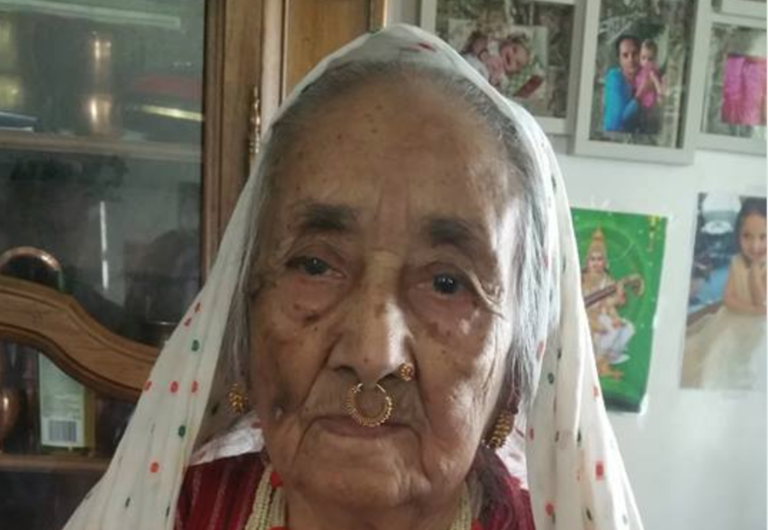
I observed her in silence from head to toe to check her apparel. Later I made the inquiry of two missing elements. The small bagging sickle (खुर्मी) was missing. She used to carry a sickle hooked at her waist bandana (पोटुका) and the handle of that sickle used to be ornamentally carved and protected by small metal ring at the end. The other missing element was the key (भोटे चाबी) precast designed by the local blacksmith at her bunch of key hanging around her neck. That key bunch was literally a first-aid kit consisting of small handmade brush from wild swine fur, ear wax remover made either from nickel or silver, clamp plier, safety pin, keys and other day to day accessories required in the wilderness of livelihood.

She had very neatly plaited her ponytail hair with thread ribbon (चुल्ठीधागो) and was tied with a thin traditional Nepali scarf, covered by large shawl. In Bhutan, she used to wear flat gold earrings but due to change in living places and personal safety in Nepal, she converted those rings into Marwari, that are still preserved. Her septum jewelry (राहदानी बुलाकी) has never changed and she emphasized the importance of that particular ornament as that jewel was given by her father-in-law at her marriage. What a gem! During her youthful years she had a large circular nose ring stud but with advancing age, she reduced into tiny stud to preserve her emptiness on the shagging skin.

On my visit, she had worn a full sleeved Chaubandi blouse. I could see different types of bangles including the gold one on her wrist. Usually she used to wear a traditional long fariya drape but on that day, she was on bulky, slippery and heavy sari. I generally give significance to the way she is dressed than the quality of material since it’s not her choice now.

Early life and marriage

Nar Maya was born in 1922 AD from Kirtiman Basnet and Dikura Basnet in a small hamlet of Tashidin under Dagapela, Bhutan.Though not a popular trend but people tend to trace their family lineage from the location of a place. This is the reason that her paternal lineage is often called as ‘Tashidinay’ Basnet clan later migrated to other parts of Dagapela. Tashidin is often referred as the ‘rice bowl’ of Dagapela because of the warmer temperature, fertile soil and accessibility to spring water. But this Basnet family was never stable at that location because of the family sorrow. Kirtiman Basnet had to perform thirteen death rituals of his family members including two children and his wife within a span of nine years. They considered that place as nonviable, bad spirited and decided to leave for better place.

Basnet family made their first shifting to ‘Bhaleygoan’ and settled there for quite an extended time. Still some of her paternal ‘kith and kin’ are living in that place in spite of the mercy of 1990 upheaval. Their new aspiration to secure a better land did not yield much with whatever left over after the recovery from loss of family members. The family couldn’t afford the nicer land than the steep untamed slopes.

Nar Maya was married to Kharga Bahadur Dahal when she was eleven years old. Kharga was the first son of famous ‘stone mason’ of Suntoley Nar Bahadur Dahal. Lt. Nar Bahadur Dahal’s popularity grew in Dagapela as the chief stone mason at the construction of Sub-divisional Administration Office building at Goshi. And, that complex has become the landmark for people of Dagapela. He was very skillful in both the stone masonry related works and wood craftsmanship. Afterwards the people from far and wide began recognizing Nar Bahadur Dahal as ‘Karmi’ Dahal and his clan as ‘Karmi’ family. During that time Dahal family was economically better-off and had occupied the heart of Suntoley land. Later such productive land in prime location became the most eye soring factor for their expulsion.

Editor’s note: Remaining section of this story will be published in the next week’s Diaspora stories, Please keep following.

Chasing the dreams- Refugee camp to Sydney

After two years of undergoing through a tedious vetting process for my resettlement, I couldn’t wait longer to leave refugee camp- a place where not only were I was born, but also raised and spent the most frolicksome time of my childhood and teenage calling it a home. Since my childhood, I have been a people’s advocate. Whether it was with UNHCR staff who visited the camps for inspection or advocating and encouraging young people in camp to focus on education and extracurricular activities, I would step forward. As happily we all wanted to live, the struggle was real. While growing up, I have witnessed so many premature and preventable deaths including my close friends who I used to play with. Hence, I always dreamed of working as a healthcare professional, or at least, be a part to prevent those premature and preventable deaths.

The dream seemed approachable after I received a travel document to come to Australia. I was very excited, and it soon turned into a big sigh of relief, as if Australia was offering me, my family and thousands of others a second chance in life.

As soon as I arrived in Australia in November 2008, I started recalling my dreams and resetting my goals while working onto successful integration into my new home. Again, “the struggle was so real” to integrate into a whole new world of new culture and new way of life.

Despite the fact it was a bumpy-ride at the initial phase of my resettlement, I didn’t give up. I was very determined to look for opportunities which could create avenues to build my own identity, change the gender stereotypes and eradicate social stigma for the people from disadvantaged minorities.

My first attempt was fulfilled when I became a “Chess Champion 2009” at Evans High School. In 2010, I had another wonderful opportunity to represent Australia in a Junior World Cup, 2010 in South Africa. My dream to represent my country with pride came true when I played football in a mixed team of boys and girls from 32 different nations. With the football skills, leadership skills and new experiences I gathered throughout, I started coaching football in one of the high schools. I am on my seventh year of football coaching at the same school.
Another hope arose when I completed my high school from St. Mary’s High School and was awarded a Jim Anderson Scholarship in 2013 to pursue my University degree. While pursuing my nursing degree, I joined My Nepal Television(MNTV) Australia as a Television Presenter of the show “Lok Lahari”. Furthermore, I founded a Funfigher’s Academy where I teach young children cultural dances, public speaking and drama in Nepali language.
I completed my bachelor of Nursing degree in 2015 at the University of Western Sydney. My dream to work as a healthcare professional came true when I landed on a job in Westmead Private Hospital as an anaesthetic nurse in Theatre, a place where I always wanted to work. In addition, I am undertaking a postgraduate course “Professional Honours in Perioperative Nursing specialisation” under a scholarship to enhance my knowledge in my specialized working area.

In parallel to pursuing my education, I am actively involved in community work, media and extracurricular activities. I just completed my 2 years of leadership as a youth coordinator at Association of Bhutanese in Australia(ABA), Sydney. In 2016, I received “Talented Artist of the ABA Sydney” award for my contributions in various areas such as sports, dance, art, singing, anchoring, being an active community volunteer for more than five years and my contribution in literature such as writing poems, articles, stories most of them featured in the Nepali literary site, Bhutanese Literature. In 2016, I was nominated as a youth representative for Football United Organisation to take part in a youth leadership workshop program held in Mumbai, India where I met young people from various countries and discussed youth issues and related solutions in various countries. Recently, I have been featured in a music video called “Asare Jhari”. In addition, I have been nominated as a Vice-President in the “International Forum of Nepalese Youths.

I would like to express my sincere gratitude to my family members, relatives, community members, mentors, friends, Football United organisation and each and every individual who have contributed in many different ways on shaping my past and present and wish to receive the same support and encouragement with my future endeavours.