Exiled citizens warn of agitation

26,644

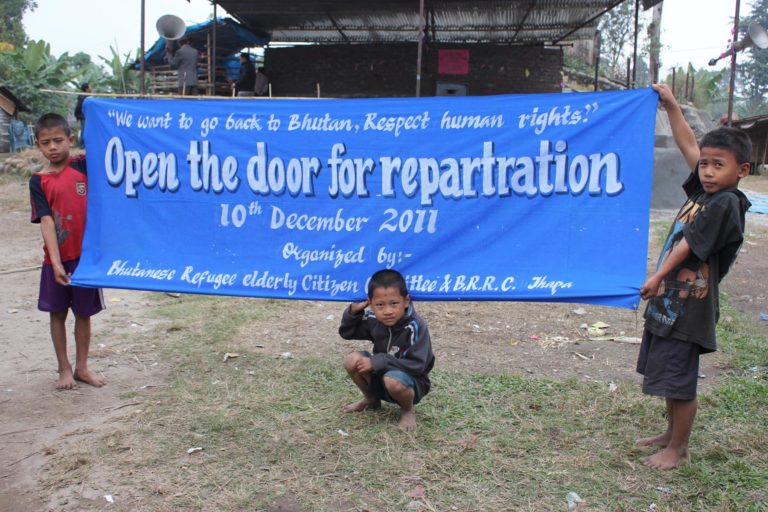
Bhutanese senior citizens in exile have alarmed the concerned authorities that they would be compelled to agitate if their demands for dignified repatriation are not met at the earliest.

File photo : Children display a banner demanding repatriation in Beldangi-II camp (Photo : Vidhyapati Mishra)

They expressed such an opinion during a program organized in Beldangi-II camp on Tuesday.

“We are mainly concerned about future of those who don’t want to resettle but prefer to return home from the refugee camps,” Dr Bhampa Rai said.

Dr Rai also mentioned that refugees would be compelled to launch protests if both Nepal and the UNHCR continue to ignore their demands for repatriation, as he accused both the parties of simply promoting the resettlement.

Likewise, Secretary of the Bhutan State Congress (BSC) Durga Sitaula warned of agitation if Nepal fails to take up refugees’ demand of dignified repatriation seriously.

Another speaker NB Giri said that Bhutan government has been continuously taking action against its citizens when they talk of human rights issues. He also demanded unconditional release of all political prisoners, and urged the international community to press Bhutan for that.

Meanwhile, Indian activist Sailendra Kumar Arora also assured his support for repatriation, assuring refugees that he would start mobilizing the mass in India in favor of repatriation.

Local political leaders from Damak cited lack of leadership in the refugee camps, and accused leaders of ignoring citizens’ sentiments by accepting to resettle in the west.

Video courtesy : Purbelitimes

Immigration, expats and the Netherlands

26,644

Holland, though a tiny country, has during the period of colonization sailed to Indonesia towards the south and Surinam towards the west. Power, business, shrewdness and the expatriates’ income led to a rapid financial prosperity of the country. There are admirations like dikes standing to block the north sea, international court of justice towering high in the air, etc., etc.

Door to immigration
Holland’s glory reached far, internationally and wide, opening doors of prospects, future and immigration. Its rapid economic transitions and industrialisations during 60’s and 70’s, led to among others a mass recruitment of Turkish and Moroccans in lower class labour forces. Many analysts view the subsequent influx of their families under the scheme of family reunion and the growth of Muslim population in the Netherlands as the beginning of the Islamisation of Europe.

In an attempt to combat the influx, in 2006 an obligatory overseas integration test was put in place. Under this law, a pass certificate on preliminary integration test is a prerequisite to apply for visa to join wives, husbands and children in the Netherlands. Though Human Rights Watch calls it a discriminatory policy targeting to certain population groups only, many Dutch ideologues are contented with its outcome.

Today, the immigrant population walking on the streets of big cities – Amsterdam, Rotterdam, The Hague, Utrecht, etc. comprises more than 60%. This indeed is a growing threat to Dutch identity and a valid reason to feel discomfort. A “small loyalist group” had been increasingly expressing its frustration on this issue since years. This anti-immigrant vocalist group was perceived as a very insignificant number. However, a sweeping public support in the election of 2010 harnessed by the ultra-anti – (Islam) immigrant party came as a shocking reality.

Holland and hospitality
Many view Holland as a hostile and as an intolerant country. In 2011, Forbes magazine rated the Netherlands as the most unfriendliest country in the world for expatriates. Most probably this has to do with the individualistic and materialistic nature of Dutch society. Furthermore, the complexity of Dutch language and challenges with integration can be illustrated by the example of, Rodaan Al Galidi. Al Galidi, who received European Union’s literature prize on 28 November 2011 on behalf of the Netherlands, failed the Dutch integration test. This test makes one eligible just to apply for Dutch citizenship, keeping aside nearing the doors of possibilities and opportunities.

Further, on 10 April 2012, the Dutch Government announced to scrap the provision of integration assistance – a support for language and orientation programs from 2013. This makes the Netherlands the most difficult country, structurally and politically, for the immigrants and refugees.

Holland’s performance in socio-economic sector
Organisation for Economic Co-operation and Development (OECD) has recently published its findings of a research conducted to compare nine public sector services in 28 developed countries during the period of 1995-2009. Though the Netherlands is reported to be doing well in the sectors of education, public administration and social security; its performance on health care sector is poor. The health care system in the Netherlands, considered one of the best in the world, according to this report is gliding down a slippery slope. The Netherlands scores 4.5 out of 10 points, concluding the expenditures in health sectors as inefficient, inappropriate and inadequate with shifting of priorities.

Opportunities in the Netherlands
The glory of the Netherlands’ job market appears dying down. The number of Dutch people migrating to other countries in search of better pastures is increasing each year. Recently, the Netherland’s Central Bureau of Statistics reported that since January to May this year, 52,000 people have left the country, making the number leaving the Netherlands 344 per day. This number in comparison to previous years is alarmingly high. The cited reasons for the migration are for better working climate, better possibilities and to escape from complex regulations and high tax.

Holland as a destination country?
If first-degree relatives are hanging in the Netherlands, there is no choice. Those who have options to make alternative choices, Holland will be an inappropriate one. However, unlike many critics conclude, immigrants who earn their own living in Holland are generally well accepted in the society; and at large, however small it be, the “successful immigrants” are happy. Contrast however is for those with limited skills, capacity and motivation.

One of the Contributing Editors of the Bhutan News Service on health issues, Dr. Lakshmi Prasad Dhakal, a Netherlands based physician, is originally from Dagapela, Bhutan. In an attempt to raise health awareness and to promote adoption of healthy behaviours among the immigrant population and among people of the developing countries, in collaboration with other public health experts Dr. Dhakal has founded, Global Health Promotion. It is a free knowledge-sharing institute operating online at www.globalhealthpromotion.org

Bhutan seeks to move out of isolation

26,644

The Bhutan government is acquiring an international profile with plans to contest the Asian seat for a non-permanent member at the United Nations Security Council. The government in Thimphu and its tiny band of diplomats and top officials have been on overdrive, lobbying with governments and diplomats around the Asian region.

The hermit kingdom, tucked along the northeastern corner of India, also borders the Tibetan region of China with which its shares close civilisational ties. The country has been going through a series of fast-paced events in recent years, shedding its isolation from the outside world and transiting from monarchial rule to an elected government. Bhutan began its transition towards democracy and modern governance in 2008 when the first ever elections were held in the country and an elected government formed.

The Bhutan government expressed its intention to contest the Asian seat during the UN session in September 2010. A two-year membership of the Security Council would propel the tiny Himalayan kingdom into the epicentre of high international diplomacy. At present, Bhutan has diplomatic relations with barely 40 countries; diplomatic ties with 15 countries were established in the past two years. Bhutan has Indian and Bangladesh resident missions in Thimphu, and has consular relations with its other large neighbour, China.

Bhutan’s prime minister Jigme Y Thinly lobbied with all the South Asian countries with varying results at the last SAARC summit held in Maldives last year.

Bhutan hopes its smooth transition towards democracy and its concept of ‘gross national happiness’ would act as a USP for showcasing its capacity to contribute to the councils of the UN. In case Bhutan wins the contest it will take up the seat vacated by India on completion of its twoyear term. The election is due this October.

As Bhutan moves out of its isolation, it is inevitable that it would seek to establish bilateral relations with other countries, including China. Bhutan does not have diplomatic ties with China as relations have been strained between them ever since China took control of Tibet in 1951.

Prime minister Thinly and Chinese premier Wen Jiabao had a historic meeting on the sidelines of the Rio+20 UN conference on Sustainable Development in Rio de Janeiro in June, when both leaders spoke about the possibility of establishing diplomatic ties.

The Bhutanese leader also sought Chinese support for the prestigious UN seat during his discussions with premier Wen. The subject came up again when Bhutan and China held border talks in Thimphu recently. The two countries have a festering border dispute and have held 20 rounds of talks to try to resolve the issue. In 1998, the two sides signed an agreement to “maintain peace and tranquillity on the Bhutan-China border areas”.

India has welcomed Bhutan’s opening up to the outside world. Under the Treaty of 1949, India handled all of Bhutan’s external relations. In 2007, the two sides signed a new treaty reflecting a new contemporary relationship based on mutual cooperation. India is Bhutan’s main trade partner and Indian built hydel power projects provide

Bhutan its main revenue source based on sale of power to India.

China’s plans to build a road network in Tibet reaching up to the Bhutan border has raised concerns in Thimphu. There have been incidents in the recent years when Chinese troops have entered Bhutanese territory close to Bhutan army posts. China claims Bhutanese territory towards the west, bordering the Chumbi valley in Doklam, Charithang, Sinchulimpa and Dramana pastureland.

The narrow Chumbi valley ends at the strategic trijunction between Bhutan, India and China. The area is of immense importance to India for it lies a few hun

dred kilometres north from the Siliguri corridor or the chicken’s neck corridor that connects Assam and the northeastern states to the rest of India.

China has indicated keenness to engage Bhutan while there are sections in Bhutan that would like to explore bilateral ties with China. Chinese goods are available in Thimphu and many would like to reopen border trade with Tibet that thrived many decades ago.

The Bhutan government has taken measured steps in its relations with China, but it may hasten the pace as it lobbies for the UNSC seat.

(The writer is a foreign affairs commentator)

Courtesy : Mydigitalfc.com

UN honours literacy program in Bhutan

26,644

Literacy programmes in Bhutan, Colombia, Indonesia and Rwanda won the 2012 International Literacy Prizes of the United Nations Educational, Scientific and Cultural Organization (UNESCO).

Mothers sit in a class in a Non-formal and Continuing Education programme run by Bhutan’s Department of Adult and Higher Education. The same classroom is used by their children during the day. Photo courtesy: UNESCO

The awards, worth $20,000 each, will be distributed on 6 September in a ceremony at UNESCO Headquarters in Paris, France, as part of the celebrations for International Literacy Day, observed annually on 8 September, the agency announced in a news release on Tuesday.

Two programmes were awarded the UNESCO King Sejong Literacy Prize, which was created in 1989 by the Republic of Korea, and two received the UNESCO Confucius Prize for Literacy, created in 2005 by the Chinese Government.

The Directorate of Community Education Development in Indonesia received one of the two UNESCO King Sejong Literacy Prizes for its work to improve the “quality of literacy education through entrepreneurship literacy, reading culture and tutor training.” The programme, a Government initiative, involves almost three million people and puts special emphasis on women so they can receive basic literacy training.

The second UNESCO King Sejong Literacy Prize was won by the National Adult Literacy Programme of the Pentecostal Church in Rwanda. The agency said that the programme was selected for its focus on women and out-of-school youth. The programme, which has reached over 100,000 people, also aims to ensure that individuals learn about human rights, reconciliation and peacebuilding through literacy.

The Non-formal and Continuing Education programme from Bhutan will receive one of the UNESCO Confucius Prizes for Literacy for its work teaching basic literacy skills through its 950 centres in rural communities.

The Interactive System Programme, operated by the Fundación Transformemos in Colombia, will receive the second UNESCO Confucius Prize for Literacy for its peacebuilding and income-generating activities in areas affected by conflict and violence. The programme seeks to improve literacy through an intercultural approach and has reached some 300,000 persons since it began in 2006.

Starting over, once again; Fire claims everything from refugees

26,644

The refugee families displaced by a North Side apartment-building fire on Monday night will have to rebuild their lives yet again.

Pabi Baniya, right, and others who live at the Summit Park Apartments watch from across the street as they wait to get back inside their units. (Picture courtesy : Tom Dodge | Dispatch)

Yesterday, families from Bhutan, Somalia and other countries of conflict watched and waited outside the charred Summit Park Apartments.

Many have been in the United States only months, or a few years at most, after being forced to flee their home countries.

The fire, which started about 7:30 p.m., burned too fast for Bhutanese refugees Ani and Ran Khadka to save anything but their two young children and a few documents.

“I took out my babies; I saved my family,” Ani Khadka said, rocking her 10-week-old daughter as her 3-year-old son played underfoot. “God saved us only.”

They weren’t sure what was left of their apartment or when they would be allowed back in. They have been in the U.S. 14 months.

If he’d had a minute more, Ran Khadka said, he would have grabbed academic certificates he earned in Bhutan.

No injuries were reported in the fire, which started in a fenced-in storage area filled with old furniture next to the apartment building at 4349 Walford St. Investigators say it was arson, Columbus Fire Battalion Chief Michael Fowler said, although they don’t know yet how it was set.

Three local agencies that helped resettle many of the families in America now are working to get them back on their feet after the fire.

Kay Lipovsky, office director of World Relief Columbus, said the focus will be on finding shelter, furniture, clothing and replacement documents for the refugees.

The fire is doubly traumatic for families who already have lost their homes once, Lipovsky said. They often have no support network, are just learning English and have low-paying jobs.

Documents such as green cards, photo IDs and other immigration papers can be replaced, she said, but that will take time.

“They’ve come over here with very little. Now, they have nothing.”

Pabi Baniya, 50, clutched all she had yesterday: her purse, cellphone and charger. She stared up at her second-floor unit as her 12-year-old son played nearby.

The Bhutanese woman laughed when asked through a translator what she’d do now.

“What do people do?” she asked.

Baniya, along with nearly 70 other displaced residents, stayed at the temporary shelter set up by the Red Cross at the Fedderson Community Center on Monday night. Of 44 units affected, 10 were destroyed and two others had major damage, a Red Cross spokesman said.

Other units were water-damaged or without electricity.

Thakur Bastola, 22, also from Bhutan, helped carry his ill grandfather and grandmother out of the apartment after the fire started. He expects his apartment, which also housed his two brothers, two uncles and an aunt, is a total loss.

Most of his family went to Cincinnati to stay with other relatives on Monday night. Yesterday, he stood outside, waiting.

“We’re simply watching the house,” he said.

Courtesy : The Columbus Dispatch

Election ad only for govt. owned press

26,644

In what could be the final nail in the coffin for the already troubled private media houses the Election Commission of Bhutan (ECB) circulated a circular yesterday saying that all election advertisement would be given only to Kuensel, Bhutan Broadcasting Service and Kuzoo FM.

The ECB Circular itself was in line with an earlier circular and letter from the Ministry of Finance sent to all government agencies to cut down on expenditure as part of its cost cutting measures.

The circular says, “In obedience to the directives contained in the circular No. MoF/R-Circular of 11th June, 2012 issued by the Ministry of Finance that government agencies are to publish advertisements in selected medium and not all the papers at the same time, the ECB hereby, notifies all concerned that henceforth all advertisements, public notifications and voter educational and information materials related to elections and the ECB will be published in Kuensel, televised through BBS and broadcast over Kuzoo FM Radio only.”

The circular was also printed on the 17th August 2012 issue of Kuensel.

According to reliable sources the ECB had not planned to take such drastic measures over the 11th June 2012 circular as it continued advertising with multiple media houses. However, the ECB was forced to make this move after a strong letter from Finance Secretary on 9th August 2012 reinforced the above circular.

Media in panic
The Circular has already sent a wave of panic and shock through the troubled private media industry that was looking at the ECB advertisement as a source of survival given the cut in government advertisement budget.

Editor of Bhutan Today, Ugyen Tenzin said, “It could be a mistake of the ECB and in the coming days, ECB should reconsider otherwise a vibrant democracy is lost.”

The chief editor of Druk Neytshuel, Chundu Tshering said “Does it mean the government does not want the private media, since the private media is doing a good job. “He said that the move was unconstitutional as the ECB notification came after Ministry of Finance (MoF) and Ministry of information and Communication (MoIC) circular.

If broadly interpreted the circular by the ECB issued on government instructions would wipe out the private media and leave only the government owned media houses standing.

The Constitution under Article 7 of fundamental rights says, “There shall be freedom of the press, radio and television and other forms of dissemination of information, including electronic.” This circular contradicts this provision including other two provisions of section 2 which gives Bhutanese citizens the freedom of speech and expression and section 3 which gives a Bhutanese citizen the Right to Information.

Media professionals including media observers also feel that the government’s stance of selectively controlling advertisement would affect free and fair elections in 2013 too.

Leki Dorji a consultant and media watcher posted on the popular facebook site called social democracy. He wrote, “This announcement from ECB worries me. If ECB as an important constitutional body needs to “obey” the directives of the Ministry of Finance to give their advertisements to only Kuensel, BBS and Kuzoo then all of the private media is going to die out. This is a sad day for democracy in Bhutan. My two main worries are no 1. Will there be free and fair elections without the voices of dissent in 2013 and no 2. although I gave the benefit of the doubt to MoIC circular asking all departments to not give any advertisement to “The Bhutanese” thereby gagging the free press, ECB having to “obey” the directives of the Ministry of Finance clearly shows that all government agencies are effectively following the directives of the MoF that will kill the private media. This is a sad day for our democracy, an effective death knell to free press guaranteed by our sacred constitution.”

A Media professional said, “The most important mandate of the ECB is to conduct free and fair elections and I don’t think this will be possible with the government doing such things.”

CEO of Druk Yodzer, Lobzang Dorji said, “The government which is responsible for promoting vibrant democracy is actually restricting media growth and private media in fact is treated as a foreign media. “He said that the ECB and media should work hand in hand to inform the voters rather than killing media houses. He also said that Bhutan Times and Bhutan Observer had started under the command of His Majesty the King.

The CEO of Bhutan Youth, Yangchen Dema Drukpa opined that the ECB must have been forced into this decision and that it was not at all good for a healthy democracy.

ECB under pressure
Prior to this the ECB had already come under fire from the National Assembly over its election expenditure in the 2008 elections and the recent local government elections. This was also in backdrop of long running tensions between the National Assembly and ECB on a host of issues from the Local Government Bill to other election related issues.

During a question and answer session in early January Mongar MP Sonam Penjore asked the prime minister on how the government was planning to cut on election spending, also saying that that it was about time for the government to consider an advertisement policy.

The Prime Minister Jigmi Y Thinley in response agreed the election spending was more than necessary, and that it merited some consideration, particularly at a time when the nation still depended on financial assistance from other countries that were planning to pull out at any time.

Lyonchhen said that the government was as concerned and mulling over how to lower its expenditure on elections and he said the Ministry of Finance would draw up ways to do so.

However, recently it was revealed that the government would be putting up only Nu 500mn to fund the 2013 elections of both the National Assembly and National Council. In 2008 the ECB had Nu 530mn to fund the elections.

For 2013 given the increased costs and possibility of primary round due to many parties coming in the ECB had proposed Nu 683.6mn.

According to the book on the 2008 elections, ‘Drukyul Decides’, the Training of electoral officers, voter education and publicity programs was Nu 54mn. According to the same book the supplementary advertising budget for the NA and NC elections was Nu 8.7mn and Nu 2.5mn for broadcast material.

Earlier in January MP Sonam Penjore pointing out the ECB’s expenditure for the 2008 elections and local government elections had said that Nu 29mn had been spent for advertisement.

Political parties worried
Apart from private media houses there is also growing apprehension among political parties on the impact such a circular will have on election coverage in 2013.

Druk Chirwang Tshogpa (DCT) members say that they will talk about the circular with ECB.

Dr. Tandin Dorji, the spokesperson for the Druk Nyamrup Tshogpa (DNT) said “When His Majesty recognized the role of media the Government should do more than this.”

Dr. Tandin Dorji said that probably all ministries could have implemented the circular but at least ECB came forward to give the notification.

The Opposition, Member of Parliament (MP) Damcho Dorji commented that this was an issue of big concern. “If the aim of the government is to reduce the cost then the best way is to tender out based on procurement rules,” he said.

A politician who did not want to be named said, “Everybody knows that the BBS completely depends on the government for survival and the new BBS board has people close to DPT or ruling ministers and Kuensel on the other hand is still 51% owned by the government. Under these circumstances what the government is trying to do is very clear.”

The Managing Director of Kuensel, Chencho Tshering said that the government is working on the advertisement policy and circulation audit.

“We respect the government view but I hope the government would look into the circular. We do not want to see all private media houses collapsing,” said Chencho Tshering.

Managing Director of Bhutan Broadcasting service (BBS), Thinley Dorji said, “The ECB circulation has to do with the national coverage and may be that is ECB’s choice”.

Courtesy : The Bhutanese

Columbus fire displaces 20 resettled families

26,644

A fire that tore through at a north side apartment complex in Columbus, Ohio has reportedly displaced 20 households of resettled Bhutanese on Monday night.

According to Tara Dhungana, firefighters battled until 1 am to contain inferno, whose cause the US officials have been investigating. Investigators are treating the fire as suspicious in nature.

Firefighters have said that it appeared that the fire started in a room used for storing bulk trash.

Columbus Division of Fire investigators returned to the scene Tuesday morning. The scoured the bulk trash bin where it is believed the fire started, local reports said.

Residents nearby told stories about escaping the fire with nothing more than the clothes on their backs. Then, there were the stories about the living conditions, which one Ssurowi Mohammed described as worse than living in a refugee camp.

The American Red Cross has been assisting the families displaced by the fire. They have opened an emergency shelter at the Feddersen Recreation Center at 3991 Dresden St. The shelter will remain open Tuesday night to help families, displaced by the fire.

“The American Red Cross and resettlement agencies are in the field to help displaced families,” Dhunaga said in his email circular to the Bhutanese community.

Monk carrying human skulls detained, later released in Assam

A Bhutanese monk bound for France via New Delhi was detained by Indian custom officials on 16 august, at Lokapriya Gopinath Bordoloi International airport in Borjhar, Guwahati for possessing human skulls and bones of limbs. He was, however, released after the Bhutanese consulate officials in Kolkota wrote to Assam government requesting his release.

Skulls and human bones confiscated by Indian authority

The monk is said to have confessed the possession of those human remains. According to him the remains are actually the “gifts” to various generous donors of France , who helped the construction of lhakhangs (Buddhist temple) in Gelephu. He was found to be carrying 25 skulls and 20 pairs of femurs in his luggage.

The penal code of Bhutan clearly lacks the stipulations/clauses about the degree of  penalty for such cannibalistic act of transporting human bones across the international border.

It is also very ironic to let the monk free by the Indian custom officials without trying him to the court as per the Indian law.

A centre to care for vulnerable children in Nepal

26,644

Four-year-old Kriti shouts greetings to all visitors at the Early Childhood Development Centre (ECDC) near the Sanischare refugee camp in eastern Nepal; a transformation from a year ago.

Children sing and dance to the tune of a Nepali rhyme in the Early Childhood Development Centre near the Sanischare camp hosting refugees from Bhutan in eastern Nepal (Picture courtesy : UNHCR/P.Ghimirey)

“He was a very difficult child. He used to cry and remain aloof some of the time,” remembers Durga Wagle, facilitator at the Centre. Now Kriti is popular for being the most enthusiastic and bright.

Kriti went through a very difficult period. His father was an alcoholic and his mother unable to cope, left the family and remarried. Kriti lives with his 50-year-old grandmother who cannot provide good care and attention as she works outside the camp during daytime. Many times Kriti is alone during the day, depending on neighbours for any help.

The ECDC built by the UN refugee agency supports more than 30 children like Kriti in the age group of two to five, both from the refugee and host communities. It was built near the Sanischare camp for easy access for both communities. The camp still hosts some 10,940 refugees from Bhutan who came to Nepal in the early 1990s.

The concept behind the Centre is to help children who are vulnerable to face protection risks as their parents leave them with inadequate or no supervision when involved in their daily activities.

“Looking at the desperate situation of many children like Kriti both in the camps and in the host community, we felt the need for a special day care facility which provides a safe and nurturing environment for these children,” said Sangita Khatiwada, Senior Protection Assistant at UNHCR’s sub-office in the eastern Nepal town of Damak.

Sangita added: “This centre has helped the parents concentrate on their daily activities and at the same time has given their children a learning opportunity based on early childhood development and education principles.”

Children attending the Centre come from different and difficult backgrounds. “Some are from families who are very poor; some with domestic violence issues, and others with separated or disabled parents. All these factors could potentially lead the children to be more exposed to protection risks,” said the supervisor of the Centre, Ramesh Adhikari.

The Centre is run by a 12-member management committee involving both refugees and host communities. “It has become a solid example of good cooperation and relationship between the two communities,” said Eirin Broholm, Associate Community Services Officer at the UNHCR Sub-Office.

Parents drop off their children at the Centre at around eight in the morning. The classroom soon becomes a busy and fun place.

Devi Chaudhari, a single mother from the village adjoining the camp brings her three-year-old daughter every day to the Centre. “We are lucky that we got this facility. The activities at the Centre have helped a lot in the overall development of my daughter and helped me concentrate in my activities,” said Devi.

Listening to stories, dance and music, painting, and building with small plastic blocks keeps the children busy at the Centre. The “outside time” is the favorite for all where they play to their heart’s content. Mealtime is fun time where some share and eat their home-made lunches and some of the youngest are fed by the helpers. By four in the afternoon, the children bid goodbye and leave for home with their parents.

“We receive requests from a large number of parents but due to the funding and space constraints the Centre has been able to provide services to a limited number of families only,” added Durga Wagle.

UNHCR regularly monitors the activities at the Centre and funds for training needed for the facilitators and teachers.

“It is really nice to see the happy faces of these children. The Centre has ensured that vulnerable children from both communities have access to quality care arrangements and has increased opportunities for vulnerable refugees and host community mothers,” said Sangita.

Courtesy : UNHCR

BCS joins 98118 coalition parade in Seattle

26,644

The Bhutanese Community in Seattle (BCS) said its representatives took part in the 20th parade program of 98118 Coalition for Refugees and Immigrants held in Seattle, WA, Saturday.

Seen as one of the exceptional events, the parade included around 65 ethnic groups from various countries of the world.

Representatives from the Bhutanese community during the parade (Picture courtesy : BCS)

“We got a great chance to identify ourselves as Bhutanese in this country by extending our participation in the joint parade,” commented one of the attendees, Devi Rizal.

Neighbor to Neighbor (N2N), Seattle Foundation provided the financial support for cost arrangements and refreshments for the participants from the Bhutanese community.

According to Rizal, such programs intend to increase the networking and good relationship of Bhutanese with other ethnic communities and mainstream organizations.

Formed in March 2012, BSC comprises of Hom Khatiwoda (President), Bisal Acharya (Vice-President), Tek Rizal (Secretary), Kapil Bastola (Vice-Secretary), Hari Pokhrel (Treasurer) and Chandra Acharya (Vice-Treasurer).