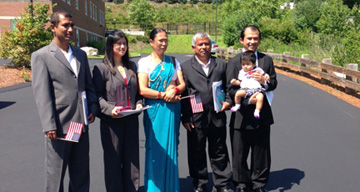
Couple from Bhutan find home, gain citizenship in Lancaster County

26,644

On May 19, 2008, Ganga and Bishnu Dhulal entered the United States for the first time.

The young refugees from Bhutan, married with two children younger than age 4, were searching for safety and freedom from life in a refugee camp in Nepal.

Bishnu and Ganga Dhulal celebrate their U.S. citizenship (Picture : Lancasteronline)

The Dhulals were some of the first of 60,000 refugees the U.S. welcomed — and the very first Bhutanese refugees to be placed in Lancaster County.

Fast forward to June 2013. The Dhulals have lived in Lancaster for almost five years, secured jobs, bought a home and gained U.S. citizenship.

They’re the first local Bhutanese refugees to do so.

The Dhulals’ journey from their refugee camp to U.S. citizenship was arduous — but ultimately rewarding.

Ganga and Bishnu were born in Bhutan. Ganga’s family traces its heritage to the 17th century, when a number of Nepalese were relocated to Bhutan.

In the 1990s, the Bhutanese government started a “cleansing” of more than 50 percent of the Nepalese who had settled in their country.

“They wanted everybody to be one people. They forced us to speak their own language, wear their own clothes, worship their own religion,” Ganga said.

Bishnu moved to a refugee camp in Nepal in 1991 at age 15. That year, life hit its lowest point for the 8,500 refugees there.

The native Bhutanese were forced to go into nearby villages to beg for rice. Their houses were huts made of bamboo stakes, with small gaps between each house for walking paths.

Occupants faced issues such as flu, diarrhea, dysentery and a scarcity of water, Bishnu said.

The harsh heat in Nepal was unlike the conditions to which the Bhutanese were accustomed.

Bishnu recalled one day when at least 28 people died because of the heat — most of them children.

“Every day, every day, like every single day, people died,” Bishnu said.

The camp, one of several in Nepal, was near the sandy bank of a river. The wind would pick up the sand and blow it into the tents and people’s faces.

Bishnu had to clean her face before she could open her eyes in the morning.

After eight months of dire circumstances, the camp was moved away from the river.

“Life started to get better then,” Bishnu said.

Ganga entered the camp in 1992 as a 22-year-old. He had just finished his high school education, and because he had good grades, he was eligible for a scholarship to study at a three-year program in India.

In 1998, Ganga and Bishnu met and were married through their cultural method of arrangement.

Because of Ganga’s Nepalese heritage, they were able to move out of the camp and blend in with the people in Katmandu, the capital of Nepal.

Both worked as English teachers, having learned some English in their Bhutanese schooling — but it was illegal.

“Only the top of the institute knew that we were refugees. The rest of the people we would have to lie (to),” Bishnu said.

After a few years of working in Katmandu, word of the chance to escape Nepal traveled through the camps.

Ganga and Bishnu moved back to their original camp with hopes of being able to leave the country.

Those who wanted to leave had to fill out their forms in secret. Members of the United Nations High Commissioner for Refugees, who had been administering the refugee camps, assigned eligible refugees their dates of departure.

Coming to the U.S. was “the best solution,” Ganga said, although he did not understand where in the U.S. they were headed.

“Somebody said we were going to ‘Pa.,'” Ganga said. “We didn’t know what ‘Pa.’ was.”

In May 2008, after much anticipation, the Dhulals boarded a plane for the U.S. with their 3-year-old daughter and 18-month-old son. They said they felt excitement rather than fear.

They recall the strange new things they encountered during their first days in the U.S., as they were introduced to seat belts, car seats, refrigerators and gas stoves.

Ganga’s parents joined them in Lancaster on July 1 of that year. On July 2, Ganga started working at Dart in Leola.

Bishnu then completed her medical assistant training and began working as a nurse with Southeast Lancaster Medical Center at Brightside.

The couple first applied for citizenship in February. On May 31, both had their interviews, which included a series of civic and history questions.

“We memorized all of them,” Ganga said.

They were nervous, but both Ganga and Bishnu passed their tests and were invited to final certificate ceremonies, Ganga on June 6 and Bishnu on June 21.

“It’s really exciting because I never had a citizenship before in any countries,” Bishnu said.

In Bhutan, citizenship cards are distributed to 16-year-olds — and Bishnu was forced to leave the country at age 15.

Their citizenship is another sign of the new life they have found in America.

“We are happy here,” Ganga said. “We never hide our identity. We say we are Bhutanese.”

Reproduced from Lancasteronline.com 

Menon, Singh to visit Bhutan

26,644

Bhutan’s new prime minister will receive two top Indian leaders Shivshankar Menon and Sujatha Sigh Friday, as they fly to Bhutan for fixing the strained relationship between two traditional neighbors and update on security concerns over China looming large.

Shivshankar Menon
Shivshankar Menon
Sujatha Singh
Sujatha Singh

Shivshankar Menon is the National Security Adviser and Sujatha Singh, the new Foreign Secretary of India. Ms Singh had indicated her first foreign visit to Bhutan earlier.

The visit is also said to be the ground preparation formality for visit of Bhutan’s Prime Minister, Tshering Tobgay to Delhi. But, speculations are rife in Thimphu that India’s punishment to DPT government by withdrawal of subsidy is something that this visit will bring to normalcy. The ministry of external affairs denies this assumption.

The duo will call upon the Foreign Minister Rinzin Dorji and Opposition Leader Pema Gyamtsho for discussing the bilateral issues facing Bhutan and India.

While security concerns over China’s intrusion in Bhutan remains a major irritant factor in Indo-Bhutan relations, Shivshankar Menon is expected to discuss this with the Prime Minister, not much expressed by the Bhutanese media.

For Sujatha Singh, it will be her focus to normalize the daily business between India and Bhutan, calling the subsidy withdrawal as ‘unfortunate technical lapse’. She will also talk about the fund-raising model exploitation of rivers in Bhutan for generation of electricity.

High school graduates honored in Charlotte

26,644

The Bhutanese Community Association of Charlotte (BCAC) honored 51 high school graduates amidst a community graduation program organized in Charlotte, NC, Saturday.

According to BCAC Chairperson, Hasta Pradhan, those honored for their achievement included Bhutanese students who graduated from high school between 2009-2013.

Monsignor Mauricio West, Vicar General Catholic Charities Diocese of Charlotte, honoring a graduate, Bikash Baral
Monsignor Mauricio West, Vicar General Catholic Charities Diocese of Charlotte, honoring one of the high school graduates, Bikash Baral

Dr. Michael Friedland, Director of the Friedland Foundation and Monsignor Mauricio West, Vicar General Catholic Charities Diocese of Charlotte, awarded the graduates with medal and letters of appreciation on behalf of the community.

In his congratulatory message delivered during the event Pradhan said that BCAC decided to organize such a program in order to establish a culture of recognizing and appreciating each other’s achievement and happiness in the community.

He also asked the high school graduates not to forget that their parents have lots of expectations and hopes from them.

“Culturally, you have grown up in a community that entirely depends on your education and progress. This means, your success brings trucks of joys not only in your family and among friends, but also in the entire Bhutanese community,” said he.

Different guest speakers, including representatives from resettlement agencies, university, cross-cultural agencies, and local schools, also congratulated the high school graduates.

Ellen Dubin, Executive Director of the Carolina Refugee Resettlement Agency, addressing the high school graduates

Ellen Dubin, Executive Director of the Carolina Refugee Resettlement Agency, lauded achievements of resettled Bhutanese and their children in the United States.

Dubin, who burst into tears while delivering her speech, also requested the Bhutanese graduates to aim high and be prepared for tougher competitions in the United States.

Dr. Michael Friedland seconded Dublin’s say.

“Students may regard that a time period of four years to earn an undergrad degree in the United States shouldn’t stand as a barrier in enrolling for a college degree. This time isn’t long if you consider your 40 plus years of your career in the life,” Dr Friedland mentioned.

Other guest speakers of the graduation program included Stacy Brown, Language Minority Resource Teacher from Smith Family Center, Tim Bunch, Student Recruiter & Enrollment Specialist at Central Piedmont Community College (CPCC), Brian Heslin, Attorney at Law at Moore & Van Allen, Cira Ponce, Director at the Catholic Charities-Refugee Office, Abdullah Sheikh, CEO at Language Resource Center, and Gregory Gabriel, teacher at Eastway Middle School, among others.

Meanwhile, Praja Subedi, a university student at the University of North Carolina at Charlotte (UNCC) majoring in Civil Engineering, made a comparative PowerPoint presentation on education systems in the United States Vs. Nepal.

So far, only four individuals from the Bhutanese community in Charlotte are pursuing their undergraduate degrees at the UNCC. Of them, TP Mishra is majoring in International Studies, and Puskar Dhital and Dilli Subedi in Software Engineering.

Veteran politician JYT resigns from parliament

The news came as mere hearsay among the parliament members that Jigmi Y Thinley, mastermind behind the mass eviction of thousands of innocent citizens, would not take his seat in the parliament as member of opposition party.

JYT tendered his resignation before the sitting of the parliament which did not come out until he is seen absent from the opposition bench.

Jigmi Y Thinley
Jigmi Y Thinley

According to media reports from inside,  the former Prime Minister tendered his resignation even before the formation of new parliament was completed. Earlier, DPT party meeting in YDF hall decided to petition the king to consider the election result, alleging that PDP had used “unfair means” to get votes.

Having failed to get the K5’s decree to reconsider the election, Jigmi Y Thinley remained absent from the state functions taking place to start a new parliament.

The new Speaker of the House, Jigme Zangpo, who is just taking his position, said he was aware of the resignation but hesitated to elaborate.

“It has come as a shock to the voters especially from his constituency and the nation as whole that a leader with decades of experience in administration at different portfolios should not have done so. Nation is at loss,” said one of the former members of parliament from Thimphu, requesting anonymity with BNS.

“Person of his stature and capability is need of time in the opposition to strengthening the young democracy. It will be different criticizing and appreciating ruling party’s move from within the parliament and outside. This move of his shall decline the trust of people towards already downsized DPT in future”, the anonymous source opined.

According to the Election Commission, the vacancy created will be filled within 90 days by conducting election for which a writ filing is required.

It is not yet clear whether JYT addressed his resignation to the Speaker or Secretary of the parliament.

Yeshey Zimba is now the officiating party head of Thinley’s party while Dr. Pema Gyamtsho has been nominated as the Opposition Leader.

मैले यसरी अमेरिकी नागरिकता लिने परीक्षा पास गरें : तीर्थकुमारी

मेरो नाम तीर्थकुमारी बस्नेत हो । मेरो जन्म भारतको आसाम राज्यमा भएको हो । म जन्मले बुढाथोकी हुँ । हाम्रा माता-पिताका एक दिदी, एक दाजु, म र एक भाई गरी हामी चार सन्तान हौं ।

नागरिक बनेको दिनः जेठा छोरा खेमबहादुर, छोरी धनरूपा, तीर्थकुमारी, पति भक्तबहादुर र कान्छा छोरा कमल (हातमा कमलको छोरा) / तस्बिर बस्नेत परिवार नागरिक बनेको दिनः जेठा छोरा खेमबहादुर, छोरी धनरूपा, तीर्थकुमारी, पति भक्तबहादुर र कान्छा छोरा कमल (हातमा कमलको छोरा) / तस्बिर बस्नेत परिवार

त्यसबेला छोरीलाई स्कूल पठाउने चलन थिएन । मैले पढ्न पाइँन । १७ वर्षको उमेरमा भूटानका भक्तबहादुर बस्नेतसँग मेरो बिहे भयो । म बुढाथोकीबाट बस्नेत भएँ । श्रीमान हुलाकमा जागिरे हुनुहुन्थ्यो । उहाँले पनि प्राथमिक कक्षाहरूमात्र पूरा गर्नुभएको थियो । म घर-गृहस्थी गर्थें । हाम्रा तीन वटा नानी- दुई छोरा र अनि एउटी छोरी भए । घर-गृहस्थी गर्नेले पढ्ने मौका कसरी पाउनु र ?

हामी अरूजस्तै सन् १९९३ मा भूटानबाट लखेटियौं । मेरो जेठो छोरो खेम त ठूलै थियो, कान्छो कमल ८ वर्ष र छोरी धनरूपा ६ वर्षका थिए । हाम्रो १५ वर्ष खुदुनाबारी शिविरमा बित्यो ।

शिविरमा बस्दा २-३ महिना प्रौढ कक्षा गएँ । नानीहरू साना भएकाले पढ्न सकिन । छाडें । कहिले वर्कशप भन्थे, कहिले ट्रेनिङ भन्थे । मैले यस्ता धेरैमा भाग लिएँ । क्याम्प कमिटीको म्यानेजमेन्टमा बसे । निकै काम गरें । मान्छेसँग घुलमिल हुन सिके । नपढेको भए पनि हिम्मत आयो । तेस्रो राष्ट्र पुनर्स्थापनाको फारम भरें । परिवारले पत्तै पाएको थिएन । पुनर्स्थापनामा आउनेमा हामी शुरुकै भयौं ।

हामी सन् २००८ मे २९ मा अमेरिका आयौं । हामी सिधै न्यु ह्याम्सर राज्यको म्यानचेस्टर आएका हौं । अहिले हाम्रो श्रीमान, म, दुई छोरा, दुई बुहारी, छोरी र एक नाति गरेर आठ जनाको परिवार छ ।

यहाँ आएपछि मैले सोचे, ‘यतिका समय त्यत्तिकै बित्यो । पढ्न कहिल्यै पाएको होइन । अब यहाँ अंग्रेजी चाहीँ पढ्छु । यो चाहीं सिक्छु ।’

म म्यानचेस्टर, युनियन स्ट्रिटको न्यु अमेरिकन लर्निङ सेन्टरमा भर्ना भएँ । त्यहाँ सन् २००८ देखि नै जान थालें । अस्ति यसै वर्ष (सन् २०१३) मार्चदेखि त्यता जान छाडे । यता म्यानचेस्टरको पश्चिम, ड्युब्युक स्ट्रिटमा होलिक्रस लर्निङ सेन्टरमा सन् २०१० मा भर्ना भएँ, अझै जाँदैछु ।

शुरु-शुरुमा युनियन स्ट्रिट जाँदा हराइएला भनेर यहाँबाट ठाडो उत्तर लाग्यो, अनि त्यहाँबाट सिधा पूर्व लागेर लर्निङ सेन्टर पुग्थे । हिउँ, गर्मी केही भनिनँ । नियमित कक्षा लिएँ । मैले यी दुइटा सेन्टरमा अंग्रेजी सिके ।

अमेरिका आएको पाँच वर्षमा शरणार्थीले नागरिकता पाउँछन् । मलाई लाग्यो, ‘म भारतमा जन्मे । त्यहाँको नागरिक हुन पाएकै थिइँन, बिहे भयो । भूटानले भएको नागरिक अधिकार लुछ्यो । नेपालमा शरणार्थी भएर बसियो । नागरिक हुने कुरै भएन । अब अमेरिकाको नागरिक त हुनैपर्छ ।’ पालो आयो, अमेरिकाको नागरिकता लिनुपर्ने जाँचको ।

नागरिकता पाउने जाँच अंग्रेजीमा दिनुपर्ने हुन्छ । मैले यसका लागि पनि कक्षाहरू लिएँ । मैले जाँच दिएँ । पास भएँ । म पास भएपछि मेरा उमेरका साथीसँगी र दिदी-बहिनीलाई पनि जाँगर चलेको छ ।

मलाई विश्वास छ, ‘कोशिश गर्‍यो भने गर्न सकिंदो रहेछ ।’

सौजन्यः राजेश कोइराला

(सन् २०१३ अगस्तको ‘अक्षरिका’ मा प्रकाशित लेखको संशोधित रुप – सम्पादक)

Is Tshering Tobgay still an Opposition Leader?

Is President of People’s Democratic Party (PDP), Tshering Tobgay, still an Opposition Leader (OL) in the Bhutanese parliament?

About Me page as of 3rd August 2013

No, he isn’t.

The reasons for ‘no’ are very clear as Tobgay was recently sworn-in as the country’s 14th Prime Minister by the K5. Additionally, any parliament has just one OL, and the National Assembly (NA) in Bhutan has Dr. Pema Gyamtsho as Opposition Leader representing former Prime Minister Jigmi Y Thinley’s party, Druk Phensum Tshogpa (DPT).

The second democratic election in Bhutan has gravely attracted attention of the global communities towards the “dramatic” downfall of Jigmi Y Thinley’s power in the Bhutanese politics. The so-called “democratic” election, that took place by restraining thousands of Nepali-speaking citizens from voting, as they were never granted voters’ identity cards, enabled Tobgay to lead Bhutan for next five years.

However, his personal blog, tsheringtobgay.com, still defines him as the country’s Opposition Leader.

His profile in the blog reads, “Tshering Tobgay is a Member of Parliament representing Sombaykha constituency in Haa. He is the Leader of the Opposition Party in the National Assembly of Bhutan.”

Don’t we regard him as OL when the country’s Prime Minister’s blog says so? Thus, Tobgay is still an Opposition Leader.

Certainly, Tobgay as Prime Minister cum Opposition Leader has hectic schedules. He doesn’t have time to update his blog, which was one of the most vibrant and regularly updated blogs until March 27 in Bhutan.

Still, this is not true. He is spending ample of time in the social media. His Facebook page and Twitter have always remained alive, and interesting he is responding to every Facebook comment, and twitter post. Not, only this, Tobgay has been running another Facebook page, Facebook.com/PMBhutan, right after he was sworn-in as the country’s PM.

Now, the question is how long will Tobgay occupy the virtual position of ‘Opposition Leader’?

Let’s hope, the Harvardian Prime Minister would find sometime to disable his personal page or amend his political position as the OL.

BWA hosts ‘integration through education’ seminar

26,644

The Bhutanese Welfare Association in the UK (BWA) said it held a seminar titled ‘integration through education’ St. Andrew Church in Rochdale, Manchester, UK on July 27.

The organizer said, the seminar was aimed at promoting integration of Bhutanese students and youths into the wider British society, where altogether 20 participants from the community and guests from various sectors got involved.

A session of the seminar on integration through education
A session of the seminar on integration

The event, co-ordinated by Sitaram Pokhrel and Rekha Subba, and led by a team of four facilitators, Yam Khadka, Dr. Prakash Subedi, Dr Suresh Chhetri (Chauwan) and Bhadri Subedi, covered sessions on integration, integration and education, challenges of integration and success stories, among others, said the organizer.

The sessions were highly interactive with group activities, quizzes and question-answer chores that added practical benefits to the participants. Success stories and inspiring messages received from the supporters from across the Bhutanese diaspora and beyond were shared with the participants, added the organizer.

BWA has also claimed that the seminar offered an opportunity for the Bhutanese youths and students to discuss the challenges they face in their journey to integration, thereby inspiring them to take up higher education to better equip themselves to combat these challenges.

In his opening speech, Durga Giri, Chairman of BWA, highlighted the importance of education through integration and voiced his determination in organising such seminars and conferences in the forthcoming day.

“Education is the first step towards achieving integration. Education should incorporate learning life skills, so such colloquiums are indispensable for youths and students to cope with full spectrum of integration challenges”, said Giri.

Further, appreciating the contributions by a team of highly skilled facilitators from with the Bhutanese community who have successfully negotiated integration challenges, Giri called the event as a unique learning opportunity for the youths and students.

The seminar ended with distribution of certificates to all the participants, facilitators, volunteers and observers.

Bhutan PM won’t sell GNH abroad

26,644

Bhutan’s new Prime Minister Tshering Tobgay says it is not his government’s job to promote the country’s famed “gross national happiness” (GNH) index abroad, departing from his predecessor’s policy of aggressive cultural diplomacyTogbay, who won the Himalayan nation’s second-ever general election held July 13, told IANS that the sole responsibility of his People’s Democratic Party is “to serve the people (of Bhutan)”.

PM Tobgay
PM Tobgay

Tobgay, a former opposition leader, understands that GNH has the potential to help the nation of fewer than 750,000 people to carve out its place in the world.

But he does not think the government should spend time and resources to sell it abroad.

Bhutan’s fourth king, Jigme Singye Wangchuck, came up with the idea of GNH in 1972, which later became the Buddhist nation’s unique way of measuring national progress in terms of the well-being and happiness of its people instead of using gross domestic product (GDP) as the indicator.

GNH “is a new paradigm… its time has arrived,” Tobgay told IANS late last month.

“It’s a philosophy that is consistent with all religions… all religions promote balance and holistic development.”

Asked if GNH is essentially a Buddhist way of understanding economics, Tobgay repeated: “GNH is relevant to all religions.”

But he added: “And since we are largely Buddhist, everything we do has a basis in Buddhism, so in that respect you can say GNH has its roots in Buddhism.”

However, Tobgay said, “I believe it’s not the job of the government to do that (exporting GNH). What we know of it we’ll seek to aggressively implement (for domestic purposes only).”

During his tenure, former prime minister Jigmi Y. Thinley, the country’s first democratically elected leader, travelled around the world to place happiness at the heart of the global economic agenda.

In 2011, the UN General Assembly adopted a “happiness resolution”, noting that GDP “does not adequately reflect the happiness and well-being of people in a country” and empowering Bhutan to speak to member states about the need for happiness to be a key component of their economies.

On April 2 last year, Thinley spoke about GNH at a high-level conference at the UN.

However, Thinley’s defeat in the July election is being attributed partly to his aggressive international public relations campaign to promote GNH at the expense of domestic needs.

Tobgay, a Royalist to the core, believes it is the nation’s king who should lead efforts to popularise GNH around the world and not the elected head of the government.

The king, Jigme Khesar Namgyel Wangchuck, is highly revered by the people of Bhutan, a constitutional monarchy.

“We have experts, the foremost of whom is our king,” Tobgay said. “I would like for real experts to take centre-stage, leading the discourse at home and abroad. I think the Bhutanese people will be thrilled if His Majesty champions the cause.”

(Vishal Arora can be contacted at [email protected])

 Editor’s note: Reproduced from Business Standard

What do we do? Sublime Hopes of Elderly Bhutanese in America.

“What do I do? I cannot speak English. I am 56 years old. I cannot go to work, I cannot do anything. I want to work. I want to do what I have been doing all my life. I want to be active. But all I do is stay at home. I have to keep quiet, because I cannot speak English”. This is one of the major issues faced by the elderly Bhutanese refugees resettled in the United States.

Since 2008 about 57,000 Bhutanese refugees have been resettled in the United States. These refugees evicted from Bhutan, lived in the 7 refugee camps in south-eastern Nepal for a minimum of 18 years;  20 years , for those who arrived in the United States in the last year or so. Along with the young and the middle aged, also came the elderly parents and grandparents, who are above the age of 65.

On a recent trip to Ohio, I met an old lady, Narmaya Dhimal, who is  now 102 years old; she was 98 when she left the refugee camps and boarded the flight/s (Kathmandu to Abu Dhabi, Abu Dhabi to London, London to New York and New York to North Carolina) to the United States.

These elderly men and women were all landowners and farmers in Bhutan. ”I had 7 acres of land in Bhutan, I had orange orchards, I had cardamom fields. I had paddy fields. I sold about 80,000 oranges every year” said Mr. Dhimal ( Narmaya’s youngest son). Some of them were dairy farmers and had cattle, producing milk and milk products. They had their own houses on their land and had a comfortable life. We had our temples and our priests. Our children went to school and learned Nepali language and culture. Then everything changed.

In 1985, the Bhutanese Government enacted a stringent citizenship law and reordered arbitrary census of the people living in southern districts of Bhutan. There were allegations of illegal migration from Nepal and neighboring areas of India, to take advantage of the free education, health and other government benefits in Bhutan. The truth actually was that the Bhutanese government was formulating policy of Gross National Happiness since 1970s, and one of the pillars of GNH is Cultural Preservation. Also known as “One Nation, One People” policy, it insisted on Bhutanization or Drukpa acculturation of southern non-drukpa population. When asked if they knew anything about the GNH, the elderly, and even those who had lived in Bhutan for at least 15-20 years of their lives, said that they had knew nothing about it.

After the pro-democracy movement in 1990,  police and army started coming to make inquiries, which turned into harassment and then torture to oust the people from Bhutan. Schools were closed, teaching of Nepali language was banned, Nepali books were burned,  and they were told to practice the drukpa culture if they wanted to live in Bhutan. They also had to wear the Bhutanese national dress ( called gho and kira) as soon as they stepped out of their homes. Peaceful protests became a cause for serious retaliation by the government. By the end of  1990 they started leaving Bhutan in groups and arriving in Nepal where refugee camps were established. They lived in the refugee camps for over 18 years.

Elderly Bhutanese  honored
Elderly Bhutanese being honored after resettlement

Resettlement in America has not been easy. While the young and middle aged have their own problems of adjustment, life has been one big vacuum for the elderly. Most of them never went to school. They don’t know how to read and write. They never had the habit of studying. The first thing they have to do in America is go to the ESL classes and learn how to read, write and speak basic English. One gentleman told me,”  I go to my ESL classes and learn English. And then I come home and forget what I learned. My brain is not a computer and it cannot retain anything, especially a foreign language”.

If they are above the age of 65 they are eligible for SSI or Supplemental Security Income for their survival along with Medicaid benefits. But they have to acquire US citizenship within 7 years of their arrival in the United States, or they will lose the SSI benefits. This has started becoming a subject of concern for the elderly as well as their children. In order to take the citizenship test, they have to learn the 100 questions about U.S. government, history and constitution and know basic reading and writing  English. “There is no way that they can pass the test”, said Tara Dhungana.  Tara works for ‘Community Refugee and Immigration Services’ in Columbus, Ohio, as Employment Counselor, helping immigrants and refugees attain employment and self-sufficiency in the long run. His wife, who is a teaching assistant and training to be a teacher, has been trying to tutor his parents and other elderly members in the family for their citizenship tests. But there is always a gap in the learning process; they forget soon.

Learning about America and her history is difficult; learning about it in a foreign language, almost impossible. They have citizenship classes, but for these Nepali speaking people learning English is the bigger of the evils. If they lose their SSI benefits they fear they would fall burden on their families and their children. They don’t know how that would play out since their children are also struggling to make ends meet and survive. Mr. Dhimal told me, “I cannot sleep at night anymore thinking about the future. I feel I have entered a dark cave and I cannot find any light”.

Other issues are also interfering with the easy resettlement that they had hoped for. A major one is the generational difference. The adult children go to work and the grandchildren go the school. Even though the families are very close knit and the parents are trying very hard to educate their kids about their own religion, language, culture and traditions, the kids are getting acculturated in the American life and learning English and American customs very fast. This is causing differences with their grandparents and they seem to be losing patience with their lack of knowledge about things American. They are trying but there will come a time when they will feel that they are better and smarter than their grandparents. They will exclude them from their lives.

Being cloistered at home, they are also thinking more: about their past, about their life in America and about the future. And the future seems like a blur. They are getting depressed and becoming sick. Some of them already had a lot of ailments living in the camps. Even with better medical facilities in America caring for the people over 65, they still live with the fears for the future. And there has been a lot of talk  about the suicide rate of  Bhutanese refugees in America. What is the reason? Will it be the elderly next? In the next two or three years, it will be seen how this issue might emerge. And if we can, we have to help them get over their fears.  A community center for the elderly is an ideal solution. There are some areas in the country, where they have been resettled, that community or recreational centers for the elderly are yet to be established.

images (19)
Resettled women from Bhutan

Third country resettlement is the last option as a solution to a protracted refugee crisis. The other two being repatriation and host country settlement. The first two solutions failed in the case of  Bhutanese refugees, as Bhutan refused to take them back and Nepal did not have enough resources to accommodate another 110,000 Bhutanese refugees. United States and other foreign countries stepped in to offer third country resettlement, and the US has resettled almost 57,000 refugees so far in different cities of the country. The US government through the different resettlement agencies in the country are giving them as much help  as possible to get settled in the US. But the issues faced by the elderly are getting lost in the struggle to keep the process going efficiently.  Our system rates success by numbers, how many resettled, how many have jobs, how many have attended the ESL classes, how many are going to school and how many are graduating. The elderly are among the numbers getting resettled, attending ESL classes and also refugees living in America. The question is, how? And what can be done to solve the issues they are facing in America? How can their fears be allayed? How can they too live the American dream and feel wanted, safe and secure  for their life in this country?

My Kudos  to the 102 year old Narmaya Dhimal, who willingly came to the United States to live rest of her life with all the members of her immediate and extended family that chose resettlement in America, instead of dying alone in the refugee camps in Nepal. She gives us hope; hope for all the elderly that they will make it. But a big effort and more policy options are to be in place.

The author is an Associate Professor of History at the University of the Incarnate Word in San Antonio, Texas and can be reached at [email protected].

BCRC organizes annual sports day

26,644

The Bhutanese Community Resource Center (BCRC) successfully organized the ‘Annual Bhutanese Sports Day’ amidst a gathering of sports lovers at Valley Ridge Sports complex, SeaTac, WA on Saturday.

“Different kinds of sports activities were included to involve people of all age groups,” said Biren Khadga, the manager of the event.

According to him, seniors competed each other for winning prizes in games like blindfolds and musical chair. The children actively participated in events like Mathematics and chocolate races.

Meanwhile, men and women also took part the inter-city soccer tournament.  Of the five men competing teams from different cities of Washington, Tukwila A bagged the winner trophy while ladies team of Burien claimed winner trophy for the games played among the females.

The event that ran from 9:00 a.m. till 6:30 p.m. entertained around 200 Bhutanese and their well-wishers.

BCRC has been organizing sports day as a yearly activity since past three years. The event was jointly founded by Seattle N2N & Seattle People`s fund.

(With inputs from Lila Kafley from Seattle, WA, while pictures used are by Prahlad Gurung)