Hanisha Luital receives Ambassador award

26,644

Hanisha Sharma-Luital, a former refugee from Bhutan, has become the youngest person at the age 19 to be honored with the prestigious ‘Ambassador Award at the Victoria’s Multicultural Awards for Excellence 2015’ amidst a special ceremony held in Melbourne on December 3, 2015.

Hanisha Luital with the Governor of Victoria after the ceremony
Luital with the Governor of Victoria after the ceremony

Luital was awarded for committing her time to numerous multicultural projects since her arrival in Australia in 2003 from Bhutan. She also served as a member of the Multi-Faith Multicultural Youth Network (MMYN) run by the Office of Multicultural Affairs and Citizenship.

She is the youngest and first Bhutanese-Australian lifeguard, and also the youngest representative to the Youth Parliament in Victoria for 2012.

According to our Melbourne correspondent, Linda Dessau AM, the Governor of Victoria, presented various awards to 75 recipients for their outstanding contributions to multicultural communities belonging to different 23 cultural backgrounds.

The Victoria government has been recognizing persons with outstanding and exemplary leadership and contributions in the community with this award annually for the last 14 years.

Her profile:
Arrived in 2003 at the age of seven from Bhutan, Luital has started volunteering in cultural programs organised by various ethnic communities.

While she was a student majoring in International Relations from the Latrobe University and also working at the Coburg Leisure Centre, Luital became the youngest and first Bhutanese refugee lifeguard at 17 followed by earning another cap as a swimming instructor when she turned 19.

Having served as the first female Australian Football League (AFL) multicultural community ambassador from the Bhutanese Community, Luital now proudly heads the Help-Himalayan Youth Foundation, a not-for-profit community organisation run jointly by Bhutanese, Karen and Nepalese youths.

Robin Scott, Minister for Multicultural Affairs, presents the Ambassador Award to Luital

When the Australian Government celebrated 2015 Refugee Week exclusively dedicating to the successful resettlement of 100,000 Bhutanese refugees earlier in June, Luital also accepted a special invitation of Peter Dutton, Minister for Department of Immigration and Border Protection (DIBP), and entertained everyone with a typical Bhutanese dance in Parliament House Canberra.

As the youngest member, she represented YMCA to the Youth Parliament in Victoria in 2012. She has also served in the Office of the Multicultural Affairs and Citizenship (OMAC) through MMYN for two years. Further, as a dedicated young volunteer, she also raised a significant amount of donations for Oak Tree Foundation, and earthquake victims in Nepal.

Luital’s social involvement has not only helped her achieved various platforms, but also inspired her sister, Sonia, to render her volunteerism to Nepal as she is presently planning a trip to Kathmandu, where she would work as a volunteer to support earthquake victims from the Dalit communities through INHURED International.

Luital has also took part in dozens of multicultural festivals organized by various ethnic communities, numerous social initiatives and fundraising events, and UNHCR-Annual Tripartite Consultation on Resettlement that was held in 2012 in Melbourne.

Various media outlets including the Border Mail, SBS Nepali Radio Sydney and Radio Pahican among others have already featured Luital’s works.

Bhutanese refugees in hunger strike; BRRRC urged for repartition

26,644
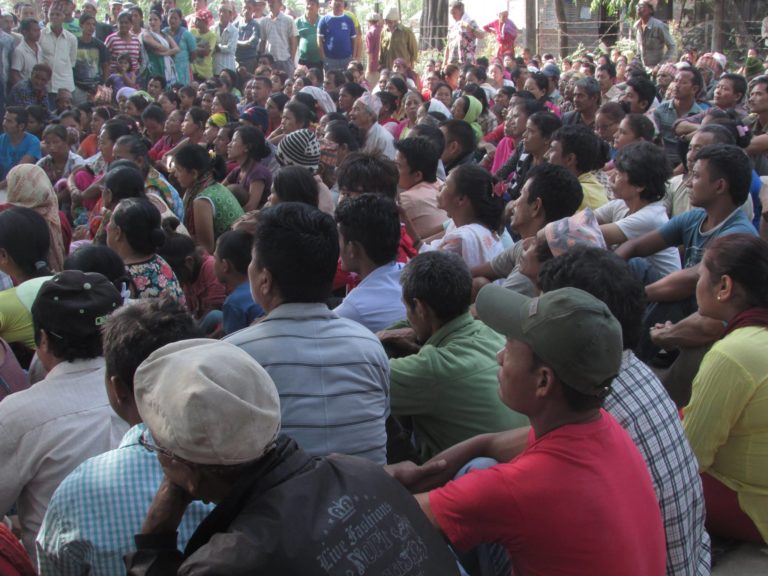
The hunger strikers with their appeal
Hunger strikers with their appeal/Photo: Yubaraj Sampang

Bhutanese Refugees languishing in Beldangi camp started hunger strike in response to the World Food Program’s (WFP) decision to curtailing the food commodities. The UN High Commissioner for Refugees (UNHCR) and WFP decided to reduce subsistence ration allowance that has been provided to refugees in Nepal, citing large-scale emergency funding need for refugees in other parts of the world.

“Refugees who do not fulfill the vulnerability criteria will receive 70 percent of the current ration starting early 2016. The composition of the reduced basket is currently under discussion with refugees’ representatives, so as to accommodate their preferences as much as possible. WFP will increase its monitoring of the nutritional status of refugees in order to detect new vulnerabilities,” WFP Nepal Country Director Pippa Bradford said in a statement published October 12, 2015.

According to Harka Jung Subba, president of Bhutanese Refugees Elderly Repatriation Committee (BRERC), the hunger strike kicked off on November 22, 2015. “We want continuous humanitarian assistance and durable solution to those willing to repatriate to Bhutan”, Subba told BNS. Subba further added, “around 7,000 refugees are willing to be resettled in third countries, while the remaining want to go back home”.Hunger strikers continue to raise voice of refugees

The Chairperson of Bhutanese Refugee Representative Repatriation Committee (BRRRC), Dr. Bhumpa Rai, visited the hunger strikers and expressed worry over the deteriorating conditions of exiled Bhutanese. He urged Nepal Government and refugee aid agencies to stimulate assistance to those remaining in camps and open the door of repatriation to those willing to return Bhutan earliest as possible.

Meanwhile, Bhutanese refugees have appealed Nepal government to negotiate with Bhutan government for repatriation. Submitting a memorandum to Home Minister Shakti Basnet on Tuesday, November 8, Bhutan Independent Peoples’ Forum (BIPF) urged Nepal government to raise the issue of Bhutanese refugees at SAARC and other international forums. “We got positive response from home Minister Basnet” DB Subba, one of the delegates of BIPF informed Bhutan News Service.

After resettlement marked 100,000 Bhutanese refugees in third countries, there are around 18,000 refugees left in the camp, according to the data of UNHCR and IOM.

Top Ten Finalist of Barsha Best Performer Announced; Finale on December 26

26,644

The grand finale of ‘Barsha Best Performer 2015’ is set for December 26, 2015 at Pittsburgh, Pennsylvania.

The first audition round of the singing show, ‘Bersha Best Performer’, started from July, 2015 with 40 aspiring resettled Bhutanese singers from different states of America. According to organizer, the program’s Live streaming will be broadcasted through ‘youtube’ and Rerun through White Himal Television.

The top ten finalist of Barsha Best Performer have completed their last studio performance and have already been assessed by the judges. Those ten contestant are Naina Monger, Deoka Bhandari, Gopal Mongar, Shiva Rai, Damu Tiwari, Ramesh Kadel, Sahara Rai, Jeetendra Giri, Santa Kafley, and Baba Khaling. Their scores have not been disclosed yet. The voting lines to vote for all ten contestants are open till December 3, 2015, Thursday 9 PM EST. The evaluator board includes famous Nepali singer Promod Kharel from Kathmandu, Nepal, Bhutanese singers Balaram Gurung from Pittsburgh, PA and Damber Kapaung from Fargo, ND.

Top Ten Contestants of Barsha Best Performer-2015. Photo: Sakshyam Group
Top Ten Contestants of Barsha Best Performer-2015.
Photo: Sakshyam Group

Barsha Best Performer is a Nepali signing series organized by Sakcham Group, an artists’ group based in Pittsburgh run and managed by resettled Bhutanese youths and supported by Barsha Jewelers in association with other business entities. According to organizer, the show is a talent contest to decide the best new singer among the resettled Bhutanese youngsters based on viewer voting and participation. It is independently produced and is not a licensed adaptation.

There are so many talented artists born and grown in the refugee camps in Nepal. Due to the lack of resources, exposure and opportunities they remained always under the shadow. Very few could exhibit their talents on their own and became successful and even have produced music albums in the past.
One of the main sponsors of this event Bhanu Phuyel, who runs Barsha Jewelers in Pittsburgh, says, ‘This is an approach to respect and promote the talents of our young brothers and sisters. Small opportunity sometimes can change the life of an individual so differently. All the contestants who participated in this event have learnt a lot and are determined to excel their skills in better ways. I am glad to be a part in promoting the hidden, otherwise, totally unnoticed talents of our younger generations.’

The top four contestants of the season will be awarded with a gift and token of love, along with the opportunity to sing two songs that will be featured in a compilation album. The winner of the season will get an opportunity to get a week long trip to Caribbean Cruise for free for 2, the organizer has stated.

राशन कटौती भएकोमा शरणार्थी खिन्न

तिलक निरौला, न्यु ह्याम्प्सर

झापा र मोरङमा बस्दै आएका भुटानी शरणार्थीहरुलाई दिईदै आएको खाद्य सामग्रीको परिमाणमा कटौती गरिएको प्रती शरणार्थीहरुले दुःख ब्यक्त गरेका छन् ।

शिविर व्यवस्थापन कार्यालयमा धर्ना दिंदै शरणार्थी

बेलडाँगी शरणार्थी शिबिर र मोरङको पथरी शिबिरमा रहेका करिब १७ हजार शरणर्थीहरुले बिश्व खाद्य कार्यक्रम मार्फत पाउदै गरेको सहायतमा कटौती गरिएकोमा दुख ब्यक्त गरेका हुन् । खाद्य सामाग्री कटौती गरेको भन्दै शरणार्थीहरुले शिविर व्यवस्थापन समितिको कार्यालयय अगाडी धर्ना समेत दिएका छन् । दातृ निकायले दुई  बर्षयता सहयोग नगरेका कारण सहायता कटौति गर्नुपरेको बिश्व खाद्य कार्यक्रम डब्लुएफपीले जनाएको छ ।

विश्व खाद्य कार्यक्रमको राशन कटौती सूचना

झापा र मोरङमा बस्दै आएका भुटानी शरणार्थीहरुलाई दिईदै आएको खाद्य सामग्रीको परिमाणमा कटौती गरिएको प्रती शरणार्थीहरुले दुःख ब्यक्त गरेका छन् ।

शरणार्थीहरुले खाद्य सामाग्री कटौती हुदा खान नपुग्ने भन्दै सहायता नघटाउन आग्रह गरेका छन् | “पहिला दिदै आएको खाद्यन्न नै थोरै थियो, त्यसमा पनि कटौती गर्दा साह्रै दुःख लागेको छ” बेलडाँगीका शरणार्थी सन्तबिर घलेले भने |

विश्व खाद्य कार्यक्रमले शरणर्थीहरुलाई दिदै आएको खाद्य सामाग्रीहरुमा नून, पोसिलो पिठो र चिनी कटौती गरेको छ । त्यस्तै बिगतमा एक ब्यक्तिलाई प्रति महिना १२ किलो चामल दिदै आएकोमा अब १० किलो मात्र उपलब्ध गराउने जनाएको छ । त्यस्तै दाल, खाने तेल लगायतका अन्य खाद्य सामाग्रीको परिमाणमा पनि कटौती गरेको छ ।

अपाङ्ग, असक्त, बालिबालिका, सुत्केरी, गर्भवती लगायतको हकमा भने खाद्य सामाग्रीको परिमाणमा कटौती नगरिने विश्व खाद्य कार्यक्रम (डब्लुएफपी) ले जनाएको छ । खाद्यसामाग्रीको परिमाणमा कटौती गरेकामा शिविर व्यवस्थापन समितिले बिज्ञप्ती जारी गर्दै सहायता नघटाउन आग्रह गरेको छ ।


Ranjit, son of late Mahasur Chhetri, passes away at 79

26,644

Ranjit Chhetri (Basnet), who was the last surviving member of the late Mahasur’s family, passed away at the age of 79 in Pittsburgh, PA, Tuesday,November 24, 2015. Ranjit was born to his father of unparalleled valor, Mahasur Chhetri, and mother, Pabitra Chhetri, in 1936 in Labshibotey of Chirang district in southern Bhutan.

Late Ranjit Basnet on the day he left the refugee camp for the US. Photo: Vidhyapati Mishra
Late Ranjit Basnet on the day he left the refugee camp for the US.
Photo: Vidhyapati Mishra

Ranjit was suffering from chronic breathing problem and was under continuous medications since several years. Lately, he was admitted at UPMC, Mercy Hospital in Pittsburgh. ‘Doctors tried their level best to treat him. I am satisfied with the level of treatment and care he received till his last moment in the hospital’, Rup Basnet, one of his sons, informed Bhutan News Service.

Ranjit, who initially arrived in former Goldhap Refugee Camp in 1992, later moved to Beldangi-II. A man of strong courage and will, Ranjit was agonized by death of his wife, Pabitra Chhetri, in 2008.

Having seen no hopes of repatriation, Ranjit applied for the third country resettlement in 2010 and arrived in Pittsburgh on August 1, 2012.

His Life History

Ranjit Chhetri was born to his father of unparalleled valor, Mahasur Chhetri, and mother Pabitra in 1936 in Labshibotey of Chirang district. His father, a trusted servant of the first Prime Minister, Jigmi Palden Dorji, was in Bhutan House at Kalimpong, India when a messenger relayed him news about birth of Ranjit in Labshibotey.

Friends and locals received Mahasur, who instantly decided to leave for Bhutan to see the baby boy, at his residence with a formal ceremony to rejoice the birth. The celebrations continued until the child was named as Ranjit following Hindu traditions on the eleventh day.

“My mother used to tell me that hundreds of locals, dozens of chaprasis and mandals were a part of the naming ceremony which was observed with panche baja, traditional dances and several rounds of gunfire. I was like a prince in the locality. Nobody can predict tomorrow. Who believes today if I tell the whole story of my father and his friends of that time?’, Ranjit told.

Ranjit was lucky to have an opportunity to get enrolled in a private school in Kalimpong. However, he decided to discontinue his studies from grade six when he was enticed by various facilities that he used to get at the Bhutan House, the official residence of the Dorji family.

According to him, the then prime minister was very unhappy when Ranjit decided to remain completely aloof from his studies. “He wanted me to become a great man like my father and always motivated me towards studies. But, I always tried to ignore his words as I found that regular study was not an easy task to do. I admit now, that was my fault, said Ranjit, as he recalled his early days of Kalimpong.

At the age of eight, Ranjit married Pabitra Khadka, who was two years older. The marriage ceremony that lasted almost for a week was regarded as the greatest and most expensive function in Bhutan during that time. The claim for total expenses of the whole ceremony is Nu 9,000 in 1944.

“Many take my marriage as a fairytale,” elaborates he, “There were 84 Darjees with seven commanders for panche bajas and over 300 hundred horses during the marriage procession to the girl’s house.” His claim of the extravagant marriage party is itself a dubious description, unlikely to command belief. “The party meal included 1,120 kilogram of rice, 14 goats and one seven-year-old he-buffalo,” claimed he.

Not only the invitees but also the hoi-polloi who heard about such a function attended the ceremony fearing that Mahasur would get upset with those who turn down his invitation. Ranjit’s wife, who was welcomed as new bride to Mahasur’s home by a queue of hundreds of women in 1944, passed away in 2008 leaving him all alone in this world.

Ranjit and his stepmother escaped to India the very next day when the then Prime Minister Jigmi Palden Dorji and his coterie packed Mahasur in a leather sack, stitched, stringed a heavy stone and threw alive into the torrential Sunkosh River in the early morning of March 8, 1951 accusing him of initiating the formation of Bhutan State Congress and request the then government for equality, equity and fair treatments to all the Bhutanese citizens.Late Mahasur’s perception is considered still relevant. History of call for the establishment of democracy in Bhutan goes back to- late 1940s and early 1950s.

The Bhutanese authority that agreed to bear funeral costs, compensate some losses and return properties seized by the authority, took Mahasur’s family to Bhutan only after 18 months of exile in India. The decision was taken following a negotiation deal between the Prime Minister’s father S.T. Dorji and the then Indian Prime Minister Jawaharlal Nehru in Kalimpong, being pressurized by the Indian Congress.

Upon his return to Bhutan, Ranjit had to accept a job at the department of forest where he worked for 20 years although his mother and step-mother were not in favor of his taking the job.

Ranjit and his family arrived in Nepal in 1992 and got initially settled in former Goldhap Refugee Camp in Jhapa, Nepal. Later, he moved to Beldangi-II.

Ranjit arrived in the United States on August 1, 2012 and was living with his son’s family in Pittsburgh, PA.
His funeral is performed on Wednesday, the November 25, 2015 in Ball Funeral Chapel located at 2600 Dunster Street, Pittsburgh, Pa 15226. Starting Thursday, the 26th of November, his family members will mourn his death per Hindu tradition and the 13th day ritual falls on December 6th 2015, at 2034 Brownsville Road, Pittsburgh, Pa 15210. All relatives, family friends and sympathizers are expected to visit at their convenient time.

Vidhyapati Mishra from Charlotte, NC contributed to this report.

PM Oli hails resettlement process as it reaches 100,000 mark

26,644

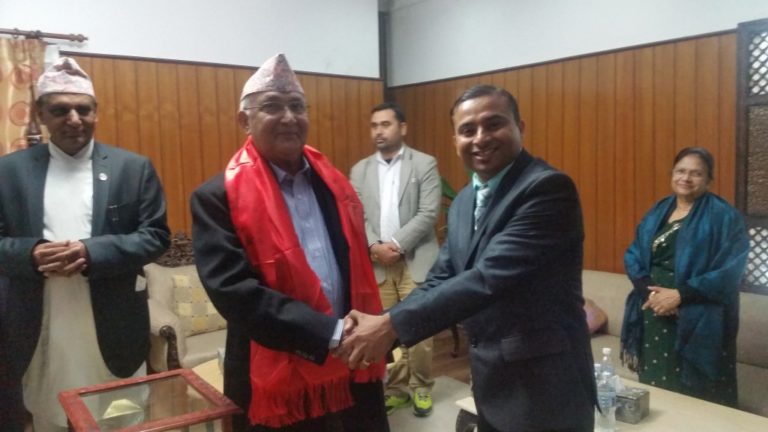
Nepalese Prime Minister KP Sharma Oli, who has been favoring the third country resettlement of the Bhutanese refugees from Nepal, hailed the resettlement process appreciating the joint efforts of all parties included, Thursday.

Prime Minister K.P.Sharma Oli giving his remarks during the marking of the resettlement of 100,000 Bhutanese refugees (Picture courtesy: UNHCR-Nepal)
Prime Minister K.P.Sharma Oli giving his remarks during the marking of the resettlement of 100,000 Bhutanese refugees (Picture courtesy: UNHCR/Deepesh Das Shrestha)

According to the UN refugee agency, PM Oli “applauded the role of UNHCR, IOM, resettlement countries and partner agencies”.

The Prime Minister expressed his appreciation while addressing a joint event of UNHCR and International Organization for Migration organized to mark resettlement of the 100,000th Bhutanese refugee in Kathmandu Thursday evening.

The refugee agency reported from Kathmandu that fifty-three-year-old Devi Maya Thapa is the 100,000th refugee to be resettled from Nepal. Together with her husband, children and grandson, she is set to leave in early December for a new life in the US state of Ohio where other family members have already settled.

“I am leaving the refugee camp forever after spending more than two decades in Nepal. I am happy that our family will be together in our new country and that my children will have a better future,” said Devi Maya, who joins 84,800 Bhutanese refugees who have already started over in the United States of America.

According to the UNHCR, the United States has accepted 84,819 refugees. Statistics of other countries resettling the Bhutanese refugees included Canada (6,500), Australia (5,554), New Zealand (1,002), Denmark (874), Norway (566), the United Kingdom (358) and the Netherlands (327).

“This is one of the largest and most successful programmes of its kind and the resettlement of nearly nine out of 10 Bhutanese refugees is an extraordinary achievement,” said UNHCR Representative Craig Sanders.

“Eight years ago few would have envisioned we would reach this milestone. We give credit and thanks to the resettlement countries, the Government and people of Nepal, the refugee community and our NGO and UN partners with whom we have worked for over two decades,” he added.

The Chairperson of the Core Group, Australian Ambassador to Nepal Glenn White said Australia was “proud to have played a part in this highly successful resettlement programme.”

The departure of the 100,000th Bhutanese refugee was, he said, a demonstration of the strong humanitarian cooperation between the eight resettlement countries, together with Nepal, UNHCR and IOM. He looked forward to working with them all to seek “resolution for the Bhutanese refugees who yet remain.”

IOM Nepal Chief of Mission, Maurizio Busatti, said, “Reaching the 100,000th resettlement is a remarkable success, it shows how strong the partnership among all actors has been. Most importantly, we honour the courage of these women, men and children in building their future in a new land, as well as the generosity of those who welcomed them at the other end.”

Meanwhile, Dilip Dahal, vice-chair of Organizations of Bhutanese Communities in America, also addressed the event representing the resettled diaspora.

The agency further said that of the remaining 18,000 refugees, some 10,000-12,000 would remain the camps in Nepal. “UNHCR, together with IOM and the international community, will continue its efforts to achieve comprehensive and lasting solutions for the remaining population,” it stated.

(Breaking news updated with a headline change. Tilak Niroula from NH contributed to this report. )

Tihar observed by worshiping cows in NH

26,644

Bhutanese community members in New Hampshire(NH) observed the third day of ‘Tihar’ festival by worshiping cows amidst a function at Bartlett Farm Dairy, in Concord on Wednesday the November 11, 2015.

Celebrant offering garland to a Cow. Photo: Tilak Niroula
Celebrant offering garland to a Cow.
Photo: Sagar Khatiwoda

The Tihar that is celebrated for five days includes four days showing reverence towards animals like Crows, Dogs, Cows and Oxen who Hindus consider having very meaningful relationship with humans. On the fifth day- the festival ends with brothers receiving Teeka from their sisters.

Cows are considered holy or motherly animal. Hindus admire cow for her kindness and non-violent nature, which is also regarded as the basis of main teachings of Hinduism. Hindu Upanishads or Vedantas have very significantly compared cow with the mother earth. The third day of the Tihar has bigger meaning for the mankind. People feed cows with delicious foods, offer garlands and adorn with colorful dyes. This is considered showing gratitude for serving people of all walks of life with milk as an elixir.

The celebration in Concord was organized by Maintaining Independence Adult Day Services Inc. According to the organizer, more than 50 resettled Bhutanese adults attended and marked the festival.

Bhakti Maya Nepal, who is residing in Manchester since the last three years, appreciated United States being such a beautiful flower garden where  each culture and religion has equal respect. “I had never imagined such opportunities in the country like USA, while we were in the refugee camps in Nepal, that we are realistically doing today. I knew today that the United States is great for many reasons”, Bhakti Maya said. She became so overwhelmed and further said that, “I feel grateful to be the part of the celebration with all my fellow friends and relatives similar to what we used to do while back in our villages in Bhutan. I feel like I am in Bhutan.”

Celebrants preparing for the Puja. Photo: Tilak Niroula
Celebrants preparing for the Puja.
Photo: Tilak Niroula

 Likewise, another celebrant Puspa Lal Adhikari recalled the way they used celebrate ‘Cow Tihar’ in Bhutan with lots of merrymaking in the evening by dancing in groups, visiting neighbors sharing and wishing the blessings from goddess Laxmi- the Goddess of the wealth.

Those showing deep reverence towards motherly animal Cows  sip a drop or two of the cow’s urine as a part of belief in the purification process. The sacred Upanishads have defined cow’s urine being therapeutic in nature with divine healing properties.


‘The Pathetic Journey’ launched

26,644

   …’ the children-
the global citizens
scratch the earth and sketch
the crown of the King
with fading color…’  

reads one of the stanzas of the poem ‘Children in the Camp’ in – ‘The Pathetic Journey’.

Terry Lee Kuhn commenting on the book. Photo: BNS
Terry Lee Kuhn commenting on the book.
Photo: BNS

‘The day my family landed in the bank of river Kankai in Jhapa, Nepal my mind remained hunting answers to questions like- why king did not love his citizens? Why king could not be the guardian of all? Why the king pick only those people of his type? What crime I happened to commit as a child so that I became stateless? It is the outcome of my past 25 years. The Pathetic journey is the collections of those answers in the form of poetry works’, says Narad Pokhrel, the author of the book.

Objectively analyzing the poems during the book releasing program organized in Pittsburgh, PA on November 8, 2015 by Literarture Council of Bhutan (LCOB), former  Prof. Terry Lee Kuhn from Kent,Ohio said, ‘Narad’s poetry describes the Lhotshampa people from southern Bhutan whose homes, farms, animals, and crops were stolen by a mercenary government that wanted it all for itself.  That Royal Government of Bhutan was able to evict many of its Lhotshampa people, but it cannot squelch the art, intellectual life, and feelings of the victims.’

One of the editors of the book, Dr. Taralal Shrestha from Kirtipur, Kathmandu Nepal has seen this book as; ‘The narration of the tragic collapse of a long lost family, their vicious past-the forced parasitic living- echo as historical statements that whisper to apprise the homeless generation through the retrospection and reconstruction of their (hi)story.’

‘This collection, consisting of enthralling stories, of the victims of the genuine cause, in soft sentiments will be a compelling read for those who wish to know about the lives lived by the exiled Bhutanese’, says Rup Pokharel, another editor of this book from Pittsburgh.

The Pathetic Journey

Presenting the commentary on the poems in the book Shivalal Dahal, one of the noted critics amidst Bhutanese diaspora remarked Narad’s poetry work as- ‘the reflection of one historical phase in the history of exiled Bhutanese. Fundamentally, poems are melancholic-originating from forced exile, broken love, deprivation and poverty. The journey described here is not only the geographical but metaphysical and the whirling move of traumatized minds too. Reading his poems, one will be deeply moved by his humanism.’

According to the Chairman of Literature Council of Bhutan (LCOB), Bhakta Ghimire, the book is the mirror displaying the other side of the untold tale of tactical drama of the elites over run-of-the-mill. The Pathetic Journey has also encouraged patience to progress and hopes to living. It is as reminiscence for those born and raised in Bhutan, bridge for those born and brought-up in the refugee camps, connecting dots to revealing truth for the children born in the countries of resettlement and something to ponder upon for the general readers- is the prime essence of this book.

Guests attending the book release session Photo: BNS
Guests attending the book release session
Photo: BNS

The 276 paged volume is published by Discourse Publication, Kathmandu and printed in Noida, India is available in the market for the readers. The copies are available in Hard bound and Paperback.


Young man died in Columbus after plunging in a pond

26,644

A man identified as Bibhu Dhakal died in a hospital in Columbus, where he was taken at critical condition, Saturday, after being pulled out of a pond near Shanley. He was taken out of the pond where his car plunged after hitting the curb and breaking the fence surrounding the pond.

According to a facebook post by Vishal . Sharma, the funeral date is scheduled for November 10 at 4:30pm.

The Dhakal family was resettled in Columbus from Goldhap refugee camp. The cause of the accident is not yet known.

BCS Elects New Board Of Directors

26,644

Bhutanese Community in Syracuse (BCS) Inc., has elected by a secret ballot an eight membered board of directors on Sunday, November 1, 2015.

The election was conducted at the office of Catholic Charities, the local resettlement agency at 527 North Salina Street. At the beginning of voting, Hari Bangaley Adhikari, chief of the election commission briefly explained the rules of the election and the method of casting votes to the candidates contesting in different positions. The election began at 1pm and continued until 7pm.

The new team of BCS has been formed under the chairmanship of Kazi Gautam. Others elected board of directors are Pavitra Sapkota (Vice Chair), Sajan Nepal (Treasurer), Parshu Dhimal (Director-Social Service and Elders), Ajaya Sapkota (Director-Religion and Culture), Dadhi Dahal (Director-Education), Yuba Bhattarai (Director-Games and Sports) and Kiran Gautam (Director-Women and Children).

New BCS board/photo : Bikash Subedi

The outgoing president of BCS, Jai Subedi congratulated the new team and expressed his desire to extend them his helping hands as and when needed.

“I will always be there to support you and I wish you the best of luck for your commitment towards the community”, said Subedi. He added that  BCS has expected a lot from the new board of directors.

Hari Bangaley Adhikari also congratulated the newly elected chairman and other board of directors through an email.

“On behalf of the General Assembly of the Bhutanese Community of Syracuse, I extend heartiest congratulation to you on becoming the chairperson of BCS. Other contestants that withdrew their names as you filed the nomination is an example of how much support you earned. This is a showcase of the trust of the people on you and a revelation of the good work you have done over the years for the community”, read Bangaley’s email.

On behalf of new board of directors, Kazi Gautam, a new chairman of BCS  thanked everyone for their support and trust on them, and expressed the new board’s desire to work continuously for the betterment of the community members.

“I do not have enough words to thank everyone for your love and support showered to our team. We do not have any agenda or anything at this point. However, on behalf of our team, I would like to assure you that we will work selflessly to help our community folks at need, and work towards preservation of our identity ”, said Gautam.

The Board of Directors will resume the office from November 2. Immediately, the board is expected to nominate a board secretary and a team of executives.