In the first part you can listen to Bhutan Coverage by Ichha Poudel from Australia followed by a conversation with Goldhap Camp Secretary Chiranjibi Rai regarding complete shifting of the camp to Beldangi within this week. In the second part you can listen to a radio talk with Yam Kharel of OBCA and Dr Purna Chhetri of ABA, moderated by TP Mishra.
Government of Nepal and the United Nations High Commissioner for Refugees (UNHCR) have started discussion on implementation of the Community Base Development Programs (CBDP) in a bid to address the problems of the local communities of Jhapa and Morang, which have been hosting thousands of Bhutanese refugees for two decades.
However, such programs were said to be transitional for a period of maximum five years.
The Nepali Home Secretary addresses the discussion session
The concept of CBDP was floated during an inaugural session of the three-day discussion series jointly organised by the Ministry of Home Affairs and UNHCR that begun in Kathmandu, Monday.
According to Home Secretary of Nepal, Lila Mani Paudyal, the proposed CBDP under discussion were figured about through a recent joint needs assessment conducted by various stakes holders including the Ministry of Home Affairs and UNHCR.
Speaking at the program, Secretary Paudyal highlighted the need of CBDP stating that the local communities have hosted the refugee community for more than two decades, and would be doing for more years.
The CBDP would benefit people of various nine VDCs and three municipalities of Jhapa and Morang districts.
UNHCR Country Representative to Nepal, Stephane Jaquemet, said that the agency was indebted towards the host community for sheltering the exiled Bhutanese in their localities for 20 years.
He said, “When we are taking of camp merge and consolidation, the UNHCR is equally concerned about initiating some development programmes to address the demands of local communities.”
US Envoy to Nepal, Scott H DeLisi speaks to the workshop's participants
US Ambassador to Nepal, Scott H DeLisi, appreciated the role the GoN has been playing in coordination with various line ministries for effective hosting of the refugees from various countries.
Assuring financial commitment for the CBDP, “The international community including the United States is thankful for the host communities that have accepted refugees for years.”
Also, UN Resident and Humanitarian Coordinator to Nepal, Robert Piper, said that the UN would play a crucial role to materialise the project.
According Stephane, there would be just two camps, Beldangi of Jhapa and Sanischare of Morang, by the mid-2012 and just 10,000 would be in camps by 2015, especially those who do not choose to resettle.
He also said that Goldhap camp would be completely shifted to Beldangi within this week.
After a successful advocacy on various refugee issues in Geneva in the past, Melbourne-based Bhutanese activist, Parsuram Sharma Luital JP, has been selected by the Refugee Council of Australia (RCOA) to advocate in Geneva as a community representative from Australia.
Supported by the Adult Multicultural Education Services, Luital would participate in the UNHCR Standing Committee Meeting and NGO Consultations in Geneva from June 21-30.
Luital, who is a member of the RCOA’s International Policy Network (IPN) formed in 2009 to create opportunities for international networks and cooperation, would represent various refugee communities including the Bhutanese during Geneva discussion sessions.
Luital with his family members
“The key focus areas of the IPN include Australia’s engagement with UNHCR, issues in the Asia-Pacific region and development and humanitarian aid for refugees and displaced people, and I am going to discuss the same thing in Geneva,” Luital told BNS over the phone.
As a regular participant of the UNHCR’s executive committee and standing committee meetings, its annual consultations with NGOs and the tripartite consultation on resettlement, Luital said that the most significant achievement in the UNHCR meeting in Geneva could be an opportunity to meet the heads of different divisions and the issues that have been impacting the refugees in the camps and resettled countries.
“On personal visit, such opportunities are never possible. If it is not the RCOA, the voice of refugees from the ground will never reach the highest level in UNHCR,” added he.
He also claimed that he would raise many confidential issues that do not become media stuffs. “I am sure, I can raise such issues and help the UNHCR develop better policies for future.
In 2010, Luital was one of the panel speakers in the side meeting of the International Working Group to monitor the implementation of the excom conclusion on women and girls at risk.
Prior to departing for Geneva, Luital would attend the 2011 Refugee Conference: looking to future and learning from the past – a conference to mark 60 years of the refugee convention in the University of New South Wales in Sydney from June 14-17.
“I am in discussion with friends’ circle within the Bhutanese community to acquire as much information as possible so that I can convey the issues to the UNHCR. I hope, I will be able to get ample of issues for my presentation.”
The Organization of Bhutanese Communities in America held its three-day second national convention in Nashville, Tennessee from June 10 – 12.
Faces of some of the newly executive board members. Photo/Tri-Bikram Adhikari.
Participants from various States—from California to the West and Massachusetts in the East—have thronged to the convention venue, a high school in Nashville.
OBCA also announced the names of executive board members at the third day program, which was said to be finalized after nearly two days continuous discussions—both open and closed doors.
DJ Khaling has been elected to the post of Chairman of the organization. Accordingly, Manaroth Khanal, Hari Upreti, and Hari Dhakal were selected as Vice Chairman, Secretary and Treasurer respectively. The election commission headed by Hari Prasad Adhikari, former National Assembly member of Bhutan, also elected 29 board members for its two-year tenure.
Besides the announcement of executive board members, chairman, among others, the third day was marked by various cultural shows along with honoring function. Participants from different States rocked the floor with Nepali as well as Dzongkha dances and songs.
The OBCA also formally announced its organizational support to the tornado victims in Massachusetts. OBCA supported the victims with 600 US dollar. The organization also supported the upcoming soccer tournament in Georgia with 800 USD.
Meanwhile, OBCA has given an honor to TP Mishra, Editor of BNS, for his contribution in Diaspora through journalism during the concluding day convention.
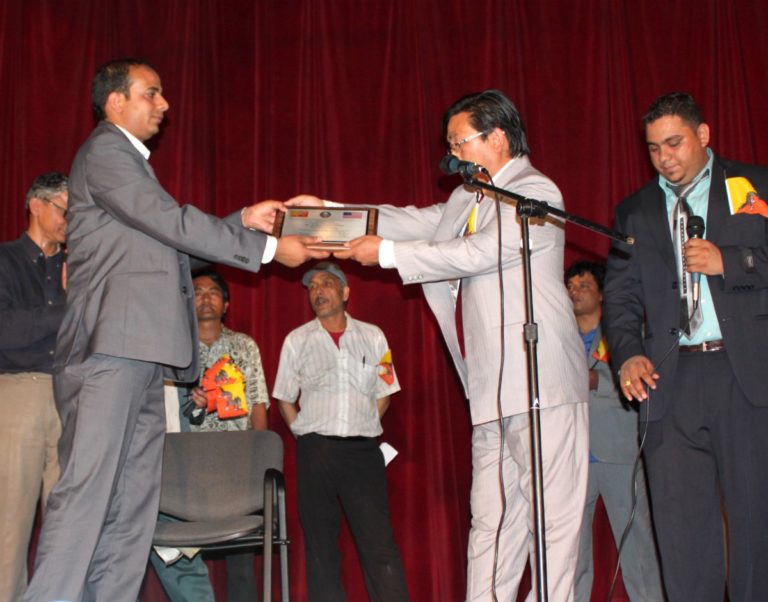
TP Mishra (L) receives letter of honor from newly elected OBCA chair DJ Khaling. The honor was handed over to Mishra jointly by former OBCA chair and chief coordinator of second national convention. Photo/Buddha Mani Dhakal.
According to OBCA, it is committed to felicitate a person or group in Diaspora, whose contribution to the society is rewarding, every year.
The newly elected chairman and former chairman of the organization along with the chief coordinator of second national convention handed over the letter of honor to Mishra amidst a special function today in Nashville, Tennessee.
Click here to read the speech delivered by Mishra after receiving the honor.
Reported by Buddha Mani Dhakal and Tri-Bikram Adhikari jointly from Nashville, TN for BNS.
Let me begin by extending my appreciation and gratitude to the government of USA, American citizens, the UN’s refugee agency, the International Organization for Migration, Government of Nepal, the resettlement agencies and all others who have explored the options of the third country resettlement program. It is because of all of your good-will humanitarian assistance that we are proudly gathered here today. Many among us never have imagined that we would be in the USA, a country widely believed to be a place of opportunities and new hopes.
I am also grateful to my colleagues: especially the editors, board members, and correspondents at the Bhutan News Service (BNS). It is because of their continuous dedication and effort that the Agency is being honored today. In every respect, I will consider this honor as the one to all exiled journalists, who are dedicated to safeguarding Bhutanese citizens right to information.
Despite many challenges, the team of BNS continued to work to offer a reliable, responsible and objective news service. We regularly covered stories about the hardships faced by our fellow community members—groups, families or individuals. We were and are always ready to celebrate, through our news coverage, the success stories that involve our community.
BNS activities Vs Challenges Interestingly, the sufferings and hardships encountered by our emerging media outlet have been rarely mentioned. We have been running the BNS as a service to the community, funding it from our own pocket. Over the years it has cost us dearly in terms of personal contributions and effort but we, as a team of volunteer journalists felt that our primary role was informing the public—their right to information—in an era where reliable information was a far cry. Behind all we did, our main calling has been to continue to campaign for press freedom in Bhutan.
When other needs become the top priority of the community, we have never run off from such situations. We collected 16,000 plus US dollar for recent fire victims in camps within few weeks and mobilized it very transparently. It is supplementary evidence that explores our readiness to get involved in society’s welfare, besides our reporting duty.
In addition to what we have received, I urge everyone to support our mission in the best possible way. The media has a powerful and momentous role to play in continuing to highlight the issues faced by Bhutan’s refugees worldwide and the issues of freedom of expression in Bhutan. It’s an ongoing and continually evolving story that must receive pellucid and accurate coverage – a role we are committed to undertake.
TP Mishra (L) receives letter of honor from newly elected OBCA chair DJ Khaling. The honor was handed over to Mishra jointly by former OBCA chair and chief coordinator of second national convention. Photo/Buddha Mani Dhakal.
The honor
Having said this, I would like to thank those who have closely observed our works for years, appreciated us and thus, considered us worthy enough to bestow with honor. The honor, as I believe, will add yet another brick to building our foundation in a stronger way. On a personal level, I have felt that more responsibilities have been placed on my shoulders. As a team, BNS has felt that such encouragement has added on to our sense of responsibility and our cause. For several years our media works went unnoticed.
At the initial phase, we lacked support and encouragement. During that time we faced negative criticism, discouragement and opposition. The honor from this Dias today, in my opinion, represents a new chapter in our history and we have no comprehension how that chapter will unfold. BNS team fills that Bhutanese care for our professional contribution in the community and it gives us an added incentive to work harder for the group. We honestly respect the support and dedication of the community.
Question of single national level organization More than 38,000 Bhutanese refugees have begun new lives in the US. They have new hopes, new opportunities, new friends and new horizons. Various success stories have continued to emerge. Many of the resettled Bhutanese have made a valuable contribution and have been doing well, despite the situation in the job market. Much of the hope for the future rests on the shoulders of our younger generation, who have started pursuing the standard modern education. However, this does not mean all the resettled Bhutanese in the USA have become self-reliant.
A majority of the resettled folks have language barriers in their new homes. This has served as the greatest setback during job hunt. Some have been struggling for more than a year to secure any kind of job position, but to no avail. Many in course of time have lost their jobs. At a time when we are having fun times here with a get- together (though for good cause), chances are that some of our fellow friends in other States might be struggling to pay off their basic bills.
Due to their working policies and lack of adequate resources, resettlement agencies have limited roles after certain period of time. There are other several minor problems our resettled folks might have been undergoing, which I believe, can be solved through community efforts. There is still a great deal of work to be done to help them settle, adapt, contribute and grow. Together we can make this happen. This has been well proven by other communities in the USA.
Ongoing calls have been continuing since the past year for a single and united national level organization in the US. It might sound odd, especially at this hour, but I will not hesitate to join the individuals or groups to strengthen the voices further for a single national level community organization. BNS will contribute to this in best way possible, if needed. We have miles to go to reach our final destination. As a journalism practitioner, I strongly believe we will reach there if we move ahead collectively. We don’t have options than working together for a common cause and we have to iron out our differences by unlearning our differences that we have got accustomed to in our camp life.
The Future For us, the recognition is evidence that people have listened to us and that people do understand the effort and cost that have been invested to tell the story of the Bhutanese refugee communities. We are a dignified people. Despite many imputes and challenges, we are proud that we remained true to ourselves. We fought for the highest standards in journalism and refused to be beaten down. We knew that all we were creating was for the future generation of Bhutanese; both inside Bhutan and living globally in the Diaspora.
The role of journalism – as made clear by the Bhutan News Service over the years – is to inform the public debate. To do so, we must always aim to rise above and beyond the circumstantial situations we find ourselves in. During the years of journey to our mission in the refugee camps we managed to do this through our training programs for young journalists. They are trained at the par of standard journalism ethics keeping them away from prejudice and personal bias. Our journalists were taught to be fair, to be accurate, objective and, most of all, to operate with integrity. These are the values that kept us alive. They are the assets that we believe Bhutan will one day aspire to adopt.
I want to thank you all again for making this moment possible. America has given us precious opportunity. We are proud and honored to be here and we want to make a positive and meaningful contribution in return. Thank you again for your generosity, warmth and, most importantly, continued support.
(The writer delivered this speech in Nashville, TN on June 12, 2011 after he was given honor by Organization of Bhutanese Communities in America, Inc, for his contribution in diaspora through journalism)
In a bid to promote language and literature of Nepali-speaking Bhutanese people through an integrated approach, Literary Council of Bhutan has been announced, Saturday.
Bhutanese litterateurs, who have been associated with various literary bodies and the Nepali Sahitya Parisad Bhutan (NSPB), unanimously decided to give a new look through a Skype conference this morning, according to apress statement issued by the Council.
Bhakta Ghimire
“The initiative aims at preserving and promoting the literary treasure of Bhutanese from diaspora and Bhutan, without limiting it to the customary Nepali literary works,” said Public Relation Coordinator of the Council, Rup N Pokhrel, from California, US.
The statement further said a series of discussions were held among the former NSPB’s members and other well-wishers in this regard decided to up-grade the institution under the banner Council with effect from June 11.
The meeting also decided to elect Bhakta Ghimire, resettled in America, as the Council’s chairman and former chief coordinator of the NSBP, Shiva Lal Dahal from Khudunabari, as vice-chairman.
Likewise, Yeti Raj Ajnabee (Australia), Yam Thulung (Nepal), Ramesh Gautam (Norway), Dona Acharya (America), Rup N Pokharel (America) and Puranaghare (America) have been elected to the Council’s executive board, added the statement.
TheBhutaneseliteraure.com, which has been under operation since May 2009, will be managed as official publication site of the Council, Ramesh Gautam, founding-chairman of the website, told the Bhutan News Service over the phone from Norway.
“This step has institutionalized the ongoing publication works of this portal and I am hopeful of making the publications more effective and reader-oriented,” said Gautam.
Formed in 1993, the NSPB was popularly known among the exiled Bhutanese for transforming uneducated persons into graduates of Nepali language.
Massachusetts Governor Deval Patrick Friday visited the victims of tornado that made 13 Bhutanese homeless in the city of West Springfield, MA on June 1.
Governor spent about an hour listening to the stories from the victims. Patrick said that he is aware of the pain and sufferings of the victims.
Benu Chhetri, one of the Bhutanese victims of tornado, submitted a memorandum highlighting their situations to the governor on behalf of Bhutanese Community of Western Massachusetts.
Answering to the questions of the victims, governor mentioned that he has already set up recovery centers at three locations to assist with their housing, food stamps, social security and employment, among other assistance.
Meanwhile, the executive director of the Office of Refugee Resettlement (ORR) is scheduled to visit the victims at the shelters in Springfield, MA later this afternoon.
Reported by Bhuwan Gautam for BNS from Springfield, MA.
Three years have lapsed since the ‘democratic’ constitution was promulgated after much fanfare and ceremony. Actual change, as the appearance suggested then, hasn’t yet come under the fifth King, Jigme khesar Namgyal Wangchuck. The Samtenling directive, connected to the fourth king’s palace, is still pervasive. And, the fundamental human rights enshrined in the constitution are still denied to the citizens.
The three major ethnic communities in Bhutan are the Ngalongs of the west, Lhotshampas of the south and Sharchops of the east. From 1972 to 1990, the share of top positions in government belonged first to the Ngalongs, followed by the Lhotshampas and Sharchops. After the rebellion by the Lhotshampas in 1990s, the position changed slightly. Ngalongs continued to occupy the top slot. The Sharchops leapfrogged to second place, relegating Lhotshampas to last position. Influential posts including the chief of army, chief of police and Gyalpoi Zimpon still go to the Ngalong community.
Prior to the promulgation of the ‘democratic’ constitution of 2008, a change was expected, but it was not to be. What we are seeing in Bhutan now is ethnic discrimination just as in the earlier times. The fifth King, too, is giving more importance to the Ngalong community. He gave away influential positions of the Gyalpoi Zimpon and Dronyer to the Ngalongs. This assertion doesn’t mean that the Ngalongs occupy all the elite positions. A handful of Sharchops are also in high positions, but they don’t owe their position to partiality or discriminatory policies. They have reached where they have based entirely on their merit and hard work. In the lower rung of the bureaucracy, army, police, business and other sectors, the Sharchops and the Lhotshampas, however, continue to dominate.
Many Bhutanese assumed that the western region had prospered more in comparison to other regions because the capital is situated in west. However, after three decades of observation, the basis for such deduction seems unfounded.
The neglect of the development in other regions is deliberate and the result of the discriminatory policies of the Samtenling directive. The government receives large funds for development from international donors and India. Where do those billions promised in each successive five-year plans to development projects to eastern and southern regions of Bhutan go, and will continue the same trend in future? For example, the Kurichu Hydropower Project, which has the potential to generate over 1000 MW, was reduced to a 45 MW plant. The government makes a big deal of having established this project in the east, whenever the question of development in the eastern region is raised.
To mention a rather dark-humoured incident that brings to the surface this sectarian attitude at the very top in Bhutan – during the general elections of 2008, gup Hopola, from Bartsham, Trashigang, who had served the queens for years, when asked by Queen Dorji Wangmo who he had voted for, frankly admitted that he had voted for Jigmi Thinley’s party as he thought that this party would serve the country best. Ashi Dorji Wangmo became very angry and said that Sharchops should never be trusted, definitely she had expected him to vote for her brother, Sangay Nidup’s party. Hopola was immediately sacked.
The fury of the fourth king against the Lhotsham and Sharchop communities for rebelling against the Royal Government of Bhutan in the 1990s hasn’t subsided even now. Sons and daughters of many Lhotshampas and Sharchops are denied security clearances and citizenship identity cards. They are denied opportunities in further studies and access to many welfare schemes that are available to other Bhutanese. I may be wrong, but so far I have not heard a single case of such denial to western Bhutanese. The denial of security clearances, better known as non-objection certificate, and citizenship has been the main policy of the fourth king Jigme Singey Wangchuck to satisfy his anger. On this issue, even the Members of Parliament are helpless, despite it being one of major problems affecting their constituencies.
The only person who can rectify this is the fifth King. We are happy that many vulnerable sections of society are receiving kidu from him. An overhaul of this obnoxious policy by the King would be a great kidu for the general public. Ex-Dzongda Kado, during a National Assembly session of 1970, had remarked that the government’s policies are similar to horse dung. From outside, it looks very smooth, but enclosed inside is full of waste. His observation of government policies of that time is no different than the policies of the present government, indeed.
The struggle by the Druk National Congress (DNC) and also the Lhotshampas has not much to do with the institution of monarch. The DNC’s struggle is to empower the Bhutanese people, ensure freedom and democratic rights and responsibilities under a written constitution, and to strengthen the sovereignty of the country. Likewise, the Lhotshampas have struggled to demand reinstating of their citizenship rights. The fourth king, who is ruling the nation from behind the scene, is solely responsible for the political crisis that ensued thereafter. Instead of putting an end to the crisis, he himself had created in first place by abdicating the throne leaving the crisis afresh as it is.
Now, the responsibility lies with the King to end the outstanding political crisis and break the adherence to the Samtenling directive. As to others, the DNC has high expectations from the fifth King. The discriminatory policies and the non-issuances of citizenship identity cards, and security clearances were the hallmark of the Samtenling directive. An overhaul of this will bring immense benefits to the people and the country. In addition, the respect for the years-old monarchy is going to increase more. Time has come to initiate a new directive from the Khesar’s palace – Lingkhana directive. Sooner the better.
(Dorji, who is President of the Druk National Congress, has been leading the strategic coalition formed by the party with Bhutan People’s Party, Bhutan National Democratic Party and Human Rights Council of Bhutan. The article which was first carried by the Bhutan Today, a bimonthly bulletin of the Dorji’s party, has been reproduced for readers of BNS.)
Nepali Prime Minister Jhala Nath Khanal has asked the government of Bhutan to repatriate the exiled Bhutanese, Thursday.
Nepali Prime Minister Khanal
Addressing a program organized by the Nepal Council of World Affairs in Kathmandu, PM Khanal said Bhutan should respect the right of refugees to return home with dignity and honour.
Khanal, who did not speak anything about the resumption of the much-awaited bilateral talks, requested Bhutan to pave congenial environment for repatriation of over 100,000 exiled Bhutan saying the refugees have been longing to return since several years.
According to PM Khanal, the international community should be more active in handling the long-standing refugee imbroglio, as he claimed it has already become an international issue.