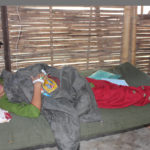
The hunger strike of 12 women, who are denied of refugee status and other facilities from the aid agencies, still continues on the tenth day, Thursday.
Earlier today, the agitating women padlocked offices of various agencies and Refugee Coordination Unit of Beldangi-II and Extension camps.
However, security later intervened into the situation and unlocked all offices, informed Durga Devi Bista, who has been leading the hunger strike.
The local authority has been making various efforts, through different organizations including human rights groups, to beak the fasting-to-death. However, the women have remained firm in their demands.
Meanwhile, AMDA Nepal has been providing 24-hour services to the women, maintain a separate desk in the venue. Two women, whose blood sugar level has fallen critically, are being treated in Damak-based AMDA Hospital.
Meanwhile, the Bhutan Media Society today said it is preparing to launch an online donation drive to support hunger strikers and their children during the post hunger period.
Women, who are fasting to death since last Tuesday, need special dieting to recover their health when they decide break their fasting, and we will very soon start our donation drive involving the resettled community, said Vidhyapati Mishra, Manager of the Society.
The Society said, it has been monitoring the situation from the very start of the protest, and conditions of the women are very critical.
Bhutan and the Republic of Fiji formalized diplomatic relations at a ceremony in New York over the weekend.
The ISRIA news service Monday reported that Fiji’s Permanent Representative to the United Nations, Ambassador Peter Thomson and his Bhutan counterpart Lhatu Wangchuk, signed a joint communiqué establishing diplomatic relations between the two countries.
“The communiqué expresses the desire of countries to promote and strengthen the bonds of friendship and cooperation between the two Asia-Pacific nations,” said the report.
It further reported that the communiqué affirms that this relationship will be guided by the principles and purposes of the Charter of the United Nations, the Vienna Convention on Diplomatic Relations, and other norms of international law, particularly those pertaining to the mutual respect for independence, sovereign equality, territorial integrity and non-interference in the domestic affairs of other States.
Officials of the Permanent Missions of Bhutan and Fiji to the United Nations attended the ceremony, according to the report.
“Following the signing of the communiqué, the national representatives held discussions on areas of common interest to their two countries, including Fiji’s support at the United Nations for Bhutan’s work in promoting enhanced quality of life through its Gross National Happiness initiative.”
Fiji, an island nation in Melanesia in the South Pacific Ocean, has military appointed government, and has less the half the area of Bhutan.
The Bhutanese community living in Charlotte, North Carolina formally announced the formation of the Organization of Bhutanese Community in Charlotte (OBCC), North Carolina amid special function held here in the city on Sunday.
The announcement of this not-for-profit community-based organization came after a series of efforts made among the community members dwelling in Charlotte area.
A three-member election commission, which was tasked with the responsibility to hold a general election, finally nominated 13-board member committee to run the organization citing that the general election at the inception phase could derail the smooth functioning of the organization.
According to newly elected Board Chair, Hasta Pradhan, the election commission nominated the 13 potential board members. The 13-board members through closed-door voting procedures made finalization of the names of Board Chair, Vice Chair, among other major positions.
OBCC (NC), according to Pradhan, shall strive to serve Bhutanese; preserve and promote language tradition and culture, value and encourage creativity, artistic performance and provide guidance towards sustainable community development practices.
In a press statement the OBCC (NC) stated that Pradeep Gurung was nominated as Vice-Chair while Kamal Dhimal was tasked with the responsibility as Admin. Mitra Koirala, Dilli Sharma, Kubir Khadka, Gupta Rai, Poonam Mainaly were nominated as finance coordinator, press and public relations coordinator, fund raising coordinator and community affairs coordinators respectively.
Representatives from various organisations and local authority failed to bring the ongoing fast-unto-death to an end Sunday as agitating women remained firm in their demands.
Representatives from GoN, Acting CDO (third from left) and other agencies in the hunger strike venue (Picture : Vidhyapati Mishra)
Following mounting pressures from various sectors, Acting Chief District Officer of Jhapa, Yogendra Dulal, visited Beldangi. However, he failed to convince the hunger strikers.
CDO Dulal requested Durga Devi Bista, who has been leading the 12-member women team in the protest, to end the strike, which she refused flatly.
Dulal tried convincing Bista that the government was not in a position to meet their demands immediately.
In reponse, Bista told him that her team was ready to sacrifice their lives if the government doesn’t agree to commit in written.
Local rights activist K.P.Siwakoti talking to strikers
Rights defenders associated with the Human Rights Organization of Nepal communicated the development of the last meet held by their President Sudip Pathak with Nepalese Home Minister Bijay Kumar Gachchadhar.
According to their claim, Minister Gachchadhar has committed to address the issue in the next 10 days.
Meanwhile, two women, whose blood-sugar level has dropped down critically, are being treated in Damak-based AMDA Hospital.
12 exiled women from Bhutan, who have been deprived of refugee identity cards and other facilities from aid agencies, have already completed their 150 hours of fasting-to-death since last Tuesday.
Relocation of exiled Bhutanese from Timai camp will commence from Monday.
The Lutheran World Federation (LWF) said, for easy consolidation of people 241 new huts have been already constructed so far.
In the first lot, four families – Jyoti Gurung, Laxmi Gurung, Saru Gurung and Ishak Gurung, are being planned to be shifted, informed one officer of the LWF.
“We have planned to shift some 77 vulnerable families to be shifted near the service center and in the areas with their family linkage,” said the officer.
Timai camp, which houses some 4700 exiled Bhutanese, is the second camp after Goldhap to suffer camp merging.
Some 200 families will be shifted to Sanischare camp of Morang district. Three camps in Beldangi would have around 700 families from Timai, according to the source.
The LWF further said that it has planned to issue a single hut for family size up to seven, double huts for family size up to 17, and triple huts above that.
The Federation last week assured various community programs like plantation, support for community school, gravelling of road, and different income generating schemes, among others for the local community of Santinagar Village Development Committee, Timai, that hosted the refugee community for two decades.
“If everything goes as per our plan, the relocation will complete by December.”
The Human Rights Organization of Bhutan (HUROB) has expressed worry over the deteriorating heath conditions of exiled Bhutanese women, who have been undergoing fast-unto-death since Tuesday.
HUROB Chairman Subba
Issuing a press statement on Saturday, HUROB Chairperson S.B.Subba requested the Government of Nepal and UNHCR to consider the case and meet their demands at least on humanitarian ground once for all.
“It may be over stepping of the policy, the kind humanitarian gesture would be highly appreciated and the refugees will remain ever grateful,” said he.
According to the HUROB, such kindness from the concerned authority would relieve the non-registered Bhutanese refugees forever from their daily trepidation and psychological fear of insecurity of the future of their children and means of survival.
Subba has warmed that if the problem is left unaddressed, there is fear of 3,749 refugees becoming stateless, and that will become a concern for the international community.
Meanwhile, the Bhutanese Refugee Representative Repatriation Committee (BRRRC) has asked the Government of Nepal to end the ongoing hunger strike by fulfilling their demands on moral grounds.
Issuing a press statement on Sunday, BRRRC Chair Dr Bhampa Rai said, demands put forwarded by hunger strikers must be immediately addressed considering the worsening health conditions.
Meanwhile, a group of rights defenders on Saturday requested protesting women to bring their hunger strike to an end.
However, protestors said, they have decided to sacrifice their lives unless their demands are met.
At least four exiled women, who have been on the ongoing fast-unto-death since Tuesday, are under medical observation in the camp-based health center. They have already completed 75 hours of fast to death, Friday afternoon.
Those under medical supervision included Indira Bhattarai (25), Chandra Maya Khadka (37), Indra Kala Bhandari (25) and Radhikar Poudel (22), informed an AMDA representative.
Meanwhile, Renuka Mongar (27), whose blood-sugar level has fallen extremely low, has been admitted in AMDA Hospital, Damak.
Almost all in the hunger strike are getting support even while going to toilet, said Durga Devi Bista, who has been leading the women team.
Meanwhile, the organizing committee told Bhutan News Service that preparations to start similar hunger strike in Khudunabari and Sanischare were underway.
“If our demands are not met on time, we are ready to sacrifice our lives,” said Bista.
Durga Devi Bista, who has been leading 15-member team on the ongoing fast-unto-death since Tuesday, told government representatives and rights activists Thursday that her group has demanded “refugee status, not the Nepali citizenship.”
Exiled women in the protest. Most of those in the fast-unto-death have fallen ill
Bista and her team denied ending the hunger strike until the demands like registration of asylum seekers, issuance of photo identity cards and distribution of rations among others even after repeated requests from the local authority.
Representatives from District Administration of Jhapa, United Nations High Commissioner for Refugees, and rights activist pleaded to end the strike citing the Chief District Office is in a visit to China.
However, Bista demanded presence and written assurance to fulfill their demands from higher authority than the CDO.
Stakeholders and community representatives in the discussion to end ongoing hunger strike
Meanwhile, the Camp Management Committee (CMC) of Beldangi camp issued a press statement Friday urging the concerned authority to find a proper way to bring the ongoing hunger strike to an end.
“Heath conditions of hunger strikers have deteriorated a lot as they have already completed their fasting of 72 hours, and we are worried about their health,” said Camp Secretary Dhan Bir Subba in the statement.
Altogether, 12 representatives from the CMC have signed the joint statement that expressed solidarity to the demands of asylum seekers and other Bhutanese, who have been deprived of aid facilities.
The statement further said that the CMC should not be held responsible if unforeseen situation arises due to delay in addressing the demands forwarded by the protestors.
Based on the result of the 15thround of bilateral talk between Nepal and Bhutan, which was held in October 2003, Bhutan had agreed to return verified exiled Bhutanese from Khudunabari camp. The Joint Verification Team completed its assigned task and published the result of categorization, which drew a lot of criticism from the refugees, human rights groups and the international community. Interestingly, the scenario took another angle following the Khudunabari incidence, when some irate Bhutanese were compelled to pelt stones at Bhutanese members of the Joint Verification Team in December, the same year. Since then, Bhutan has been making various excuses including security concern for Bhutanese delegates to give continuity to Nepal-Bhutan bilateral talks.
Minister Shrestha (Picture : Ekantipur)
The 17th SAARC Summit has added some rays of hope on exiled Bhutanese as Prime Ministers of both the countries, Jigmi Y Thinley and Dr Baburam Bhattarai, agreed to resume the stalled bilateral talks to find a lasting solution of the two-decade long refugee imbroglio. In this connection, Deputy Prime Minister and Minister for Foreign Affairs of Nepal, Narayan Kaji Shrestha, clarifies the government’s preparations to sit for a decisive talk with Bhutan in the first week of December. His excerpts:
What is the government’s preparation on Bhutanese refugee issue to sit for the next bilateral talk?
Basically, we already have more or less the same principles that Nepal has been applying on the Bhutanese refugee issue. We will move ahead following the same principles. Our first priority is to address the issue of refugees who don’t choose to resettle but want to return to Bhutan from Nepal. However, the government will continue telling Bhutan that even resettled refugees, if they wish, should be accepted back home.
We already have the Nepal-Bhutan Joint Verification Team (JVT). The team had verified some refugees (of Khudunabari camp), and we’ll press Bhutan to repatriate those verified first. Then, the JVT should be reactivated to start the verification of remaining refugee population. We want to sit for a decisive talk to find the long-term solution of this problem.
The Prime Ministers of both the countries have agreed to sit for a meeting in the first week of December. Even, same thing was agreed during the conversation with the Bhutanese Foreign Minister in Maldives during the 17th SAARC Summit. The government will very soon write to Bhutan to schedule this meeting.
Nepal has failed to convince Bhutan even after sitting for 15 rounds of high-level talks. How committed are you to convince Bhutan on refugee issue this time?
As of now, Nepal and Bhutan don’t have any other issues except the refugee imbroglio. Nepal has been always hopeful that Bhutan will be ever positive to our deal. We have been asking Bhutan to settle this issue immediately. Now, the third country resettlement has simplified Bhutan’s problem to some extend as the camp population has been almost reduced to half.
What we have been stressing is that Bhutan should accept the verified refugees since verification was done by JVT that was agreed by the Bhutanese government. Based on this, if Bhutan goes serious in returning back its citizens, the relationship between the two countries will enhance further. Not only this, both being land-locked countries in the Himalayas, Nepal and Bhutan can raise common issue in the international arena. The government remains ever committed to convince Bhutan to find the lasting solution of the refugee issue.
At one hand, Nepal has been issuing Travel Document and Exit Permit to resettling refugees. On the other hand, the government is trying to sit for decisive talk to repatriate refugees to Bhutan.
Nepal always wants refugees to return Bhutan but only on voluntary basis. If they want, they can also travel and get resettled in various western countries. While issuing Travel Document and Exit Permit, the government makes sure that refugees have their self-chosen interest towards resettlement. This is because Nepal always respects their right to return back to their own hometowns with dignity and honor. Principally, we will not have any moral difficulties in shouldering both the tasks.
What is your opinion to bring India in the talk?
We haven’t discussed this matter with India yet. We are exercising to initiate bilateral talk on new scenario. The international community is also aware of India’s role to settle this issue. This is why even other countries have been raising this issue with Bhutan on regular basis. Definitely, India can play a pivotal role in this regard. The government will first re-energize the bilateral talk with Bhutan. If Bhutan remains firm in its past position (for not accepting refugees), we definitely need to explore other options.
If Bhutan accepts only a few thousands following settlement of majority of the camp population, doesn’t it mean that Nepal is indirectly supporting the so-called democracy in Bhutan?
This also depends on desires of the refugees. The government has never compelled them to accept the third country resettlement package. Even if resettled Bhutanese are not happy to remain in the country of their settlement but want to return to Bhutan, Nepal will also ensure their rights. And, the government will tackle the matter in the similar manner with the Bhutanese team in the up-coming talk.
Transcribed from Saranarthi Sandesh of November 16, 2011.
पहिचान र सहायताबाट बञ्चित भूटानी शरणार्थी महिलाले झापाको बेलडाँगी शरणार्थी शिबिरमा मंगलबारदेखि माग पुरा नहुञ्जेलसम्म भन्दै आमरण अनसन शुरु गरेका छन् ।
काखको नानी एकैछिन बिसाँउदै बिहान ११ बजे राहत बञ्चित शरणार्थी महिला समुहकी संयोजक दुर्गादेबी बिष्टले पहिचान र सहायता बिना छाप्राभित्र भाकभोकै छट्पटाएर मर्नु भन्दा सहायता अधिकारीहरुका कार्यालय अगाडी माग राखेरै मर्न तयार भएको मन्तब्य दिँदै आमरण अनसन शुरु गर्नुभएको थियो ।
नेपाल मानब अधिकार संगठन दमकका अध्यक्ष देब सुबेदी , शरणार्थी र स्थानियको संयुक्त शान्ति समितीका अध्यक्ष नैनसिंह भण्डारी , भूटानी शरणार्थी प्रतिनिधि स्वदेश फिर्ती समितीका अध्यक्ष डाक्टर भम्पा राई , बेलडाँगी शरणार्थी शिबिर ब्यबस्थापन समितीका सचिब धनबिर सुब्बा , राहत बञ्चित पिडित शरणार्थी समुहका संयोजक नन्दु पौडेल लगायतले आमरण अनसनकारीका मागमा आफ्नो एैक्यबद्धता र साथ रहेको जनाए ।
एउटा अनौपचारिक तथ्यांक अनुसार झापा र मोरङका छ वटै शरणार्थी शिबिरमा तिनहजार सातसय ४९ जना भुटानी पहिचान र सहायताको पर्खाइमा छन् । उनिहरु मध्ये धेरैजसो पुग्दो सहायताको अभाबका कारण कामको खोजिमा शिबिर बाहिर जानु परेकोले शरणार्थी दर्तामा छुटेको बताइएको छ ।
बितेका केहि बर्षदेखि पहिचान र सहायताबाट बञ्चित भूटानी शरणार्थीले आफ्ना माग अघि सार्दै बारम्बार आन्दोलन गरिरहेका भए पनि उनिहरुका माग पुरा भएका छैनन् । मंगलबार आमरण अनसनमा १५ महिला बसेका छन् ।